Speech-to-Speech vs STT–LLM–TTS for Hindi Phone Agents
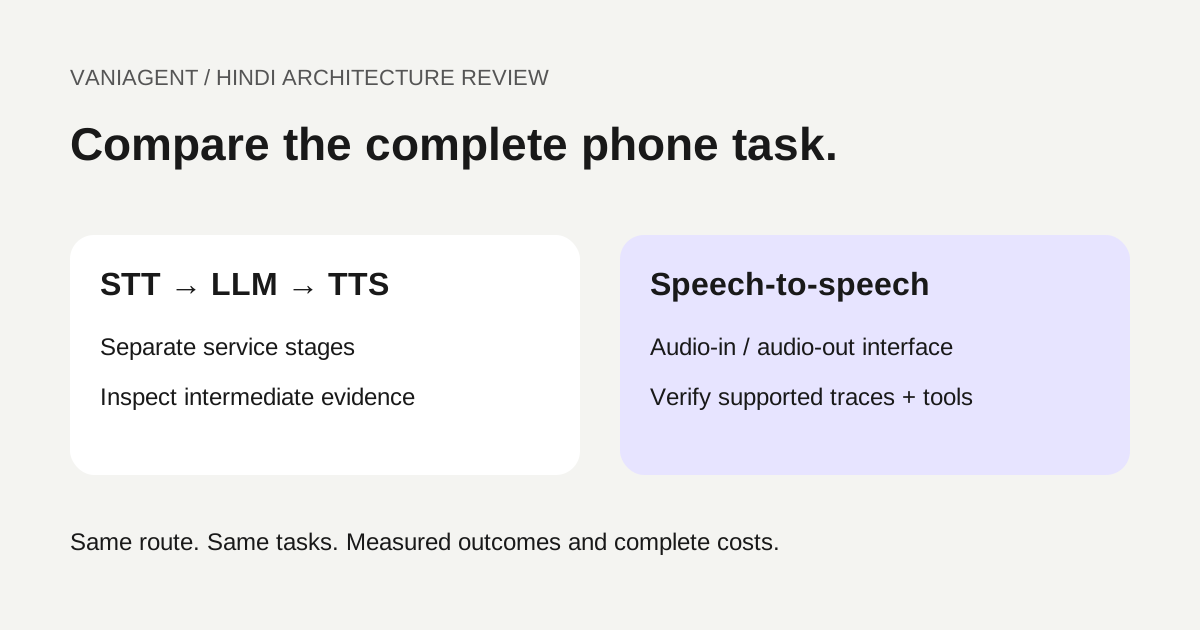
Choose between speech-to-speech and STT–LLM–TTS for Hindi phone agents by testing the complete customer task, not by counting components. Both designs need reliable telephone audio, correct handling of Hindi and Hinglish corrections, controlled tool use and an honest recovery path when the task cannot finish.
Native audio can combine conversational processing and speech generation within one model interface. A staged pipeline exposes separate recognition, reasoning and synthesis services. Those differences affect integration and observability, but do not establish which implementation performs better on your business calls.
This guide provides a comparison matrix and a proposed evaluation plan. It contains no measured head-to-head benchmark or VaniAgent architecture guarantee. For model-selection context, see best LLMs for AI voice agents in India.
Understand the two designs
In an STT–LLM–TTS pipeline, caller audio reaches speech recognition, recognized text reaches the language model and generated response text reaches speech synthesis. The application coordinates turns, tools and playback. Stages can stream or overlap, so the design is not necessarily a sequence of three full waits.
In a speech-to-speech design, the model interface accepts audio and returns audio. It may also expose text events or tool calls depending on the service. The application still handles the telephone connection, authorized business actions and session state.
Google's Live API capabilities guide, checked on 16 October 2026, documents native-audio functionality and transcription options. Verify the selected model and interface capabilities rather than assuming every audio model supports identical output and tool behaviour.
| Dimension | Staged STT–LLM–TTS | Speech-to-speech |
|---|---|---|
| Service boundaries | Separate recognition, model and voice stages | Audio-in/audio-out model interface |
| Debugging | Intermediate text and stage events can aid diagnosis | Available traces depend on the interface |
| Component changes | Can replace one stage, with integration retesting | Model changes may affect several behaviours together |
| Voice control | Depends on the selected synthesis service | Depends on model and supported configuration |
| Tool actions | Application validates and executes | Application still validates and executes |
| Performance | Measure the configured route | Measure the configured route |
These are architectural distinctions, not vendor scores. A poorly coordinated staged system and a well-tuned one can behave very differently; the same is true of native-audio implementations.
Hold the telephone path constant
Use the intended carrier route and permitted human audio. A clean browser microphone comparison can conceal telephone-format constraints, packet disruption and playback buffering.
Google Cloud's speech-recognition best practices explain matching recognition configuration to source format and native sample rate. For each candidate, document any required decoding or conversion. Upsampling a narrowband source does not restore detail absent from the original capture.
Compare the same reference conditions and label unavoidable differences. If one system is tested on a handset route and the other only in a browser, the result does not isolate architecture. Preserve route, codec, model version and configuration with each run.
Use the Hindi telephone-audio testing method to build the input set, and the noisy-call diagnosis guide for acoustic and transport failures.
Test Hindi and Hinglish decisions that affect the task
Include names, localities, spoken amounts, relative dates, negation and corrections. Review the final intended field as well as the words recognized. A system that sounds natural but books the wrong date should not pass.
An illustrative case can ask for one branch, then change it before the lookup. Another can correct “tomorrow” to a named day. Have competent Hindi-speaking reviewers validate the actual audio and expected outcomes; example prompts are not evidence of native-speaker testing.
Score clarification appropriately. If the caller omits AM or PM, asking a concise question can be correct. Do not reward a guessed value merely because it matches the evaluator's unstated assumption.
Keep the held-out set separate from tuning examples. Report speaker coverage, speech origin, tasks and exclusions so a small study does not become a universal language-accuracy claim.
Compare interruptions and turn boundaries
Test the caller interrupting during a long answer, pausing before a correction and speaking while the agent's earlier audio is still buffered. Inspect what the caller actually hears and what the workflow treats as the final request.
For both designs, verify that cancelled speech is not played later and that interrupted work cannot create an obsolete booking or CRM write. A stop-playback event alone does not prove the corresponding business action was cancelled.
Test a long pause and a short “haan” separately. The system must distinguish useful confirmation, background speech and a caller who has not finished. Record the configured turn rules and uncertainty rather than claiming architecture alone solves conversational timing.
Keep tool reliability independent of speech quality
Use the same business-tool contract for both candidates where practical. Require validated branch, service, date and authorization before a write. Return explicit success, failure and uncertain results.
| Tool scenario | Expected behaviour in both designs |
|---|---|
| Availability lookup fails | No fabricated slot |
| Booking write succeeds | Confirmation matches the saved record |
| Write response is lost | Inspect existing state before duplicate retry |
| Caller corrects a field | Use the final verified value before action |
| Staff handoff fails | Explain and follow the approved recovery path |
Inspect authoritative records using the CRM integration guide and booking safeguards. A fluent confirmation is not an acceptance criterion without the corresponding result.
Measure latency at the caller's ear
Define an end-to-end measurement such as the interval from the caller's final audible speech to the first relevant audible response. State how clocks are aligned and how playback is observed. Measure simple replies separately from turns that require a tool.
Report median and tail latency, sample size, failures and test conditions. A fast acknowledgement does not establish that the substantive answer or booking completed quickly. Keep those timing points separate.
For a staged system, stage measurements can help locate the delay. For native audio, collect the supported generation and playback events without treating an output event as proof it reached the caller. Use the latency measurement guide for the broader timing protocol.
Avoid adding provider benchmark numbers from incompatible conditions. A text token benchmark and a real Hindi telephone response measure different things.
Compare complete cost at the same workload
Request quotes for the actual call length, task mix and selected models. Separate carrier usage, AI or model usage, speech services, transcripts, storage, concurrency and support. Native audio and staged services may expose different billable units.
| Cost comparison field | What to hold constant or disclose |
|---|---|
| Customer workload | Same task mix and duration assumptions |
| Input and output | Actual billable audio or text units |
| Tools | Comparable actions and response behaviour |
| Telephony | Same route or declared difference |
| Additional services | Recording, transcripts and monitoring scope |
| Outcomes | Verified completions and staff recovery effort |
Do not sum the list prices of staged components if a platform already bundles them. Do not assume a native-audio price includes telephone transport or retained transcripts. Use the pricing guide to normalize the scope and compare cost per verified task alongside usage cost.
Review data handling and failure recovery
Map which services receive raw audio, text, context and tool results. A staged pipeline may expose data to several providers; a native-audio deployment still has telephony, storage, tools and support paths. Neither label establishes a complete residency or privacy outcome.
Use the voice-agent data-flow template for the actual configuration. Confirm recording choices, access, retention and diagnostics rather than assuming fewer service boundaries means fewer retained copies.
Test session disconnect, provider timeout, unavailable tools and capacity exhaustion. Identify the approved staff fallback and whether retrying can repeat an action. A fallback model or provider also needs its own data and behaviour review.
Use this architecture decision worksheet
| Criterion | Evidence to record for each candidate |
|---|---|
| Hindi task accuracy | Reviewed fields, clarification and saved outcomes |
| Audio robustness | Route-specific and noisy-condition results |
| Interaction | Interruption, correction and turn-boundary tests |
| Tools | Success, failure and uncertain-write recovery |
| Latency | Defined timing points and distributions |
| Cost | Complete scoped quote and measured usage |
| Observability | Available traces and unresolved evidence |
| Operations | Capacity, fallback, versioning and maintenance |
Set mandatory acceptance conditions before scoring preferences. A candidate that fails consequential booking safeguards should not win simply because its voice quality receives a high subjective score. Keep subjective reviewer impressions separate from measured action and timing results.
Choose the tested implementation, then revalidate changes
Begin with one narrow workflow and controlled fictional records. Run a paired evaluation where feasible, randomize test order to reduce order effects and retain the configuration identifiers. Acknowledge where live conversations cannot be exactly identical.
Choose based on the constraints your business needs to meet. Some teams may value exposed stage diagnostics; others may prioritize a particular native-audio interaction after proving task reliability. The evidence should decide the configuration, rather than a blanket claim that one architecture is always faster or more accurate.
Revalidate after model, voice, turn-control or route changes. Use the hallucination monitoring plan to review the deployed cohort and keep unsupported answers separate from recognition and tool errors.
Frequently asked questions
Is speech-to-speech better than STT–LLM–TTS for Hindi phone agents?
There is no universal winner. Compare the configured systems on the same Hindi and Hinglish tasks, carrier route, tool outcomes, interruption handling, latency and complete cost. Public feature support does not establish measured performance on your calls.
What is an STT–LLM–TTS voice pipeline?
Speech recognition converts caller audio to text, a language model uses that text and approved context to decide a response or tool action, and speech synthesis produces the spoken reply. Streaming and turn control determine how those stages interact.
Does native audio remove the need for business tools?
No. Booking, CRM updates and other business actions still need authorized integrations, validated parameters and verified results. Native audio output does not prove a backend action succeeded.
Can I compare the two architectures using only transcripts?
No. Review permitted audio, interruptions, tool traces and saved outcomes. A transcript can support review but does not establish pronunciation, heard response timing or all information used by a native-audio system.
Is native audio always faster?
No such guarantee follows from architecture alone. Measure the deployed route, including turn detection, buffering, model response, tools and playback. Report latency distributions and failures instead of a single best-case demo.
Can I switch architectures without changing the telephone integration?
Possibly, but verify codecs, sample rates, streaming events, session lifecycle, interruption control and transfer behaviour. A working browser demonstration does not prove compatibility with the existing telephone route.
Scope a Hindi architecture comparison
Bring your carrier route, target tasks and acceptance criteria to a scoped VaniAgent demonstration. Confirm supported configurations and inspect actual task evidence before choosing an architecture.
Put these ideas into production
Deploy AI voice agents in minutes and build outbound, inbound, and follow-up workflows on one platform.
Related Articles
Which LLM Is Best for AI Voice Agents in India?
Compare GPT, Gemini, Claude, and open models for AI voice agents in India. Learn how to choose models for latency, Hindi and Hinglish, tool calling, cost, reliability, and production routing.
How to Test Hindi Speech Recognition on Real Telephone Audio
Test Hindi phone speech recognition with native carrier audio, held-out human recordings, reviewed transcripts, WER, field accuracy and live-stream checks.
Hindi and Hinglish Voice-Agent Task Accuracy: A Transparent Evaluation Method
Score Hindi and Hinglish speech, corrected fields and saved task outcomes with reference labels, normalization rules and native-reviewer disagreement tracking.
How to Measure Voice-Agent Latency on Indian Phone Calls
Measure caller-perceived response delay with explicit audio boundaries, cold and warm runs, percentile reporting and tool-turn separation.