Map Where Your Voice-Agent Data Goes: A Vendor Review Template
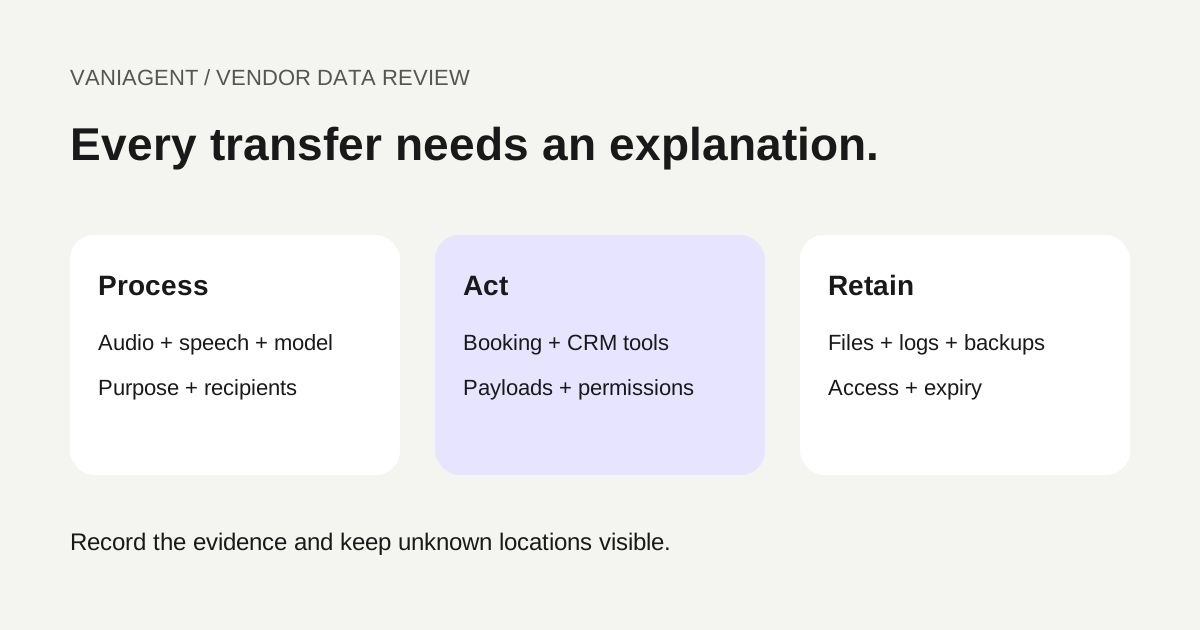
A useful voice-agent data map follows the information through the complete interaction, rather than stopping at the main AI vendor. Include telephone audio, speech and model processing, tool requests, recordings, transcripts, CRM updates, monitoring, backups and authorized support access.
For every destination, record what data is sent, why it is needed, where it is processed or retained and who can verify the claim. This guide provides a vendor-review template and a fictional worked example. It is an operational review aid, not a completed audit or a claim about VaniAgent's production architecture.
Use the broader voice-agent security checklist for security controls and the recording, storage and residency cost guide for commercial scope. This article focuses on tracing the actual flow and its evidence.
Start with one defined workflow
Choose a concrete interaction such as an inbound appointment enquiry at one branch. Record the intended channels, tools, data categories and outcome. A diagram for an unspecified “AI platform” is too broad to establish what your account does.
Ask the implementation owner to distinguish enabled features from optional ones. A product can offer recordings, analytics and several models without your configuration using all of them. Conversely, a disabled visible feature may not establish that every diagnostic copy is absent.
Preserve the configuration version and review date. If the model or integration changes, the map may need updating even when the caller-facing script stays the same.
Use established references without treating them as proof
NIST's Privacy Framework resources include inventory, mapping and data-processing ecosystem topics. These support a structured review; citing the framework does not certify a deployment.
Twilio's subprocessor list and data privacy FAQs illustrate product-specific supplier disclosures. The FAQs distinguish telecommunications providers from the listed subprocessors. Therefore, a procurement review should ask about the relevant carrier path as well as the applicable subprocessor list.
These references were checked on 16 October 2026. They are examples of evidence to request, not a substitute for the proposed supplier's actual configuration and contract. Have the responsible legal and privacy team determine roles and obligations for the workflow rather than assigning them solely from a diagram.
Walk through the normal call path
Create a numbered sequence from caller entry to final stored outcome. For each step, identify both the incoming information and what the service creates.
| Stage | Information to trace |
|---|---|
| Telephone entry | Caller and called-number metadata, live audio and carrier routing |
| Gateway or adapter | Audio decoding, temporary buffering and operational events |
| Speech processing | Audio sent for recognition and resulting text |
| Model request | Prompt, retrieved facts, conversation context and tool results |
| Speech output | Generated text, synthesized audio and playback path |
| Business tools | Booking, CRM or other request fields and returned records |
| Post-call processing | Transcript, summary, extraction and quality analysis |
| Retention | Audio files, text records, logs, replicas and backups |
A direct speech-to-speech system can combine steps differently. Draw the deployed path instead of forcing it into a separate STT–LLM–TTS chain. Ask which service receives raw audio and which receives text, including subsequent analytics.
Copy this vendor-review record for every transfer
| Review field | Required answer |
|---|---|
| Flow ID and version | Stable reference within this reviewed workflow |
| Source and destination | Service and relevant legal entity, not just a product nickname |
| Data categories | Audio, transcript, identifiers, business fields or derived metadata |
| Purpose | Why this transfer is required for the scoped task |
| Processing location | Confirmed scope or explicitly unknown |
| Storage location | Primary, replica and backup scope where applicable |
| Retention and deletion | Period, trigger, exceptions and owner |
| Access | Client, vendor staff, support and administrative roles |
| Protection | Relevant transport, storage and access controls |
| Contract and evidence | Applicable reference, version and verification date |
| Open gap and owner | Unanswered question, next step and review deadline |
Use “unknown” for an unanswered field. Do not convert “vendor has a security certification” into a location or deletion answer. Different evidence supports different claims.
Keep credentials and real personal data out of the review document. Record references to authorized evidence rather than copying sensitive payloads into a broadly shared template.
Fictional example: an appointment enquiry
Suppose a caller asks for a consultation at the Baner branch. In this illustrative design, a telephone service sends audio to an AI application, the application checks approved branch information and the scheduling tool creates an appointment after confirmation.
| Flow | Minimum task information to evaluate | Question for the owner |
|---|---|---|
| Audio to speech service | Caller speech for the current interaction | Is audio retained, and under which account setting? |
| Context to model | Branch, requested task and necessary conversation details | Does the request include unrelated customer history? |
| Booking tool request | Authorized patient reference, service and chosen slot | Which scheduling account receives the write? |
| Summary to CRM | Booking reference and approved follow-up state | Who can view and export the resulting note? |
| Error to monitoring | Redacted error and action identifier | Does the diagnostic payload accidentally contain sensitive content? |
This example is not a recommended universal payload or a verified system diagram. The business must establish appropriate verification and information handling for its service. Only send the fields the approved task requires.
Inspect actual tool inputs and outputs using fictional records. A model can receive a large returned object even when the caller hears only a short answer. Review returned data as carefully as outgoing requests.
Add paths that appear only when something fails
Timeouts, fallback models, staff escalation and support investigations can create data destinations absent from the normal flow. Include them in a second pass.
Ask whether an alternate model receives the same context during an outage. Check whether failed requests are logged with full payloads, whether diagnostic exports include recordings and whether staff copy a transcript into a support ticket. These are questions to verify, not assumptions that every supplier follows those practices.
For each approved fallback, record the destination and access scope. A recovery feature should not silently invalidate the location or retention commitment made for the primary path.
Use the human handoff guide to trace staff access and the WhatsApp context guide if the interaction continues in messaging.
Separate processing, storage and remote access
A statement that recordings are stored in one region answers only the scope of those recordings. It does not establish where speech recognition runs, where logs are retained or where authorized support personnel can access records.
Ask the supplier to label each location statement by data category and operation. Include customer-owned storage and downstream CRM systems, since your business may control those destinations independently.
Encryption should have its own evidence field. It can protect data while stored or transmitted, but does not by itself establish geographical location, retention duration or who may decrypt it. Avoid collapsing all these questions into one “secure” checkbox.
Verify retention through the derived records
Trace audio, transcripts, summaries, extracted fields and business records separately. Deleting a recording may leave the CRM note or exported copy intact under another policy.
Use fictional interaction identifiers to test normal expiry and an approved deletion process. Inspect accessible records, derived objects and documented backup handling. If a supplier cannot expose backup-level evidence directly, record its contractual or procedural assurance accurately rather than claiming an independently observed result.
Identify authorized preservation exceptions and who can approve them. A short retention promise should not be made without understanding the relevant business and legal requirements.
Classify evidence honestly
| Evidence status | What it means |
|---|---|
| Observed in test | Verified behaviour in the dated test configuration |
| Configured | A setting is visible; effect still needs validation where relevant |
| Contractually stated | A defined commitment applies within its scope |
| Documented product capability | Public material describes a feature; account use is not yet proven |
| Unverified | No adequate supporting evidence obtained |
These statuses can coexist. A location commitment may be contractual while a retention action is observable in a test. Record both without pretending one proves the other.
Assign review decisions and change triggers
For each material gap, assign an owner and a decision: resolve before launch, restrict the affected feature or seek approval for a documented exception. Do not close a procurement question merely because the vendor has answered a different security question.
Review the map when a model, speech provider, region, tool, recording configuration or support arrangement changes. Include queued jobs and retained historical data where the change affects them. A new model can alter recipients without any change to the phone number.
Keep the reviewed version with the vendor RFP. Use it in acceptance testing and incident review, not just as a purchasing attachment. The map is useful when each important transfer has a purpose, an owner and evidence that matches the deployed workflow.
Frequently asked questions
How do I map where voice-agent data goes?
Trace one scoped interaction through telephony, audio processing, models, tools, storage, integrations and support systems. Record each transfer’s data, purpose, locations, retention, access owner and supporting evidence. Include failures, exports and backups as well as the normal path.
Is a vendor subprocessor list a complete data-flow map?
No. It identifies parties within the list’s stated scope but does not by itself show which services your configuration uses, what each receives or how carriers, customer integrations and exports are handled.
Does local audio storage prove local AI processing?
No. Audio storage, live processing, transcripts, model requests, logs and remote access can have different locations. Verify the actual scope of each location commitment separately.
What evidence should a vendor provide?
Request relevant architecture, configuration and contract references, product-specific processor information, access controls and retention details. Validate observable behaviour with fictional records and keep unsupported statements marked unverified.
Should the map include CRM notes and support tickets?
Yes, where they contain information derived from the interaction. A summary copied to a CRM or diagnostic ticket is a separate destination with its own access and retention responsibilities.
When should I review the map again?
Review it after relevant model, provider, region, integration, recording or retention changes, and on the business’s scheduled review cycle. Keep a dated version and assign owners to unresolved gaps.
Review your proposed data path
Bring your workflow, enabled integrations and location requirements to a scoped VaniAgent demonstration. Request configuration-specific evidence before treating a public feature page as a completed data review.
Put these ideas into production
Deploy AI voice agents in minutes and build outbound, inbound, and follow-up workflows on one platform.
Related Articles
Is Your AI Voice Agent Secure Enough for Customer Calls?
Use this AI voice agent security checklist to protect call recordings, transcripts, customer data, tool access, prompt injection surfaces, retention policies, and audit logs.
Recording, Storage and Data Residency: The Extra Costs in Voice AI Quotes
Compare voice AI recording and storage costs with a worked retention budget, data-residency scope matrix, deletion checks and supplier acceptance checklist.
Voice-Agent RFP Template: Questions to Ask Before Signing a Vendor Contract
A practical voice AI procurement matrix covering task evidence, billing, integrations, data access, support and exit terms before a vendor contract.
When Should an AI Voice Agent Transfer to a Human?
Learn when an AI voice agent should transfer to a human, how cold transfer, warm transfer, smart routing, and context handoff work, and what Indian businesses should test before launch.