Which LLM Is Best for AI Voice Agents in India?
Which LLM Is Best for AI Voice Agents in India?
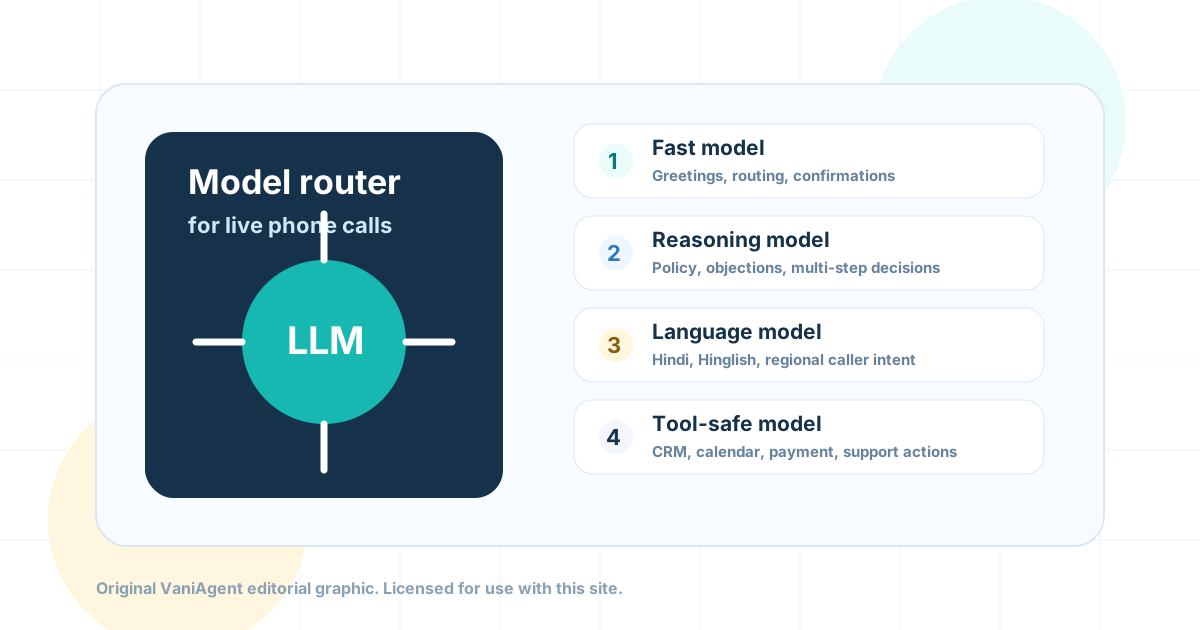
Short answer: The best LLM for an AI voice agent is not always the biggest or newest model. The best LLM is the one that makes the right decision before the caller notices the delay. For Indian voice agents, the winning setup is usually model routing: use a fast model for simple turns, a stronger reasoning model for complex moments, a language-tested model for Hindi and Hinglish, and a tool-safe model for CRM, calendar, payment, or support actions.
Voice agents do not need the smartest model on every turn. They need the right model at the right moment.
That is the sentence to remember.
Most buyers ask the wrong question first: "Should we use GPT, Gemini, Claude, or an open-source model?"
The better question is: "What kind of decision does this phone call need in the next two seconds?"
Why voice agents are different from chatbots
A chatbot can pause. A voice agent cannot.
In chat, a customer may wait a few seconds for a polished answer. On a phone call, silence feels broken. Delay feels like confusion. Over-answering feels rude. The model has to understand intent, decide what to do, and respond in a short conversational turn.
This changes model selection.
| Chatbot model choice | Voice agent model choice |
|---|---|
| Optimize for complete answer | Optimize for fast next turn |
| Longer response is often acceptable | Short response is usually better |
| User can reread text | Caller must understand immediately |
| Latency is annoying | Latency breaks trust |
| Tool error can be corrected in chat | Tool error may book, charge, or route incorrectly |
The best voice agent model is not just intelligent. It is timely, concise, reliable, and safe.
The four jobs of an LLM inside a voice agent
One model does not always need to do everything.
| Job | What the model does | Best model trait |
|---|---|---|
| Conversation turn | Understands what the caller just said and decides the next sentence | Low latency, concise responses |
| Reasoning | Handles objections, policy, eligibility, and multi-step decisions | Strong reasoning and instruction following |
| Language interpretation | Handles Hindi, Hinglish, regional terms, and messy phrasing | Real-world language performance |
| Tool use | Calls CRM, calendar, order, ticket, payment, or WhatsApp tools | Structured output and reliability |
If your agent uses one expensive frontier model for every "haan", "okay", and "one minute", you may be overpaying and adding latency. If your agent uses one cheap model for complex policy, finance, or healthcare calls, you may be under-protecting the customer experience.
The answer is routing.
GPT vs Gemini vs Claude vs Llama for voice agents
This is not a permanent leaderboard. Model quality changes quickly. Use this as a practical selection map, then test on your calls.
| Model family | Where it can fit well | What to test before choosing |
|---|---|---|
| GPT-class models | General reasoning, tool use, structured workflows, broad business conversations | Latency, cost per call, tool-call accuracy, Hindi/Hinglish behavior |
| Gemini models | Large context, multimodal workflows, Google ecosystem, long business knowledge | Response speed, instruction discipline, Indian language behavior, tool outputs |
| Claude models | Careful reasoning, policy-heavy scripts, support and knowledge workflows | Voice brevity, tool-call structure, latency under production load |
| Llama/open models | Private deployment, cost control, self-hosted workflows, custom routing | Hosting latency, language quality, safety, operations cost, fallback behavior |
OpenAI's model docs describe current model families and choosing stronger models for complex reasoning or smaller variants for latency and cost. Google documents Gemini model versions and APIs across stable, preview, latest, and experimental variants. Anthropic documents Claude model families and performance tradeoffs. Meta documents Llama model cards and prompt formats for open model deployments.
The practical lesson is not "pick the famous model." The practical lesson is "map the model to the call moment."
The model router pattern
A production voice agent can use a model router.
| Call moment | Model choice |
|---|---|
| Greeting | Fast, low-cost model or deterministic script |
| Intent detection | Fast model with strong classification |
| FAQ answer | Fast model plus approved knowledge base |
| Objection handling | Stronger reasoning model |
| Eligibility decision | Stronger reasoning model with strict rules |
| Tool call | Model with reliable structured output |
| Hindi/Hinglish turn | Model proven on your Indian call tests |
| Escalation | Deterministic policy or stronger safety model |
| Summary | Cheaper model after the call, not during live conversation |
This is how you keep calls fast without making the agent shallow.
What Indian businesses should test
Do not choose a model from a benchmark page alone. Choose it after testing the calls your customers actually make.
For India, test:
- Hindi and English in the same sentence
- Hinglish phrases like "fees ka breakup", "kal ka slot", "payment link bhej do"
- Regional names, city names, and company names
- Noisy mobile audio converted into imperfect transcripts
- Short answers like "haan", "nahi", "theek hai", "baad mein"
- Angry or impatient callers
- Price objections
- Appointment changes
- WhatsApp follow-up requests
- Domain-specific vocabulary such as EMI, COD, KYC, site visit, batch, renewal, prescription
| Test phrase | What the LLM should do |
|---|---|
| "Mujhe 10 minute baad call karo" | Schedule callback, not continue sales pitch |
| "Fees ka breakup WhatsApp kar do" | Send fee details on WhatsApp if permitted |
| "Kal nahi, parso available hai kya?" | Understand date shift and check availability |
| "EMI link bhej do" | Send payment link safely, not collect card data |
| "Human se baat karni hai" | Escalate or schedule callback |
If the model fails these phrases, it is not ready for Indian customer calls, even if it performs well on generic English tests.
The latency question
Twilio's latency guidance breaks voice-agent latency into multiple parts: speech recognition, model processing, text-to-speech, and network/telephony path. The LLM is only one part, but it is often the part teams overcomplicate.
In live voice, latency is emotional.
A caller does not think, "The model generated 120 more tokens." They think, "Why is this thing not responding?"
| Latency problem | Caller experience | Fix |
|---|---|---|
| Slow first response | Agent feels broken | Use faster routing for first turn |
| Long generated answers | Caller interrupts or disconnects | Force short phone-style turns |
| Slow tool call | Caller waits in silence | Use filler, status update, or async follow-up |
| Heavy model every turn | Cost and delay rise | Route simple turns to lighter model |
| Region/network delay | Voice feels laggy | Test telephony path and deployment region |
The best LLM for a voice agent is often the model that knows when to say less.
Tool-call reliability matters more than poetry
Voice agents take actions. They book appointments, update CRMs, send WhatsApp messages, check order status, and create tickets.
That means tool-call accuracy matters.
Test:
- Does the model produce valid structured output?
- Does it ask for missing required fields?
- Does it confirm before taking irreversible actions?
- Does it handle tool failure gracefully?
- Does it avoid calling tools when the caller is unsure?
- Does it preserve phone number, date, time, and customer name correctly?
| Tool action | Model failure to catch |
|---|---|
| Book appointment | Wrong date or timezone |
| Create CRM lead | Missing lead source or intent |
| Send WhatsApp | Wrong number or wrong template |
| Payment reminder | Unsafe pressure or wrong amount |
| Support ticket | Misclassified issue |
| Human transfer | No context passed to agent |
The model does not need to sound clever. It needs to be correct.
Cost is not just token price
For voice agents, model cost is only one part of the economics.
| Cost layer | What affects it |
|---|---|
| LLM tokens | Prompt size, response length, reasoning model choice |
| Speech-to-text | Call duration, audio quality, language |
| Text-to-speech | Response length, voice provider, streaming |
| Telephony | Carrier, provider, country, call duration |
| Tool calls | CRM, database, WhatsApp, payment, support system |
| Human fallback | Transfer rate and manual resolution time |
| Failed calls | Retries, complaints, lost conversions |
A cheaper model that causes more transfers may be more expensive. A stronger model that resolves calls faster may be cheaper at the journey level.
Measure cost per resolved call, not only cost per token.
When to use a stronger model
Use a stronger model when the call involves:
- Policy interpretation
- Objection handling
- Financial or healthcare-adjacent information
- Multi-step qualification
- Complex customer history
- Unclear caller intent
- Tool actions with business consequences
- Escalation judgment
Use a lighter model when the call involves:
- Greeting
- Basic routing
- Simple FAQ
- Confirmation
- Repetition
- Post-call summary
- Labeling outcomes after the call
This is the operating principle: expensive reasoning should appear only where reasoning is needed.
Model selection scorecard
Score each candidate model on your own calls.
| Category | Points | What to test |
|---|---|---|
| Latency | 20 | First response, average turn time, tool-call delay |
| Task completion | 20 | Did it complete the actual workflow? |
| Hindi/Hinglish handling | 15 | Code-switching, local terms, partial phrases |
| Tool-call accuracy | 15 | Correct JSON, correct fields, safe confirmation |
| Concision | 10 | Short phone-ready answers |
| Safety and policy control | 10 | Does not hallucinate offers, refunds, approvals |
| Cost per resolved call | 5 | End-to-end journey cost |
| Fallback behavior | 5 | Escalates or retries safely |
Launch only after testing the model against your real call scripts.
Bad model choices for voice agents
Avoid these patterns:
- Choosing the biggest model because it sounds impressive.
- Choosing the cheapest model because token cost looks low.
- Using one model for every turn.
- Testing only in English when customers speak Hinglish.
- Ignoring tool-call accuracy.
- Letting the model generate long paragraphs.
- Measuring demo quality instead of live completion rate.
- Not having a fallback model.
In production, "best model" means "best behavior under real pressure."
FAQ
Which LLM should I use for phone call agents?
Choose from your call tests, not a general brand ranking. Compare candidates on end-to-end turn latency, correct understanding of real caller phrasing, tool-call accuracy, and safe handling of uncertainty. Use the fastest model that meets your quality threshold for routine turns; route complex decisions to a stronger model or a human. Re-test whenever the model, prompt, speech pipeline, or telephony route changes.
Which LLM is best for AI voice agents in India?
There is no single best LLM for every AI voice agent. The best setup usually routes simple turns to a fast model, complex decisions to a stronger model, Hindi/Hinglish turns to the model that performs best on your customer calls, and tool actions to the most reliable structured-output model.
Should voice agents use GPT, Gemini, Claude, or Llama?
Use the model family based on the workflow. GPT-class models can fit broad reasoning and tool use. Gemini can fit large-context and multimodal workflows. Claude can fit careful policy-heavy reasoning. Llama or open models can fit private or cost-controlled deployments when infrastructure is strong.
Should an AI voice agent use the same LLM for every call?
Usually no. A model router is often better. Simple turns can use faster models, complex decisions can use stronger models, and post-call summaries can use cheaper offline processing.
What matters more for voice agents: intelligence or latency?
Both matter, but latency is more visible. A slightly smarter answer that arrives too late can feel worse than a simpler answer that arrives naturally and asks a useful follow-up question.
How do you choose an LLM for Hindi or Hinglish voice agents?
Test the model on real Indian call transcripts and imperfect speech-to-text output. Include Hindi, Hinglish, regional terms, noisy audio, interruptions, short answers, and industry vocabulary.
Can open-source or open-weight models work for AI voice agents?
Yes, but only if you can manage latency, hosting, language quality, safety, tool-call reliability, and fallback behavior. Open models are not automatically cheaper if operations are weak.
What is the safest model strategy for production?
Use model routing, tested fallback models, strict prompts, tool validation, short response constraints, monitoring, and real call evaluation. Do not rely on one model choice as the entire safety strategy.
Final answer
The best LLM for AI voice agents in India is not one fixed brand name. It is the model architecture that gets the next call turn right.
Use fast models for simple turns. Use stronger models for complex reasoning. Test Hindi and Hinglish on real calls. Validate tool calls. Measure latency and cost per resolved journey.
Voice agents do not need the smartest model on every turn. They need the right model at the right moment.
Related reading: AI voice agent testing checklist, Reducing voice latency, What makes a voice AI agent sound human?, and AI voice agent pricing in India.
For a route-specific evaluation worksheet, compare speech-to-speech and STT–LLM–TTS for Hindi phone agents.
For task selection, context preservation and safe fallback, read routing LLMs for different AI phone-call tasks.
For argument validation and saved-action scoring, read choosing an LLM for reliable booking and CRM tool calls.
Put these ideas into production
Deploy AI voice agents in minutes and build outbound, inbound, and follow-up workflows on one platform.
Related Articles
How Do You Test an AI Voice Agent Before It Goes Live?
A practical AI voice agent testing checklist for teams preparing to launch real customer calls. Learn how to test latency, Hindi and Hinglish conversations, interruptions, tool calls, handoff, and production readiness.
Reducing Voice Latency to <500ms: A Deep Dive into Edge Architecture
Achieve sub-500ms voice latency with edge computing & WebSocket optimization. Technical deep dive into building natural AI conversations with minimal delay.
What Makes a Voice AI Agent Sound Human? Latency, Turn-Taking and Indian Accents
Learn what makes AI voice agents sound human: latency optimization, natural turn-taking, emotional intelligence, and handling Indian accents and Hinglish. Technical guide for building natural voice AI.
AI Voice Agent Pricing in India: Per-Minute vs Monthly Plans
Compare AI voice agent pricing in India, including current VaniAgent plans, inbound and outbound call costs, usage, onboarding fees, telephony, and ROI.
Speech-to-Speech vs STT–LLM–TTS for Hindi Phone Agents
Compare native audio and STT–LLM–TTS for Hindi phone agents using task accuracy, interruptions, tool reliability, latency, cost and a decision worksheet.
One Model or Several? Routing LLMs for Different AI Phone-Call Tasks
Evaluate LLM routing for AI phone tasks with model eligibility, context safeguards, safe fallback, a worked cost example and acceptance tests.
How to Choose an LLM for Reliable Booking and CRM Tool Calls
Evaluate LLM tool calling with booking and CRM test cases, argument validation, authorization, uncertain-write recovery and verified action scoring.