How to Monitor AI Voice-Agent Hallucinations After Launch
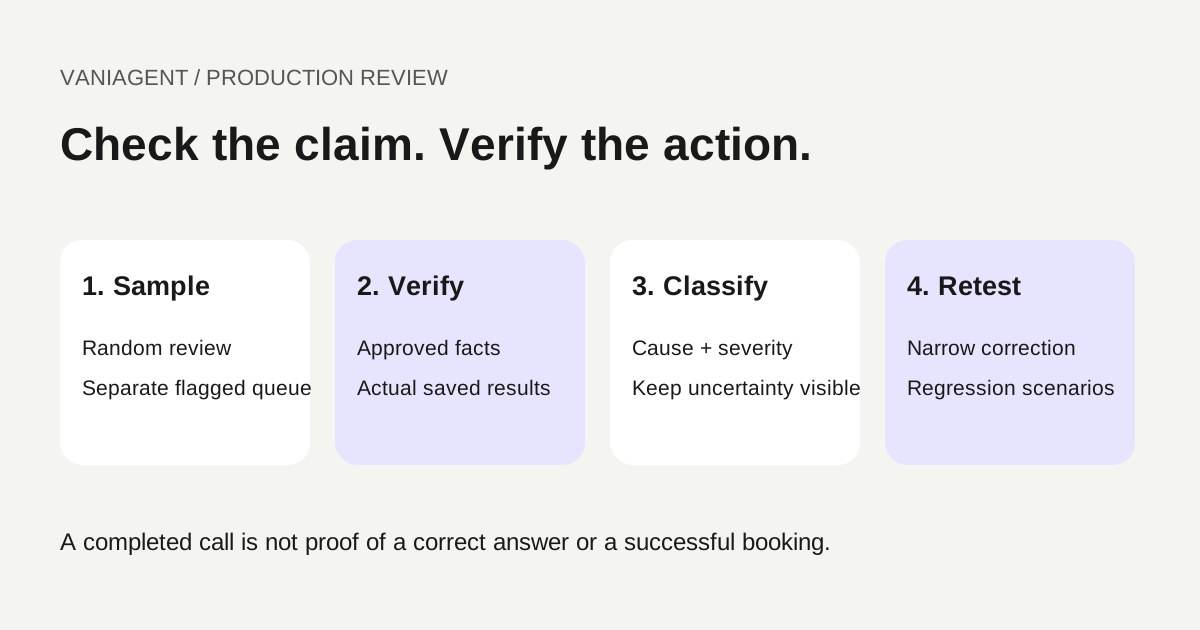
Monitor AI voice-agent hallucinations by comparing what the agent said with the information and action results that were valid at that moment. A fluent call, positive sentiment or completed connection does not establish a correct answer. Monitoring needs evidence, a repeatable review rubric and a clear response when a consequential claim is wrong.
This guide provides a proposed operating plan for teams running appointment, sales and support voice workflows. It focuses on production review after launch, rather than repeating the design controls in our AI voice-agent hallucination prevention guide.
The examples and sample counts are illustrative. They are not VaniAgent performance measurements or a guarantee that a particular platform provides every monitoring feature described here.
Define the errors you want reviewers to find
NIST's Generative AI Profile describes confabulation as confidently presented false or erroneous generated content and identifies the risks of relying on it. For a voice workflow, use narrower operational labels so reviewers can distinguish unsupported answers from failures elsewhere in the system.
| Error type | Example | Evidence to inspect |
|---|---|---|
| Unsupported business claim | Agent invents a discount | Approved offer version and retrieved context |
| Stale factual answer | Agent gives yesterday's branch hours | Information effective at the call timestamp |
| False action confirmation | “Your booking is saved” after a failed write | Tool result and scheduling record |
| Wrong action parameters | Correct service booked at the wrong branch | Confirmed caller intent and saved booking |
| Speech-recognition error | A date or name was misheard | Authorized audio and recognition output |
| Unresolved evidence | Relevant tool result is missing | Logging coverage and source availability |
Not every category is a hallucination in the narrow model-generation sense. Keep the labels separate while tracking their customer impact. A stale source requires a different repair from an invented answer, and a correct spoken answer can still accompany an incorrect database action.
Preserve the evidence needed for review
Record the interaction reference, agent version, model configuration, approved information version, tool requests and results, and relevant timestamps. Link business action identifiers such as the booking reference or CRM update result.
Use authorized audio where needed to resolve what was actually said. Transcripts can omit interruptions or misrecognize numbers. Apply the business's approved access and retention rules, and respect the caller's recording choice; monitoring is not a reason to bypass it. See the recording-refusal workflow.
Avoid exposing secrets, unnecessary personal details or complete raw records in a review dashboard. Give reviewers enough evidence to assess the claim while limiting access by role. When evidence is unavailable, mark the case unresolved rather than assuming the agent was correct.
Use two review queues with different purposes
A random sample helps estimate errors in a defined population. A targeted queue helps find suspicious or consequential failures quickly. Both are useful, but their percentages answer different questions.
| Queue | How calls enter | What the result can support |
|---|---|---|
| Random review | Selection independent of outcome from the eligible call population | A sampled trend, with uncertainty and defined coverage |
| Targeted review | Tool failures, disputed confirmations, unusual replies or complaints | Investigation and prioritization, not an unbiased population rate |
| Release cohort | Calls using a new configuration or information version | Checks on that change within the reviewed cohort |
Include successful-looking calls in the random sample. Reviewing only complaints misses confident errors that customers did not notice. Make language, branch and workflow coverage visible: an aggregate score can conceal a failure concentrated in one segment.
As a planning example, a team could randomly review 40 eligible calls each week and investigate flagged incidents separately. Forty is a workload example, not a statistically justified minimum. Choose the sample size and stratification according to the precision and risk decisions you need.
Give reviewers a claim-by-claim rubric
For each material claim, record what the agent said, the expected source of truth and whether the evidence supports it. Keep the review unit consistent: one call, one factual claim and one action are different denominators.
Use this worksheet:
| Review field | Required entry |
|---|---|
| Interaction and version | Call reference and deployed configuration |
| Material claim | Exact relevant statement or a faithful short extract |
| Source of truth | Approved document, live lookup or saved action record |
| Source timing | Version or state valid when the claim was made |
| Finding | Supported, contradicted, unsupported or unresolved |
| Root-cause category | Speech, source freshness, retrieval, tool, state or generation |
| Severity | Business-approved impact level |
| Reviewer action | Correct data, repair workflow, escalate or monitor |
A practical severity scheme might label wording defects as low, an incorrect routine price as material, and a consequential false action or sensitive disclosure as urgent. These are example categories; the business should approve thresholds for its services. Clinical, financial and other consequential decisions need their own escalation requirements.
Verify action claims against the actual system
Suppose an agent says, “Your consultation is booked for 4pm at Baner.” A reviewer should compare the caller's confirmed choice, the booking request, the tool response and the saved calendar record. Inspect the branch, service, date, timezone and status, not just whether some event exists.
If the response timed out but the write succeeded, the correct recovery may be to look up the existing booking rather than create another one. If the write failed, an optimistic spoken confirmation is a false success claim. If the tool returned success for the wrong parameters, the issue may be validation rather than generation.
For CRM actions, check the actual record and action scope. “I have updated your details” should not pass solely because the transcript contains that phrase. Use the CRM integration guide to connect the interaction to authoritative results.
Use automated scoring as a review aid
Automated rules can flag an agent confirmation after a tool error, an unapproved price or a missing handoff result. Model-based evaluation can identify suspicious factual claims and compare them with supplied context. Neither method replaces evidence or guarantees detection.
Retell's post-call analysis page, reviewed on 16 October 2026, describes structured custom analysis fields and access to results through its platform interfaces. Such fields can support a review queue; their existence does not establish that a hallucination detector is accurate for your task.
Validate any scorer using examples independently labelled by reviewers. Include real failure patterns, correct refusals, speech errors and uncertain cases. Measure how many confirmed errors it catches and how often it flags correct calls. Also sample unflagged calls to look for missed errors.
Keep the evaluator's instructions separate from the reviewed transcript. Caller text should be treated as evidence, not as instructions to the reviewer model. Version the scoring rubric and calibrate it again after major task or model changes.
Report rates without hiding sampling limits
For a call-level confirmed-error rate, divide adjudicated calls containing at least one confirmed error by all adjudicated calls in that sample. Show unresolved calls and exclusions alongside the result.
In a fictional random sample of 100 calls, suppose 95 can be adjudicated, five remain unresolved and four of the 95 contain confirmed errors. The reviewed-sample rate is 4 ÷ 95 = 4.21%, with five unresolved cases reported separately. It is not a precise production-wide rate and should not be reported as “95.79% safe.”
If a targeted queue contains 12 errors among 20 reviewed calls, its 60% finding rate reflects the selection method. Do not combine it with the random sample and label the result representative. Where reviewers oversample a segment, use an appropriate weighted estimate or report segment results separately rather than silently pooling them.
Zero observed errors in a small sample does not prove zero risk. Show counts as well as percentages, and seek statistical guidance when using sampled rates for consequential release decisions.
Connect confirmed findings to a response plan
| Confirmed cause | Narrow response to evaluate |
|---|---|
| Outdated approved information | Correct the source and invalidate stale copies |
| Retrieval misses relevant policy | Repair lookup scope and test similar questions |
| Unsupported generated answer | Tighten source-bound answering and uncertainty handling |
| Tool failure followed by success claim | Correct state handling and confirmation requirements |
| Speech error on a date or amount | Add appropriate read-back and validation |
| Wrong branch or customer record | Repair mapping and verification controls |
Set escalation ownership and response time by severity. For an urgent incident, the approved response may restrict the affected workflow or route it to staff while the cause is investigated. Preserve useful evidence and identify potentially affected cases without making broad unrelated changes.
Do not automatically change the model whenever an error appears. A model swap cannot fix a stale price list or a backend that returns an ambiguous write result. Apply the narrow correction, then check whether the original failure and adjacent cases are resolved.
Turn each incident into a regression scenario
Create a fictional or appropriately redacted test from the confirmed failure. Preserve the relevant task, source state and tool outcome. Include the expected spoken behaviour and the expected saved action, since one can pass while the other fails.
For example, simulate a booking timeout with an uncertain write result. The agent should avoid an unsupported confirmation and the workflow should inspect existing state before retrying. Add nearby cases: definite failure, definite success, duplicate response and caller correction.
Run the targeted regression suite before releasing a fix, then inspect a defined post-release cohort. Keep the earlier agent and source versions available according to your release policy so you can explain which change affected the results.
Establish a weekly monitoring rhythm
- Each operating day, inspect urgent flags and unresolved consequential actions.
- Each week, adjudicate the random sample and review coverage by language and workflow.
- Compare reviewers on a shared subset and resolve disagreements against evidence.
- Prioritize the recurring causes, assigning an owner and a narrow fix.
- Run regression tests and inspect the affected release cohort.
- Report reviewed counts, severity, unresolved cases and verified corrective outcomes.
Track task completion, escalation and customer correction alongside factual accuracy. An agent that avoids every answer may reduce unsupported claims while failing the service requirement. The objective is a useful workflow whose statements and actions agree with verifiable evidence.
Frequently asked questions
How do you monitor AI voice-agent hallucinations after launch?
Review a defined sample of calls against the approved information available at call time and the actual results of tool actions. Combine automated flags with human adjudication, track severity and sampling method, and turn confirmed failures into regression tests.
Can an LLM judge reliably detect every hallucination?
No. Use model-based scoring to prioritize review, then validate it on independently labelled examples. Track missed errors and false alarms, and keep uncertain cases separate from confirmed passes.
Is a transcript enough to verify a booking claim?
No. Compare the claim with scheduling records, tool results and relevant timestamps. A transcript saying the appointment was booked does not prove that the write succeeded or used the correct branch and time.
How many calls should a business review?
Set the sample using volume, risk and available review capacity. Include a random sample for trend measurement and a separate targeted queue for suspicious calls. A fixed sample size or a few clean calls cannot guarantee that errors are absent.
What hallucination rate should appear on a dashboard?
State the unit, denominator, review period, sampling method and unresolved count. Call-level confirmed-error rate is reviewed calls with at least one confirmed error divided by adjudicated calls in that sample. Do not present a targeted review queue as a representative production rate.
Should every error trigger a model change?
No. First identify whether the cause is speech recognition, stale business information, retrieval, tool failure, state handling or generation. Apply the narrow correction, then retest the failed scenario and related workflows before release.
Review your monitoring design
Bring your approved information, tool-result records and review rubric to a scoped VaniAgent demonstration. Verify the available evidence and monitoring controls for your proposed workflow before relying on a dashboard score.
Put these ideas into production
Deploy AI voice agents in minutes and build outbound, inbound, and follow-up workflows on one platform.
Related Articles
How Do You Stop an AI Voice Agent From Making Things Up?
Learn how to stop AI voice agents from hallucinating during customer calls using grounding, tool validation, fallback rules, structured outputs, human handoff, and production testing.
How Do AI Voice Agents Integrate With CRM Systems?
Learn how AI voice agents integrate with CRM systems like HubSpot and Salesforce, what fields to sync, how call summaries work, and what workflow automations to test before launch.
What Should an AI Agent Do When a Caller Refuses Recording?
Design an AI caller recording-refusal workflow with verified stop controls, transcript checks, accurate scripts, human fallback and retained-media tests.