How to Test Hindi Speech Recognition on Real Telephone Audio
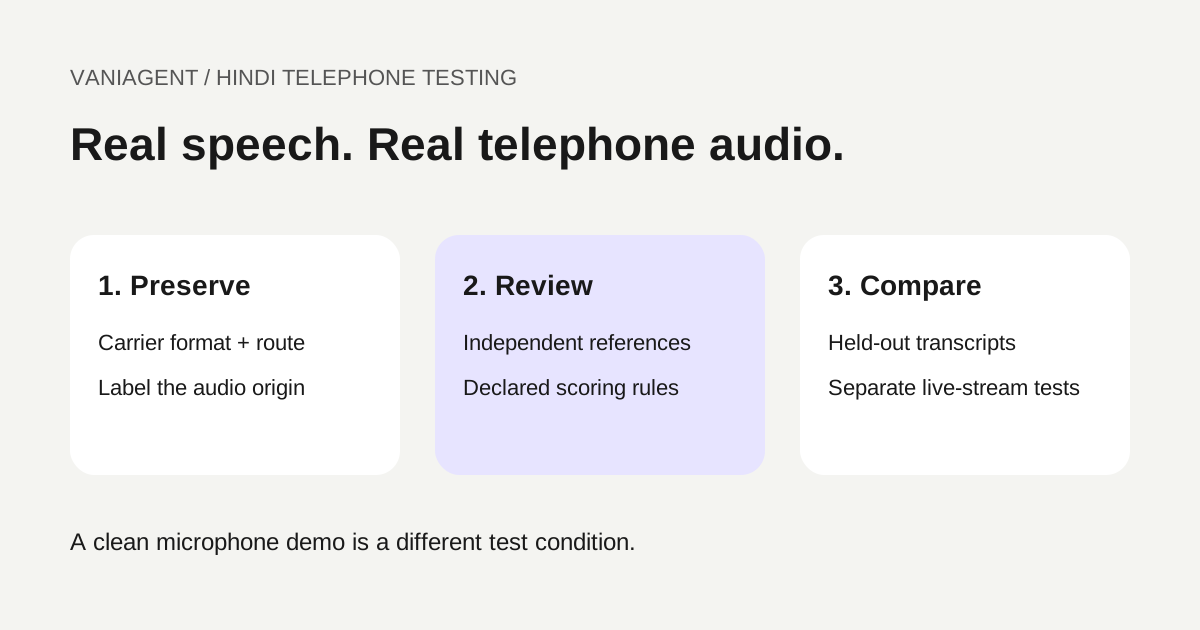
Test Hindi speech recognition on the audio your telephone integration actually receives, not only on clean microphone recordings. Preserve the carrier format, use permissioned human speech with reviewed references and compare the same held-out recordings under declared settings. Then test the live stream, because offline transcription cannot prove correct turn timing.
This guide focuses on capture and recognizer comparison: codec handling, channel isolation, segmentation and reproducibility. Use the broader Hindi and Hinglish task-accuracy method for reviewing completed business actions, and the Hindi voice-agent test kit for conversation scenarios.
The worksheet and sample counts below are proposed test designs. No Hindi benchmark, native-speaker review or measured VaniAgent accuracy is claimed here.
Trace the actual telephone audio path
Write down the path from the speaker's handset to the recognizer: carrier, gateway, streaming adapter, decoder and any resampling. Record the codec, sample rate, channel count and whether the file is raw audio or has a container header.
Twilio's Media Streams specification, checked on 16 October 2026, documents audio format information and base64-encoded media payloads, with mu-law audio at 8,000 Hz for its stream. That is a specific integration format, not a universal specification for every Indian carrier or SIP route.
Google Cloud's speech-recognition best practices recommend matching recognition configuration to the source audio and its native sample rate rather than unnecessary resampling. If another service requires a conversion, document it and preserve the original. A file converted from 8 kHz to 16 kHz has not regained the missing acoustic detail.
Listen to a decoded sample before comparing models. Incorrect codec interpretation, clipping or wrong playback speed can make every recognizer look poor. Fix the capture path before attributing those failures to Hindi language support.
Separate human speech, replay and synthetic input
| Test condition | Useful for | What it does not prove |
|---|---|---|
| Human caller through the intended carrier route | Recognition on that observed telephone path | Accuracy for every speaker or network |
| Human browser recording | A separate capture baseline | Carrier-path performance |
| Recorded clip replayed through a test call | Repeatable route and streaming checks | Natural interaction by a new caller |
| Synthesized Hindi sent directly to STT | Deterministic plumbing and regression cases | Spontaneous human pronunciation accuracy |
Label the origin on every result. Do not combine clean synthesized phrases and difficult human calls into one headline accuracy without showing the mix. A route-specific test should contain the conditions customers actually encounter, with permission and appropriate access controls.
Build a small reference set with an explicit scope
Start with a declared use case, such as appointment enquiries in Hindi and Hinglish. Recruit speakers who can participate with informed permission, record the relevant device and route conditions, and avoid collecting unnecessary personal information.
A planning set might contain 120 utterances from 12 speakers, with ten utterances per speaker. These counts illustrate workload only; they do not establish statistical power or coverage of Hindi speakers. Include natural phrasing alongside scripted cases, and keep tuning and evaluation speakers separate where feasible.
| Condition | Example test content |
|---|---|
| Hindi with English service terms | “Mujhe follow-up appointment chahiye” |
| Dates and corrections | Caller first asks for Tuesday, then corrects to Thursday |
| Numbers and amounts | Spoken amount followed by a confirmation question |
| Branch names | Locality names and similar-sounding alternatives |
| Negation | “Kal nahi, parson” with a known reference date |
| Natural hesitation | Pauses, self-correction and incomplete starts |
The Romanized examples are editorial prompts, not validated benchmark audio. A Hindi-speaking reviewer should check their intended meaning and suitability before recording the actual set. Include the reference date and timezone when evaluating relative dates.
Avoid tuning vocabulary hints on the held-out answers. If a recognizer supports custom vocabulary, evaluate a declared baseline and a separately labelled tuned configuration. Use the same business vocabulary allowance across suppliers where a fair comparison requires it.
Keep caller audio separate from the agent
For recognition scoring, isolate the caller track where the integration permits it. A mixed recording can include the agent repeating the correct answer, making the recognizer appear more accurate than it was on the caller's original speech.
Record whether echo, crosstalk or interruption is present. Do not remove difficult segments silently. If you exclude an unusable capture, keep the reason and count it as a capture failure in the report rather than erasing it from the operational picture.
Preserve original media with controlled access. Store test references and redacted public examples separately. The recording-refusal guide explains why audio capture and transcript retention need distinct controls.
Create reviewed transcripts before running comparisons
Have a competent reviewer transcribe the permitted audio without seeing the recognizer output first. Independently review a subset and adjudicate disagreements using the original audio. Mark genuinely unintelligible content rather than inventing a reference.
Choose transcription conventions before scoring: Devanagari versus Romanized Hindi, punctuation, fillers, English terms, numerals and compound words. Preserve the raw reference and the normalized scoring version. Apply equivalent transformations to every recognizer's output.
Normalization should remove declared formatting differences, not change meaning. “1500” and its correctly transcribed spoken equivalent can follow a common representation. “15000” must not become equivalent to “1500,” and a missing “not” must remain visible.
Use word error rate alongside field-level accuracy
Word error rate is conventionally calculated as (substitutions + deletions + insertions) ÷ reference words. Define tokenization and normalization so the score is reproducible. It can exceed 100% when insertions are numerous; do not cap it silently.
In a fictional example with 100 reference words, eight substitutions, four deletions and three insertions produce 15% WER. That figure alone does not tell you whether the correct appointment date survived.
Score consequential fields separately: final corrected date, amount, branch, service and negation where relevant. Distinguish an exact transcription mismatch from an equivalent meaning, and distinguish both from a wrong business action. Keep unresolved reference cases separate from confirmed passes.
Use the task-accuracy evaluation method to assess whether the agent clarified ambiguity and saved the intended result. Recognition testing is one layer of that wider evaluation.
Compare models on identical held-out inputs
Freeze the audio set, reference version, model identifier, language configuration and adaptation settings. Give each recognizer the same permitted source clips, with only the required documented format conversions.
Report per-condition counts and errors, not only one pooled score. A supplier that performs well on simple enquiries may fail on branch names or corrected amounts. Avoid declaring a universal “best Hindi STT” from one small dataset.
If a model version changes during testing, split the results or rerun the affected comparison. Record failures and timeouts rather than calculating quality only on successful responses. A partial result can be useful, but its coverage needs to remain explicit.
Test live streaming separately from offline clips
Offline files remove parts of the interactive problem. A live agent must decide when speech begins and ends, whether a partial result can be revised and how to handle a caller who interrupts.
Run live tests for short answers, long pauses, mid-sentence corrections and speech overlapping the agent. Compare the final recognized content with the offline result for the same permitted utterance, while keeping the two conditions labelled.
Measure the time from a defined audio event to the final transcript event. State whether timestamps come from one clock and what buffering is included. This is recognition timing, not end-to-end time until the caller hears the agent. Use the voice-agent latency measurement guide for the complete response path.
Do not treat an interim transcript as a final decision. An early “Tuesday” can be revised after “no, Thursday.” The downstream workflow needs appropriate read-back and validation before taking consequential actions.
Keep a reproducible run worksheet
| Field | What to record |
|---|---|
| Clip and speaker reference | Pseudonymous IDs and permission scope |
| Origin | Human handset, browser, replay or synthetic |
| Route and format | Carrier path, codec, rate, channels and conversions |
| Recognition setup | Provider, model version, language and vocabulary settings |
| Reference | Reviewer, transcript version and normalization rules |
| Result | Raw transcript, final status and elapsed-time definition |
| Scores | WER counts and consequential-field findings |
| Failure label | Capture, decoding, segmentation, recognition or downstream task |
| Review outcome | Adjudicated finding or unresolved evidence |
Link the worksheet to a fixed manifest of the evaluation set. Preserve the set version when adding new cases, so a score change is not mistaken for improvement when the test itself became easier.
Decide what to fix before changing providers
If every model fails on one route, inspect the audio conversion and capture. If offline recognition is correct but live output drops the final word, investigate segmentation and streaming. If the transcript is correct but the saved date is wrong, investigate task interpretation and validation.
Change one relevant factor at a time, then rerun the frozen evaluation and the affected live scenarios. Report the configuration, sample limits and remaining errors. The useful result is evidence about your telephone workflow, rather than an unsupported accuracy percentage for an entire language.
Frequently asked questions
How should I test Hindi speech recognition for phone calls?
Capture permitted human speech through the intended telephone route, preserve the native audio format and create reviewed reference transcripts. Compare recognizers on the same held-out audio, then separately test live streaming, turn boundaries and consequential fields.
Is a browser microphone demo enough to prove Hindi phone accuracy?
No. A browser recording may use a different codec, bandwidth and capture path. Use it as a separate test condition rather than as evidence of performance on the intended carrier route.
Should I upsample 8 kHz telephone audio before testing?
Follow the recognizer’s documented input requirements. Upsampling does not recover speech detail already lost in the original capture. Preserve the source and document any required conversion rather than presenting the converted file as native wideband audio.
How do I compare Hindi and Romanized Hindi transcripts?
Declare the script, transliteration and number-normalization rules before scoring, preserve the originals and apply the same rules to both outputs. Separately inspect names, dates, amounts and negation so normalization does not conceal a material error.
Can synthetic Hindi audio replace real callers in a benchmark?
Synthetic speech is useful for repeatable plumbing tests, but it does not establish accuracy for spontaneous human telephone speech. Label synthetic and human conditions separately and obtain appropriate permission for the human recordings.
Does low word error rate guarantee a successful voice-agent task?
No. A single incorrect date or missing negation can change the task despite a good average transcript score. Verify field extraction, clarification and saved actions separately from recognition accuracy.
Scope your Hindi telephone test
Bring your carrier route, permitted test recordings and target tasks to a scoped VaniAgent demonstration. Verify the capture format and review the evidence before relying on a language-accuracy claim.
Put these ideas into production
Deploy AI voice agents in minutes and build outbound, inbound, and follow-up workflows on one platform.
Related Articles
Hindi and Hinglish Voice-Agent Test Kit: Names, Numbers and Real Calls
Evaluate Hindi and Hinglish voice agents with original names, amounts, dates, corrections and interruption cases, plus a downloadable task-scoring worksheet.
Hindi and Hinglish Voice-Agent Task Accuracy: A Transparent Evaluation Method
Score Hindi and Hinglish speech, corrected fields and saved task outcomes with reference labels, normalization rules and native-reviewer disagreement tracking.
How to Measure Voice-Agent Latency on Indian Phone Calls
Measure caller-perceived response delay with explicit audio boundaries, cold and warm runs, percentile reporting and tool-turn separation.
Hindi AI Voice Agents: What Indian Businesses Should Check Before Buying
Learn how to choose a Hindi AI voice agent for Indian customers, including Hinglish support, accents, pronunciation, telephony quality, compliance, and production testing.