Hindi Voice Agents in Noisy Calls: Which Audio Problems Break the Workflow?
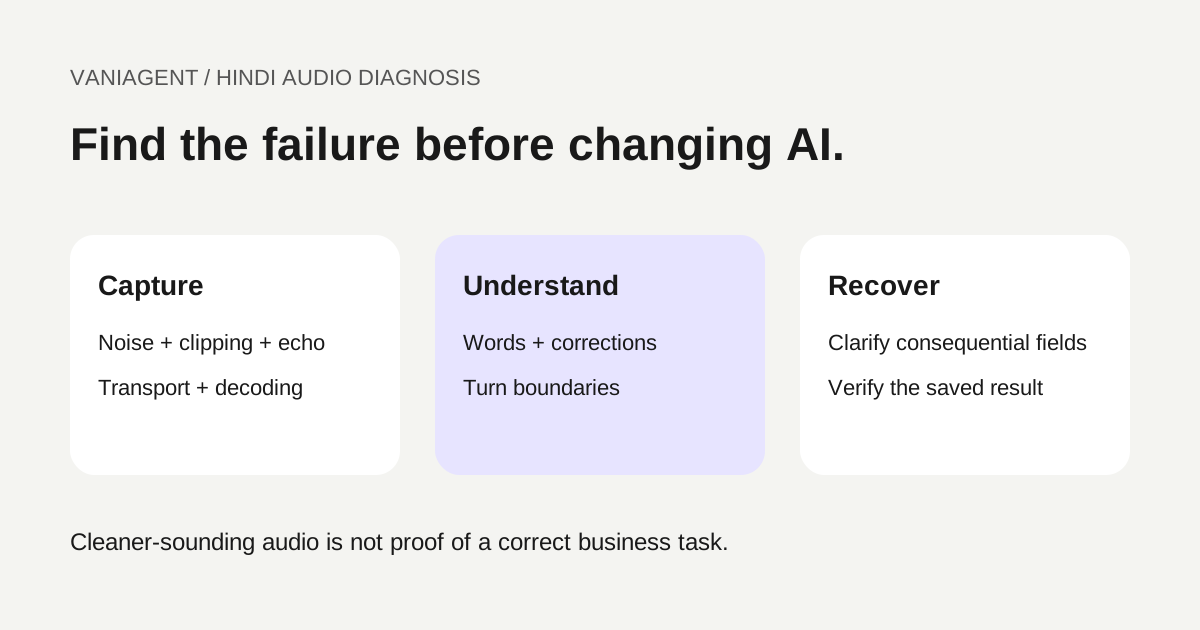
When a Hindi voice agent struggles on a noisy call, locate the failure before changing the model. Compare the caller audio, decoded stream, recognition output, turn boundaries and saved task result. Background sound, network disruption and language interpretation can create similar symptoms but require different corrections.
This guide provides an audio-failure diagnosis worksheet and recovery tests. It complements our Hindi telephone speech-recognition method and Hindi/Hinglish task-accuracy guide. It does not publish measured Hindi noise robustness or claim a particular VaniAgent configuration supports every control described here.
Separate acoustic noise from transport problems
A fan, traffic or another speaker affects sound captured at the microphone. Packet loss, decoding errors and buffering affect how that sound reaches the application. Both can produce a bad transcript, but a new prompt cannot repair missing or misdecoded audio.
| Symptom | Possible cause to investigate | Evidence to compare |
|---|---|---|
| Words cut out | Transport loss or capture gaps | Leg metrics and timestamped audio |
| Distorted loud syllables | Clipping or gain issue | Waveform and original capture |
| Agent responds to another person | Background speech or speaker confusion | Caller track and turn decisions |
| Agent hears itself | Echo or mixed-track input | Track routing and playback overlap |
| Final correction disappears | Premature endpointing | Audio ending, interim and final recognition events |
| Audio sounds too fast or slow | Format or sample-rate mismatch | Stream metadata and decoder settings |
Treat the table as hypotheses, not a diagnosis from symptoms alone. Preserve the relevant configuration and timestamps so the team can reproduce the finding.
What provider guidance can tell you
Google Cloud's speech-recognition best practices advise appropriate source formatting and avoiding clipping, and describe the recognizer's handling of background noise. This does not establish a universal benefit from an additional noise-processing stage in your route.
Twilio's call-quality summary discusses jitter, latency and packet loss as voice-quality factors. Its Voice Insights FAQ describes visibility limits. Interpret metrics in the context of the observed call leg rather than treating a dashboard score as a complete acoustic or task evaluation.
These references were checked on 16 October 2026. They are technical guidance, not a Hindi benchmark or an account-specific finding.
Build a diagnostic case from one failed interaction
Record the interaction identifier, route, codec, sample rate, model configuration and permitted evidence available. Note the exact moment when the caller's intended field diverged from what the system used.
Compare these stages:
- What the caller actually said in the authorized audio.
- What audio arrived at the recognizer after decoding and processing.
- Interim and final transcription, if the architecture exposes them.
- The conversational interpretation and any clarification.
- Tool parameters and the saved business result.
A speech-to-speech architecture may not expose a separate authoritative STT transcript. Record that observability limit rather than inventing an intermediate result. Use supported traces and task evidence to narrow the cause.
Apply the approved recording and retention policy. The recording-refusal guide explains why debugging should not override the caller's supported choices.
Test Hindi and Hinglish details that change the task
Noise matters most when it changes a consequential word or field. Include dates, amounts, branch names, negation and the final correction after a hesitation.
An illustrative Romanized prompt is “Kal nahi, parson,” with a known reference date and timezone. If the system drops the negation, a plausible transcript can still produce the wrong appointment. Another case can start with one amount and explicitly correct it before confirmation.
Have a competent Hindi-speaking reviewer validate the actual recorded cases. Editorial example text is not native-reviewed benchmark evidence. Include varied permitted speakers and realistic phrasing rather than testing only one clear synthesized voice.
Inspect read-back and clarification as well as first-pass recognition. Asking a short question can be the correct outcome when the evidence is ambiguous; a lucky guess should not pass the test.
Use controlled conditions without hiding the origin
Start with a preserved clean reference recording and compare declared changes one at a time. Keep naturally noisy human telephone calls as a separately labelled validation set.
| Condition | What to record |
|---|---|
| Background fan or traffic | Noise source, mixing method and level where measured |
| Competing speech | Speaker overlap and which speaker carries the task |
| Loud or quiet input | Gain change and whether samples clip |
| Echo simulation | Delay, level and which track is affected |
| Transport disruption | Controlled impairment method and observed route metrics |
| Long pause before correction | Speech timestamps and endpointing behaviour |
Artificially inserting silence into a file is not the same as measuring packet loss on a real network. Label the simulated impairment accurately. If using signal-to-noise ratio, state how speech and noise power were measured rather than attaching an unexplained dB label.
Do not tune on the same examples used for the final comparison. Keep a held-out set and preserve exclusions so difficult cases do not quietly disappear from the report.
Compare processing changes against a baseline
Evaluate the original permitted audio and the proposed denoised or gain-adjusted path under otherwise comparable settings. Inspect both missed speech and false speech detections.
A processing stage can reduce background sound while altering a quiet syllable, number or correction. Score the final field and task, not just whether the result sounds cleaner. Also inspect added latency and endpointing changes in the live route.
Change one relevant setting at a time where practical. If several stages change together, report that the test cannot isolate which one produced the difference. Do not declare a universal best noise-suppression setting from a small route-specific sample.
Define a bounded clarification workflow
For uncertain dates or amounts, the agent can ask one concise question and read back the answer. Avoid long repeated explanations that increase the chance of another interruption.
After a defined number of unsuccessful clarification attempts, use the approved staff or alternative route. The business should set that limit and the response for each task. Do not let the system repeatedly ask for sensitive details or continue guessing because a call-duration target is being measured.
If a keypad option is proposed, verify its actual support and suitability. A staff fallback must also be tested under the same route; it should not be promised merely because a transfer tool exists.
Score recovery and business outcomes separately
Track recognition errors, clarification requests, successful recoveries, false confirmations, staff escalations and saved-task accuracy. Report by condition, speaker coverage and task type where the sample permits.
In a fictional set of 40 difficult calls, suppose 12 need clarification, nine of those recover correctly and three require staff. The recovery rate among clarification cases is 9/12 = 75%. That is not the overall task-success rate, which needs evidence for all 40 outcomes. Do not count a transferred call as resolved unless the intended outcome is verified.
Use the task-accuracy method for references and scoring conventions. Use the latency guide to keep recognition timing distinct from the time until the caller hears a response.
Keep an audio-failure review worksheet
| Field | Evidence needed |
|---|---|
| Case and configuration | Interaction ID, route and version |
| Input origin | Human call, replay or synthetic input |
| Audio condition | Natural noise or declared controlled impairment |
| Observability | Tracks, metrics and intermediate events available |
| Reference | Reviewed utterance and final intended fields |
| First divergence | Capture, decode, recognition, turn boundary or action |
| Recovery | Clarification, safe fallback or unsupported guess |
| Saved outcome | Correct task result, failure or unresolved evidence |
| Change tested | Setting and comparison conditions |
Keep raw and processed references linked under appropriate access controls. Avoid attaching complete customer audio to broadly shared tickets when a restricted reference and minimal diagnostic extract suffice.
Launch fixes narrowly and review the affected cohort
Test the confirmed failure and adjacent cases before release. If clipping is the cause, repair gain handling rather than rewriting the entire Hindi prompt. If turn detection drops corrections, test pauses and interruptions as well as the original phrase.
Inspect a defined set of permitted post-change calls and retain the version link. Monitor whether the correction reduced errors without increasing latency, false interruptions or unnecessary escalation. Use the hallucination monitoring guide to distinguish unsupported answers from audio-induced errors.
The objective is a workflow that recognizes uncertainty and preserves the intended task under the tested conditions. Report what the evidence supports and keep untested speakers, devices and routes outside the claim.
Frequently asked questions
Why does a Hindi voice agent fail on noisy phone calls?
Possible causes include background speech, clipping, echo, packet loss, incorrect decoding, recognition errors and premature turn endings. Inspect the audio and intermediate results before assuming the language model is responsible.
Should I add noise suppression to every Hindi call?
No universal setting is best for every route. Compare an unchanged baseline with the proposed processing on the same permitted audio, checking consequential words and live timing. Suppression can change the speech signal as well as the noise.
How can I tell an STT error from an agent reasoning error?
Compare authorized caller audio, final recognition output, confirmed task fields and saved action. If the transcript is wrong, investigate capture and recognition first. If it is correct but the action is wrong, inspect interpretation and tool state.
Does a low packet-loss reading prove the whole call was clear?
No. Metrics describe an observed leg and interval, not necessarily every part of the route or the caller’s acoustic environment. Correlate them with timestamps and available audio evidence.
What should the agent do when it cannot understand a date or amount?
Ask a concise clarification and read back the consequential field. After a defined unsuccessful recovery limit, use the approved staff or alternative path rather than guessing.
Can artificial noise tests replace real Hindi telephone tests?
No. Controlled degradation is useful for reproducible comparisons, but label it separately from naturally noisy human calls. Validate important findings on the intended route with appropriate permission and review.
Review your Hindi audio test
Bring your intended carrier route, permitted test audio and target tasks to a scoped VaniAgent demonstration. Identify the first failure stage before changing recognition or conversation settings.
Put these ideas into production
Deploy AI voice agents in minutes and build outbound, inbound, and follow-up workflows on one platform.
Related Articles
How to Test Hindi Speech Recognition on Real Telephone Audio
Test Hindi phone speech recognition with native carrier audio, held-out human recordings, reviewed transcripts, WER, field accuracy and live-stream checks.
Hindi and Hinglish Voice-Agent Task Accuracy: A Transparent Evaluation Method
Score Hindi and Hinglish speech, corrected fields and saved task outcomes with reference labels, normalization rules and native-reviewer disagreement tracking.
How to Measure Voice-Agent Latency on Indian Phone Calls
Measure caller-perceived response delay with explicit audio boundaries, cold and warm runs, percentile reporting and tool-turn separation.
How to Monitor AI Voice-Agent Hallucinations After Launch
Monitor voice-agent hallucinations with a review rubric, random and targeted sampling, tool-result verification, honest error rates and regression tests.