AI Loan Enquiries: Route Home, Business and Personal Loan Calls Correctly
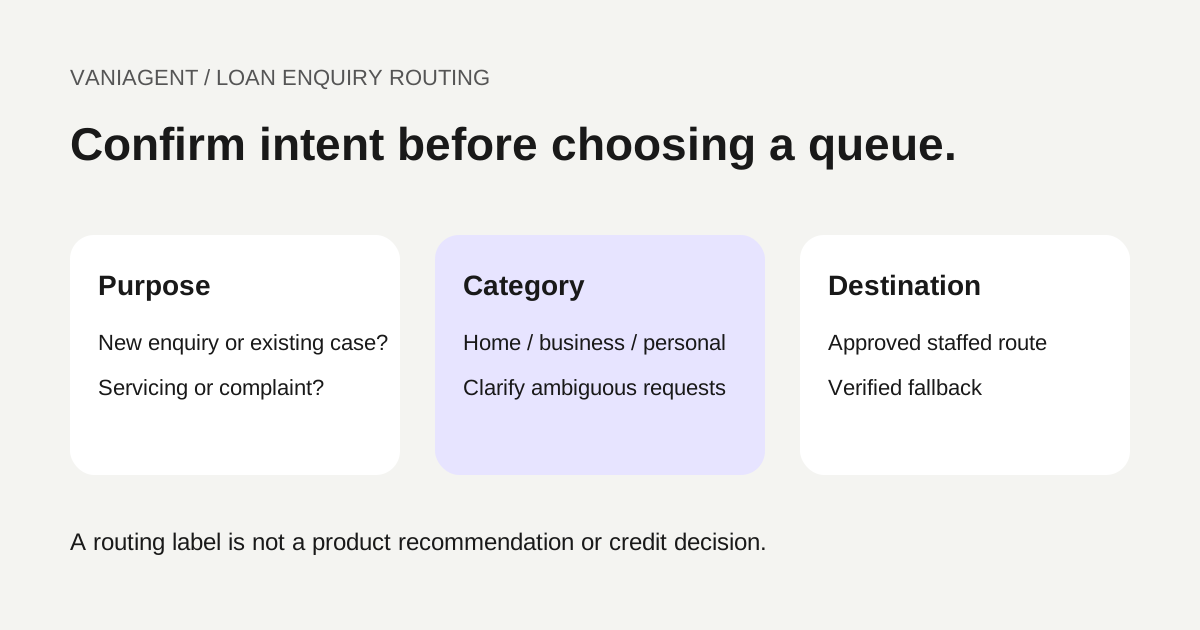
An AI loan-enquiry router should identify the caller's purpose, confirm the intended category and connect the appropriate authorized team. Home, business and personal-loan enquiries need distinct mappings, but an existing application, repayment question or complaint should not be forced into a new-sales category.
The task is routing, not choosing a suitable financial product or approving credit. A good conversation collects only what is needed for the next authorized step and explains the handoff accurately.
This guide provides a proposed routing matrix, clarification examples and acceptance tests. It does not describe a verified VaniAgent lending integration or promise that a particular lender offers every product below. Start with the broader loan-enquiry voice-agent guide for India.
Classify the purpose before the product
“I need a home loan” can mean a new application, a question about a submitted application or help with an existing account. Routing only on the product phrase can send a servicing caller to sales.
Use a short opening question when needed: “Is this a new enquiry, an application already started, or help with an existing account?” Add an obvious staff or complaint route rather than requiring every caller to choose one of three products.
| Purpose | Appropriate route to define |
|---|---|
| New borrowing enquiry | Approved product-enquiry team |
| Existing application | Authorized application-support workflow |
| Existing loan servicing | Relevant account-service team |
| Complaint or disputed contact | Approved grievance or support path |
| Unclear request | Brief clarification or general support |
The exact categories should match the lender's operations. Do not create a department because the language model invents a plausible label.
Build an approved product-routing matrix
Use stable internal route identifiers, supported destinations, staffed hours and backup paths. Separate conversational labels from telephone numbers or queue identifiers.
| Stated new-enquiry category | Clarification if needed | Approved destination label |
|---|---|---|
| Home-related borrowing | Confirm the enquiry category using approved wording | Home-loan enquiries |
| Business funding | Confirm business-purpose enquiry without assessing suitability | Business-loan enquiries |
| Personal borrowing | Confirm the requested personal-loan enquiry | Personal-loan enquiries |
| Property-backed or mixed purpose | Ask a neutral question or route to specialist review | Approved specialist or general support |
| Product not offered or unknown | Explain the limitation accurately | General support or approved alternative |
These are fictional route labels, not a universal lender product taxonomy. Have the responsible team approve which categories exist and which ambiguous cases need a person. A loan against property is not automatically a home-purchase enquiry simply because property is mentioned.
Store each mapping with its owner, effective date, operating hours, permitted language path and no-answer outcome. The information-maintenance guide explains how to keep those facts current.
Ask purpose-based questions without performing underwriting
Use the minimum clarification needed to choose a route. Avoid collecting income, identity documents, detailed liabilities or other financial information simply to decide which desk should answer.
For “I need money for a shop,” ask whether the person wants to discuss business funding, a property-related enquiry or an existing application. Do not conclude that they qualify for an unsecured business loan or that the property can be used as collateral.
If the caller asks which product is best, route to the authorized advice or enquiry process. A classification label is not a suitability assessment. Do not infer eligibility from age, occupation, postcode or a brief statement of income.
Confirm corrections before handoff
Read back the selected purpose and category: “You want to speak with the business-loan enquiry team about a new request. Is that right?” Keep the wording concise and avoid repeating private details unnecessarily.
If the caller changes the purpose, update the routing state and discard obsolete destinations. A request that starts as a new personal-loan enquiry may become an existing-application status question. The latter requires a different authorization path.
For Hindi and Hinglish callers, test local product wording and corrections with reviewed human examples. Use the Hindi task-accuracy guide rather than assuming a keyword match establishes intent.
Support keypad fallback only where tested
Twilio's Gather documentation, checked on 16 October 2026, describes speech and keypad collection with timeout behaviour. This is a provider-specific implementation option, not evidence that a deployed VaniAgent route supports it.
If a keypad menu is used, include an approved support path and avoid excessively long menus. Test no input, invalid input and a caller who requests a person. Do not let a menu choice bypass identity checks required for application details.
Keep product information within the approved scope
The router may answer a limited public FAQ if the lender approves it. Personalized terms, approval estimates and required disclosures need their own source and authorization process.
The RBI Digital Lending Directions, 2025, reviewed on 16 October 2026, address applicable lender–service-provider arrangements, borrower disclosures and conduct. Their multi-lender provisions address fair comparison and misleading presentation within scope. A voice-routing label does not exempt a workflow from applicable requirements or establish compliance.
Have the responsible lender review the script and current obligations. Do not tell callers one product is guaranteed, cheapest or approved unless the exact authorized statement is supported. Do not route toward a preferred product while presenting the decision as neutral advice.
Protect existing application and account details
Before discussing private status, use the approved identity and record-scope process. Caller ID and knowledge of a reference are not universal authorization.
Use the loan-status verification guide for disclosure boundaries. For incomplete forms, use the application follow-up guide.
Do not disclose a customer's previous application category to another person on a shared phone. A representative claim should enter the lender's authorized-representative workflow rather than a convenient routing shortcut.
Transfer using a controlled destination
The application should map an approved route ID to its actual destination. Do not allow the model to generate arbitrary phone numbers or accept a caller-provided number as the lender's department.
Check staffed hours and supported endpoint type before transfer. Define ringing timeout, busy, no answer and rejected handoff outcomes. Prevent the target from forwarding back into the same router indefinitely.
Share only the approved context needed by the receiving team: confirmed enquiry category, current purpose and unresolved question. Keep verification scope distinct from a conversational summary. The human handoff guide covers ownership and acceptance evidence.
If staff cannot answer, offer the approved next step. A callback should be confirmed only after its request is saved, and it should not promise a response time the team has not approved.
Use these fictional routing cases for acceptance
| Caller statement or event | Expected outcome |
|---|---|
| “I want to buy a home” | Confirm new home-related enquiry and approved route |
| “I applied for a home loan yesterday” | Application-support path, with disclosure controls |
| “I need money for my shop” | Clarify purpose; no inferred eligibility or collateral |
| “Personal loan… actually this is for my business” | Reconfirm final category before handoff |
| “I need help with an EMI” | Existing-loan servicing, not new-sales classification |
| “Stop calling me” | Approved contact-suppression path |
| “I want to complain” | Grievance or support path without forced sales questions |
| Product team is closed | Approved fallback with no false transfer success |
| Destination forwards back | Loop prevention and visible failure outcome |
The examples are editorial test prompts, not validated financial classifications. Have lender staff review the actual cases and permitted response wording. Inspect destination records and the receiving team's outcome, not just the agent's explanation.
Measure routing accuracy separately from lending outcomes
Track confirmed route, staff-reported wrong queue, successful handoff, callback creation, abandoned transfer and unresolved intent. Keep sales conversion, application approval and disbursal in separate downstream measures.
In a fictional review of 100 adjudicated routing calls, suppose 92 reach the intended queue, five are misrouted and three encounter destination failure. Report all categories. A correct classification followed by a failed connection should not be described as successful end-to-end routing.
Review the causes of errors: unclear product boundaries, stale destination data, recognition problems and transfer failures need different fixes. Do not attribute every problem to the model or rewrite the whole prompt before inspecting evidence.
Launch one approved routing tree first
Start with a small lender-approved category set, fictional tests and a known general-support fallback. Version the matrix and inspect a defined pilot cohort before expanding languages, branches or products.
Use the hallucination monitoring plan to review unsupported rate or approval claims, and the capacity worksheet to validate busy-period behaviour.
The router succeeds when it preserves the caller's intent and reaches the authorized next step. It should make the enquiry easier to handle without turning a conversational category into a lending decision.
Frequently asked questions
How should AI route home, business and personal-loan calls?
First distinguish a new enquiry from an existing application, servicing request or complaint. Clarify the caller’s stated purpose, confirm the selected category and use an approved destination mapping. Do not treat routing as a credit decision or product recommendation.
Can the bot select a loan product from the caller’s occupation?
Not safely from occupation alone. Ask a short purpose-based question where needed and follow the lender’s approved scope. Product suitability and credit decisions require the relevant authorized process.
What if a caller says they need money for a shop?
Clarify whether the enquiry concerns business funding, a property purchase or an existing application, using approved wording. Do not infer collateral, business eligibility or a particular lending product from the word shop.
Should a loan-status enquiry go to a new-sales queue?
Not by default. Existing application status and servicing need separate identity, authorization and routing rules. Confirm the purpose before transferring.
Can the agent quote interest rates while routing?
Only within the lender-approved information and disclosure scope. The routing workflow should not invent a personalized rate, omit relevant conditions or promise approval.
What happens if the selected department is unavailable?
Use a defined timeout and approved callback or support route. Confirm any saved callback result before announcing it, and avoid transfer loops or silently choosing an unrelated department.
Review your loan-enquiry routing
Bring the lender-approved category matrix, staff destinations and fictional caller cases to a scoped VaniAgent demonstration. Verify the routing and disclosure boundaries before moving live enquiries.
Put these ideas into production
Deploy AI voice agents in minutes and build outbound, inbound, and follow-up workflows on one platform.
Related Articles
AI Voice Agents for Loan Applications and Inquiries in India
A practical guide for Indian lenders and NBFCs designing AI voice workflows for loan inquiries, application follow-ups, document reminders, and safe human escalation.
How Should a Voice Bot Verify a Caller Before Sharing Loan Status?
Design loan-status caller verification with scoped backend authorization, disclosure rules, shared-number handling, secure fallback and acceptance tests.
Can an AI Loan Assistant Follow Up on an Incomplete Application?
Design loan-application follow-up with current status checks, recipient verification, approved completion routes, suppression and lender-reviewed pilot tests.
When Should an AI Voice Agent Transfer to a Human?
Learn when an AI voice agent should transfer to a human, how cold transfer, warm transfer, smart routing, and context handoff work, and what Indian businesses should test before launch.