How Many AI Calling Channels Does Your Business Need?
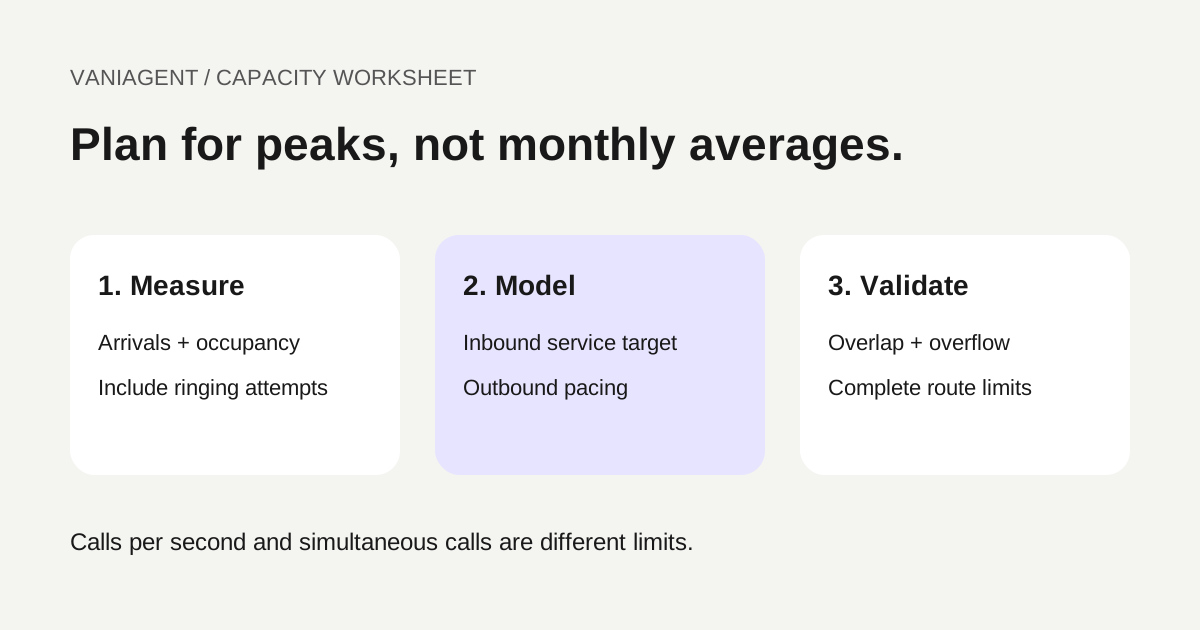
Size AI calling channels from peak traffic and the service you need to deliver, rather than dividing monthly minutes by opening hours. Measure how long each inbound call or outbound attempt occupies the relevant capacity pool, decide what happens when that pool is full and test the proposed limits with realistic overlap.
This guide gives a worked mixed-workload calculation and a capacity worksheet for Indian businesses. It extends our simultaneous receptionist calls guide with a purchasing method for inbound demand and outbound campaigns sharing resources.
All workload numbers below are fictional planning inputs. They are not measured VaniAgent capacity, a provider guarantee or a recommended channel count for every business.
Define what a channel means in the quote
The same conversation can consume an AI session, a telephone connection and a second connection during transfer. Ask the supplier which resource its quoted channel limit counts and at which events the resource is acquired and released.
| Limit | What to verify |
|---|---|
| AI concurrency | Simultaneously active or reserved AI sessions; ringing and transfer treatment |
| Carrier capacity | Telephone legs or trunks permitted at the same time |
| Calls per second | New-call initiation rate and queuing or rejection behaviour |
| Backend capacity | Model, speech and integration limits under concurrent load |
| Staff availability | People or approved destinations able to accept escalations |
| Account scope | Whether branches, agents and campaigns share the same pool |
Twilio's voice limitations distinguish outbound calls-per-second limits from other voice constraints. Its high-volume voice guidance discusses outbound queuing and the queue-time field. These provider-specific references, checked on 16 October 2026, illustrate why initiation speed and active-call capacity must be assessed separately.
Do not assume an API rate-limit increase adds AI sessions, or that more AI sessions fixes a carrier bottleneck. Confirm the smallest relevant limit across the complete route.
Collect timestamped traffic before calculating
Export representative inbound and outbound records with initiated, answered and ended times, direction, outcome and transfer details. Identify advertising bursts, opening-time queues and seasonal peaks rather than relying only on a quiet week.
Keep unanswered attempts in the dataset. Ringing can occupy resources even when billing is zero. For transfers, identify when AI capacity is released and whether telephone legs continue. The failed-call billing guide and warm-transfer worksheet explain why billable duration and resource occupancy can differ.
Separate offered inbound demand from answered traffic. If the existing system rejects callers at full capacity, answered-call records understate what customers tried to send. Add available queue, rejection and abandonment evidence, and mark missing demand as a limitation.
Calculate an inbound workload baseline
Suppose 30 inbound calls arrive in a busy hour, and each occupies the relevant AI capacity for four minutes on average. The offered workload is:
30 calls/hour × 4 minutes ÷ 60 = 2 Erlangs.
An Erlang represents average occupied capacity over the stated period under the model. Two Erlangs is not a recommendation to purchase two channels. It does not show the arrival burstiness, the duration spread or the probability that all channels are busy.
Now suppose 15 of those calls arrive within the busiest 15 minutes. That interval has an arrival rate equivalent to 60 calls per hour. At the same four-minute duration, its workload is 15 × 4 ÷ 15 = 4 Erlangs. An hourly average concealed a substantially busier interval.
| Fictional interval | Arrivals | Mean occupancy | Workload baseline |
|---|---|---|---|
| Busy hour | 30 | 4 minutes | 2 Erlangs |
| Busiest 15 minutes | 15 | 4 minutes | 4 Erlangs |
Neither row establishes the final purchase. Use shorter observed intervals and actual arrival timestamps to understand the peaks, while checking that the sample period covers the situations you intend to support.
Choose the queue or blocking target explicitly
If callers can wait, define the acceptable wait, queue length, timeout and overflow. If calls are rejected when capacity is full, define the acceptable blocking level and the next contact option.
Queueing models need stated assumptions about arrivals, service times and what callers do while waiting. A loss model and a waiting model answer different questions. For bursty campaigns, abandonment, time-varying demand or shared workflows, use a suitable simulation or specialist capacity analysis rather than treating a simple average as a service guarantee.
Do not assume a monthly peak observation protects against every future burst. Test ordinary peaks and approved stress scenarios separately. Report the conditions of each result and keep an operational fallback available.
Add outbound attempt occupancy separately
Suppose a permitted campaign needs 600 attempts within three hours. That is 200 attempts per hour. Assume 25% connect, with a total resource occupancy of 180 seconds for a connected attempt and 30 seconds for an unconnected attempt.
The 180-second assumption already includes all stages counted by this particular capacity pool. Do not add ringing again unless it was excluded. The average occupied time per attempt is:
0.25 × 180 + 0.75 × 30 = 67.5 seconds.
At 200 attempts/hour, the average offered attempt workload is 200 × 67.5 ÷ 3,600 = 3.75 concurrent positions. This is an average planning load, not proof that four available channels finish the campaign on time.
| Campaign input | Fictional assumption |
|---|---|
| Target attempts | 600 |
| Operating window | 3 hours |
| Required average attempt starts | 200/hour |
| Connection rate | 25% |
| Connected-attempt occupancy | 180 seconds |
| Unconnected-attempt occupancy | 30 seconds |
| Weighted occupancy per attempt | 67.5 seconds |
| Offered average occupancy | 3.75 positions |
This model counts connected and unconnected attempts in one defined pool. If your AI sessions are acquired only after answer while the carrier holds capacity during ringing, build separate occupancy calculations for those pools. Use measured connection rates and durations; changing them changes campaign throughput.
Check initiation rate without confusing it with concurrency
Starting 200 attempts per hour corresponds to an average 0.0556 call starts per second, or one every 18 seconds. A smooth scheduler and a batch that releases all calls at once have different short-term demands despite the same hourly total.
Confirm the allowed initiation rate, carrier throttles and API behaviour for your account. Keep the scheduler from creating a growing queue of calls that will start after the intended contact window. New attempts should also respect permission, suppression and campaign stop rules.
Higher concurrency cannot compensate for an initiation bottleneck, and a high initiation allowance does not mean the system can sustain every resulting conversation. Validate both under the intended pacing policy.
Reserve inbound capacity while campaigns run
In the fictional peak interval, inbound workload is four Erlangs and outbound offered load averages 3.75 positions. Their sum, 7.75, is still only a workload indicator under the stated simultaneous conditions. It is not a recommendation for eight channels or a waiting-time prediction.
Define an admission policy for outbound work. For example, the business may reserve a measured amount of headroom for inbound arrivals and stop starting outbound attempts when available capacity falls below that threshold. An existing outbound conversation generally cannot be assumed to end instantly when a caller arrives.
Account for in-flight ringing attempts, delayed connection events and concurrent scheduler decisions. Capacity must be reserved consistently so two workers do not both claim the last available position. Ask the platform to demonstrate the behaviour, rather than assuming a dashboard channel limit implements inbound priority automatically.
Run a trace-based capacity comparison
Replay the observed arrival times and resource durations in a controlled model for each candidate capacity and policy. Include shared branches, transfers, queue rules and outbound pacing. State what the model does with rejected or abandoned calls.
For each candidate, report:
- Offered, admitted, queued, rejected and abandoned inbound calls.
- Wait-time distribution and the share meeting the stated service target.
- Outbound attempts completed within the permitted window.
- Resource occupancy and periods at full capacity.
- Tool latency, failures and staff-handoff outcomes under load.
- The assumptions, dataset coverage and unresolved limits.
A simulation estimates behaviour under its assumptions. Confirm the most important cases with an authorized overlap test using fictional records and controlled destinations. Do not conduct a load test by placing unsolicited calls to customers.
Use this supplier capacity worksheet
| Required answer | Evidence to request |
|---|---|
| Exact meaning of the channel limit | Written definition and counted states |
| Shared-pool scope | Agent, branch, campaign and account mapping |
| At-capacity behaviour | Demonstrated queue, rejection or overflow path |
| Inbound priority | Admission policy and ringing-reservation treatment |
| Transfer accounting | AI release point and carrier leg limits |
| Initiation rate | Account-specific cap and delayed-call handling |
| Downstream limits | Speech, model and CRM behaviour during overlap |
| Commercial terms | Capacity price, minimum commitment and scaling process |
Check current VaniAgent pricing and request a written configuration for your workload. Unlimited usage does not establish unlimited parallel calls. Extra capacity also does not guarantee that staff or integrations can handle the resulting work.
Increase capacity when evidence justifies it
Review peaks, waiting, rejected demand and campaign completion after launch. Inspect why capacity is occupied before buying more: a stuck session, slow tool or transfer loop may be consuming positions unnecessarily.
Recalculate when call duration, answer rate, campaign schedule or branch demand changes. Keep separate tests for normal operation and incidents such as a service outage or an advertisement-driven burst. A useful capacity plan states which service target it supports, what evidence backs it and what happens when demand exceeds the plan.
Frequently asked questions
How many AI calling channels does my business need?
Use peak inbound demand, session duration, outbound attempt workload and the intended waiting or overflow target. Calculate a workload baseline, then validate candidate capacity against timestamped traffic and a controlled overlap test. Monthly minutes alone cannot determine the answer.
Are channels the same as calls per second?
No. Channels usually describe simultaneous sessions or connections under a defined limit. Calls per second describes the rate at which new calls can start. Confirm both limits and the scope of each in the written configuration.
Do unanswered outbound calls use capacity?
They can occupy dialing, carrier or reserved platform capacity while ringing, even when they have no connected-minute charge. Measure which capacity pool each attempt occupies and for how long.
Does an unlimited calling plan provide unlimited parallel calls?
No such assumption should be made. Usage allowance and concurrency are separate commercial terms. Confirm session limits, shared-account scope, queues and overflow before selecting a plan.
Can outbound campaigns share channels with inbound calls?
Yes where the configured system supports it, but define an inbound reserve or other priority policy. Stop admitting new outbound attempts before they consume the capacity intended for incoming callers; account for ringing and already active sessions.
Does a workload of two Erlangs mean two channels are enough?
No. Two Erlangs describes average offered occupancy under the stated assumptions, not a guarantee that two channels meet a waiting or blocking target. Arrival variation, duration distribution and the handling of full capacity require additional modelling and tests.
Scope your calling capacity
Bring your timestamped call records, campaign windows and inbound service target to a scoped VaniAgent demonstration. Confirm the capacity definitions and overflow behaviour before purchasing channels.
Put these ideas into production
Deploy AI voice agents in minutes and build outbound, inbound, and follow-up workflows on one platform.
Related Articles
Can an AI Receptionist Handle Several Calls at Once?
Understand simultaneous AI receptionist calls, initiation rate, shared capacity and overflow, with a peak-demand worksheet and overlapping-call test plan.
Inbound vs Outbound AI Calling Costs in India: A Mixed-Workload Budget
Build an inbound and outbound AI calling budget for India with worked calculations for minutes, attempts, transfers, carrier fees and setup.
Are Failed Calls, Ringing and Voicemail Charged by AI Calling Platforms?
Check failed-call, ringing and voicemail charges with provider references, a worked 1,000-attempt budget, minimum billing checks and an invoice worksheet.
What Does an AI Warm Transfer Cost? Call Legs, Hold Time and Recordings
Calculate AI warm-transfer costs with a worked call-leg budget, hold-time sensitivity, failed handoff checks and a recording and invoice worksheet.