Can an AI Loan Assistant Follow Up on an Incomplete Application?
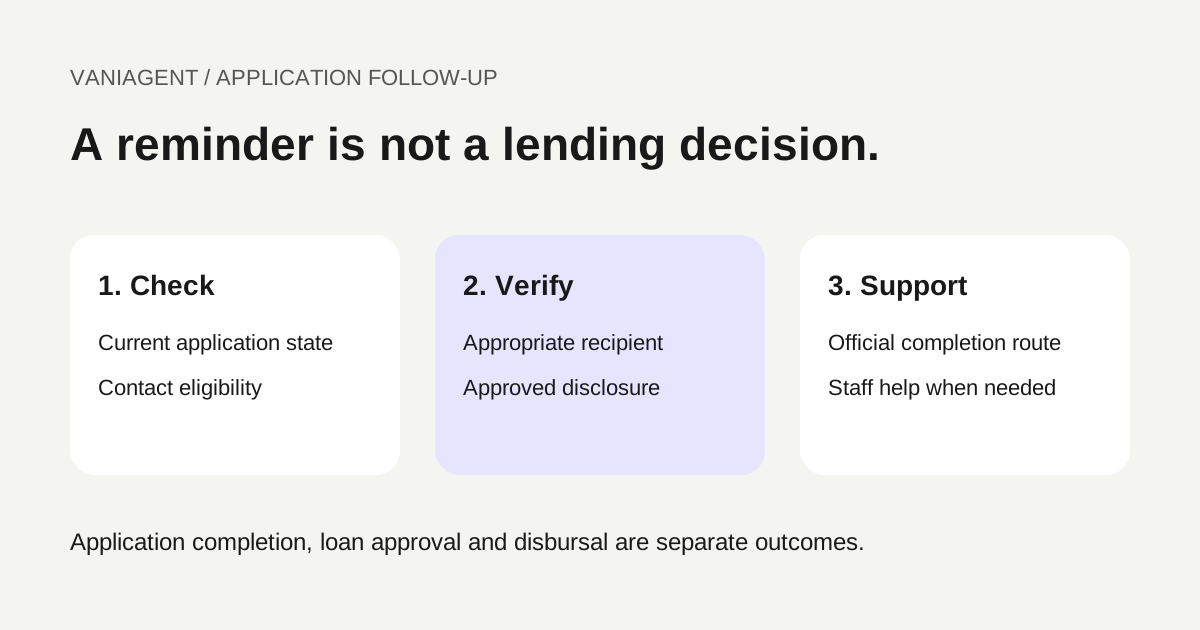
An AI loan assistant can help with an incomplete application by reminding an eligible applicant of a verified next step and offering an approved staff or digital completion route. The workflow should not decide credit eligibility, infer approval or collect sensitive documents through an improvised conversation.
The narrow task is application follow-up: confirm that the application is still incomplete, contact the appropriate person under the lender's approved rules and record the actual outcome. This is distinct from underwriting, product recommendation and loan repayment collection.
This article describes a proposed workflow, not a verified VaniAgent lending deployment or a guarantee of regulatory compliance. For the broader enquiry use case, see our AI voice agents for loan enquiries in India.
Define the lender-approved scope
Write down the entity responsible for the application, the caller identity, permitted purpose, approved channels and staff escalation route. The agent should identify the actual business accurately rather than implying it is a regulator or an independent lender when it is not.
| Scope item | Required decision |
|---|---|
| Eligible application state | Which incomplete stages may receive a reminder |
| Contact authority | Applicable evidence, preferences and suppression rules |
| Recipient verification | What can be said before and after verification |
| Permitted actions | Reminder, approved link request or staff callback |
| Restricted actions | Credit decisions, document acceptance or changes outside scope |
| Escalation | Authorized application support and grievance path |
Have the lender's responsible team approve these decisions before implementation. Do not classify a reminder as a particular regulated communication category solely because the prompt calls it a service call.
Check official guidance within its scope
The RBI Digital Lending Directions, 2025 address regulated-entity and lending-service-provider arrangements, borrower protection and data handling. They include need-based data collection with consent and audit requirements within their applicable scope. They do not constitute approval of a particular voice bot or vendor.
TRAI's consent guidance and advice to senders describe purpose-related consent and commercial communication requirements. These references were reviewed on 16 October 2026. The responsible lender and access provider should confirm current applicability, amendments, contact classification and route requirements for the actual workflow.
Keep the regulatory review separate from the technical acceptance test. A successful call does not establish that the sender, agreement or contact process meets every applicable obligation.
Use application state rather than an old lead label
An entry marked “interested” in a CRM is not necessarily an open application. Query the authoritative application reference and current stage. Distinguish draft, awaiting information, submitted, under review, withdrawn and closed according to the lender's actual status model.
Only expose the minimum approved next-step code to the calling workflow. It may need “resume through the secure portal” rather than a complete financial profile. Do not send full application documents to the model merely because the integration can retrieve them.
Recheck eligibility at dispatch. An applicant may finish the form, withdraw contact permission or be assigned to staff after a list is exported. The lead-list preflight checklist explains why static approval is insufficient for queued calls.
Maintain a minimal follow-up record
| Field | Purpose |
|---|---|
| Application and task reference | Links one reminder to the correct workflow |
| Lender and sender identity | Establishes who is contacting the applicant |
| Approved contact destination | Avoids assuming every number belongs to the applicant |
| Current stage and timestamp | Establishes whether the reminder is still needed |
| Contact eligibility evidence | Links to the applicable approval and preferences |
| Allowed next-step code | Limits what the agent may explain |
| Attempt history and owner | Prevents duplicate or competing outreach |
| Outcome and suppression state | Governs next action and retries |
Use references rather than duplicating sensitive documents in the calling list. Map the processing path using the vendor data-flow template, including transcripts and CRM notes.
Verify before discussing application details
A shared or reassigned number can reach someone other than the applicant. Use a neutral opening and the lender's approved verification path before disclosing application-specific information. Do not reveal a loan amount, missing document or financial status to whoever answers.
If the recipient is uncertain, stop the sensitive part of the conversation and offer the business's official contact route. A household relationship or knowledge of a name should not automatically authorize disclosure.
Keep detailed identity verification in its separately approved workflow. The follow-up bot should not ask for passwords, PINs or authentication codes as a shortcut. Provide a trusted route the applicant can independently verify through the lender's official channels.
Describe the next step without promising approval
After the required verification, an illustrative script might say: “Our application system shows a step is still pending. You can continue through the official application portal, or I can request help from the application-support team. Which would you prefer?”
Use only wording that matches the actual lender and verified state. Do not say “you are pre-approved,” “your loan is guaranteed” or “this is the last requirement” unless the authorized system and policy substantiate the precise statement. This reminder workflow should not generate new lending terms.
If the applicant says they already submitted the information, check current state or route to support. Do not repeatedly insist that a stale status is correct. Record the disagreement without automatically changing document-validation results.
Separate document upload from document acceptance
The applicant may upload a file without the lender accepting it. Keep uploaded, received, validated, incomplete and approved statuses distinct where the system uses them.
Route documents through the approved portal or staff process. Do not ask the applicant to send them to an unverified personal number or a generated link. If a secure continuation link is supported, validate the destination and avoid exposing sensitive tokens in logs or transcripts.
A message delivery receipt does not prove the applicant opened the portal, and a portal visit does not prove application submission. Use the authoritative result for each stage rather than promoting an intermediate event into completion.
Handle callback, stop and cancellation requests separately
| Applicant response | Appropriate next step to define |
|---|---|
| Wants staff assistance | Create an authorized callback with verified scheduling result |
| Will finish later | Record an approved preference without unbounded retries |
| Says application is complete | Reconcile current state or route discrepancy |
| Requests no further calls | Apply the contact suppression process |
| Wants to withdraw the application | Route through the authorized withdrawal workflow |
| Raises a complaint | Offer the approved grievance or staff path |
Do not equate no further calls with automatic application deletion. Conversely, do not leave reminder jobs active after contact suppression simply because the application is still open. Respect the distinction between business state and contact permission.
Control duplicate and delayed outreach
Use one logical follow-up task per eligible application stage or another documented policy key. Coordinate with staff queues so a case already being handled does not receive a competing AI call.
Bound retries by attempt count, time window and current eligibility. Recheck status and suppression before every retry. A technical call failure should not erase a later withdrawal.
If the agent creates a callback or CRM note, verify its saved result before confirming it. Use the reliable tool-call evaluation guide for failed or uncertain writes.
Test with fictional applications first
- Application completes after export: the reminder is skipped at dispatch.
- Wrong or unverified recipient: no application-specific disclosure.
- Contact permission is withdrawn: queued and retry work is suppressed.
- Applicant disputes the missing step: current state is checked or support is offered.
- Document upload is received but not validated: no approval claim.
- Caller requests terms outside the approved source: no invented rate or fee.
- Staff already owns the case: duplicate outreach is prevented.
- Callback write times out: no unsupported success announcement.
- Applicant asks to stop calls: contact preference and application status remain distinct.
- A complaint is raised: the approved escalation is available.
Have the lender review scripts, records and results. Inspect the application system and CRM, not just the transcript. An agent that sounds helpful but discloses details to the wrong person fails the workflow.
Measure verified progress without equating it to lending success
Track eligible applications, permitted attempts, verified contacts, support requests and authoritative completion outcomes. Distinguish application completion from approval and disbursal.
In a fictional cohort of 100 eligible applications, suppose 60 applicants are reached and 20 applications later become complete. Report 60 reached and 20 completed, with the defined observation period. Those figures do not prove that the calls caused the completions or that any loan was approved.
Compare like-for-like cohorts and keep staff effort, wrong-recipient events, withdrawals and complaints visible. Do not optimize call volume at the expense of accurate status or appropriate contact.
Start with a limited lender-approved pilot and a clear monitoring owner. Expand only after the evidence shows that reminders remain current, recipients are handled appropriately and the agent describes the next step without becoming a lending decision-maker.
Frequently asked questions
Can an AI loan assistant follow up on an incomplete application?
A scoped, lender-approved workflow can remind eligible applicants of an outstanding step and route them to an approved completion channel. It must use current application state, verify the recipient appropriately and avoid making lending decisions or approval promises.
Does starting an application authorize every later marketing call?
No blanket assumption is appropriate. Check the specific contact purpose, collected evidence, current preferences and applicable requirements with the responsible lender and access provider before outreach.
Should the assistant collect identity documents during the call?
Use the lender’s approved document and verification channels. A general follow-up bot should explain the required next step without asking for passwords, authentication codes or unnecessary sensitive details in the conversation.
Can the AI say the loan will be approved after documents are submitted?
No. Document receipt, application completeness, review, approval and disbursal are different states. The assistant should describe only verified current status and approved next steps.
What if the application is completed after the call list is exported?
Recheck the authoritative status before dispatch and before any consequential statement. Stop the outdated reminder rather than treating the exported list as permanently eligible.
What should happen when an applicant asks to stop calls?
Record and apply the approved withdrawal or suppression process, including pending retries. Keep contact preference separate from an application cancellation request unless the person also requests that action and the authorized workflow handles it.
Scope an application-support pilot
Bring the lender-approved contact rules, status model and fictional application cases to a scoped VaniAgent demonstration. Verify the proposed integration and controls before authorizing live follow-up.
Put these ideas into production
Deploy AI voice agents in minutes and build outbound, inbound, and follow-up workflows on one platform.
Related Articles
AI Voice Agents for Loan Applications and Inquiries in India
A practical guide for Indian lenders and NBFCs designing AI voice workflows for loan inquiries, application follow-ups, document reminders, and safe human escalation.
How to Check a Lead List Before an AI Calling Campaign
Check AI calling lead lists for provenance, permission evidence, phone formatting, duplicates, suppression and task eligibility with a preflight worksheet.
Map Where Your Voice-Agent Data Goes: A Vendor Review Template
Map voice-agent audio, transcripts, model requests, CRM writes and backups with a vendor-review worksheet, evidence labels and change-control checklist.
How to Choose an LLM for Reliable Booking and CRM Tool Calls
Evaluate LLM tool calling with booking and CRM test cases, argument validation, authorization, uncertain-write recovery and verified action scoring.