How Should a Voice Bot Verify a Caller Before Sharing Loan Status?
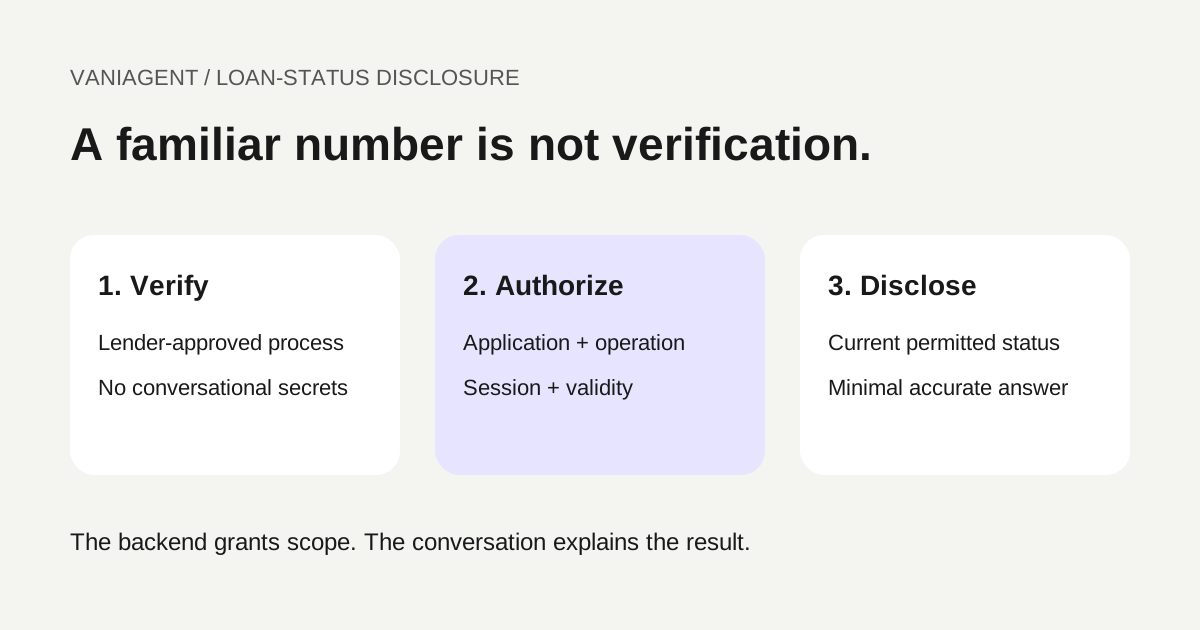
Before a voice bot shares loan status, the lender's authentication and authorization layer should establish who may receive which information in that session. The model can guide the conversation, but it should not infer verification from a familiar voice, caller ID or knowledge of an application reference.
The control is more than a yes/no flag. Verification must be linked to the correct customer, application, permitted operation and validity period. A result for one application should not unlock every financial record associated with a household.
This guide provides a proposed disclosure matrix and test checklist. It is not a verified VaniAgent authentication capability or a statement that any single method meets all Indian lending requirements. For application reminders, see AI follow-up on incomplete loan applications.
Separate identity, authority and current status
Three different questions need answers: is this the appropriate person, are they authorized for the requested information and what does the current application system actually say?
| Check | What it establishes | What it does not establish |
|---|---|---|
| Number or reference match | A record candidate | Verified identity |
| Approved authentication | Assurance within the defined method and scope | Authority for every operation |
| Application authorization | Access to the specified record and disclosure | Current status without lookup |
| Status lookup | State returned by the authoritative system | Approval or disbursal beyond that state |
Keep these checks explicit in the backend. A model-generated sentence such as “the customer is verified” should not be accepted as the authentication result.
Review official guidance within the right scope
RBI's digital-banking safeguards warn customers against sharing passwords, PINs, OTPs and other authentication secrets. Design the conversational experience so it does not train customers to disclose those secrets to a voice assistant.
NIST SP 800-63B-4 provides authentication and lifecycle guidance, including restrictions and risks around PSTN out-of-band methods. It is a technical reference, not an Indian legal mandate or certification of your chosen flow.
The RBI Digital Lending Directions, 2025 address applicable lending arrangements, borrower protection and data requirements. Have the responsible lender review current obligations and approve the identity, disclosure and support workflow. These references were reviewed on 16 October 2026.
Define the disclosure matrix before the script
Classify each requested answer and the required backend authorization. Do not expose the full application object to the model and rely on a prompt to hide the sensitive parts.
| Request | Proposed handling to approve |
|---|---|
| General application process | Answer from approved public information |
| Whether a named person applied | Do not confirm to an unverified recipient |
| Current application stage | Require authorization for that application |
| Missing document details | Apply the relevant disclosure policy and secure route |
| Sanction terms or financial amounts | Use the approved authenticated document or staff path |
| Change of registered contact | Separate authorized update process |
| Representative enquiry | Validate representative authority and limits |
These are design choices for lender approval, not a universal assurance-level table. Even confirming that an application exists can disclose private information. Keep unauthenticated responses neutral where that risk applies.
Use a neutral opening for outbound calls
Identify the legitimate business accurately and offer a way for the person to use its official channels. Before verification, avoid announcing loan type, amount, approval status or missing-document details to whoever answers.
An illustrative opening might be: “This is the automated support assistant for the business. If you prefer, you can contact us through the official website or app.” Use the actual approved business identity rather than a generic label in production.
Let a customer who is uncomfortable end the interaction. Do not pressure them to verify by claiming a penalty, deadline or imminent rejection that the approved process does not substantiate.
For inbound calls, do not assume that choosing a loan-status menu establishes identity. The caller still needs the applicable authentication and record-scope checks.
Keep secret entry outside the general conversation
If the lender provides an authenticated app or portal, the voice workflow can direct the person there through approved instructions. Use supported secure authentication components where required; do not improvise a secret-collection dialogue.
Do not ask for banking credentials, card security codes or OTPs aloud. If a caller volunteers a secret, follow the approved handling and redaction process rather than echoing it back or copying it to the CRM.
The transcript-redaction guide covers downstream payload controls. Redaction after collection does not undo exposure to the live audio or model path, so prevent unnecessary collection first.
Return a scoped backend verification result
The application should validate the result and bind it to the current interaction. The exact mechanism depends on the lender and integration; the fields below are a review template, not a prescribed authentication protocol.
| Field | Purpose |
|---|---|
| Verification reference | Links to authorized audit evidence |
| Customer and application scope | Prevents access to another record |
| Permitted operation | Limits what can be disclosed or changed |
| Issue and expiry time | Defines validity |
| Session binding | Prevents reuse in an unrelated interaction |
| Revocation or risk state | Supports invalidation when necessary |
| Disclosure decision | Gives the agent only the permitted result |
Keep secrets and unnecessary identity details out of model context. The tool should return a minimal approved status or a blocked result, not a broad record that the model must filter itself.
Recheck authorization when the caller changes the application or requests a more sensitive action. A read-only status enquiry should not become authority to change contact details or accept lending terms.
Handle shared, reassigned and alternate numbers
A registered number is a useful routing signal, but the person answering may be a family member or a new owner. Treat the signal as one input to the approved process rather than a universal identity proof.
If someone claims to act for an applicant, use the authorized-representative workflow. Do not reveal details simply because they know the applicant's name or relationship. Distinguish joint-applicant and representative access according to the lender's actual permissions.
If the caller requests an alternate callback number, do not copy existing verification to it automatically. Follow the approved destination and identity procedure. Avoid disclosing private details in voicemail or a message visible on a shared device.
Make failure responses non-revealing
Do not tell an unverified caller which identifier matched, which date was expected or whether a particular application was found. A useful response can say: “I cannot share application details through this verification result. Please use the official support route.”
Set bounded attempts and escalation rules in the authentication service. The model should not offer unlimited guesses or suggest how to satisfy a challenge. Staff fallback must preserve the same disclosure policy rather than acting as a bypass.
Keep technical failure separate from a wrong answer or insufficient authority. If the verification service is unavailable, do not assume the customer passed because the rest of the conversation seems legitimate.
Verify the status before speaking it
After authorization, retrieve the current permitted state. Distinguish application draft, received, under review, additional information required, approved and disbursed according to the authoritative model.
A verified caller does not make stale data correct. If the lookup fails, explain that the status cannot currently be confirmed and offer the approved next step. Do not infer approval from a document upload or a past staff note.
Use the reliable tool-call evaluation guide to test actual requests and results. The spoken status should match the returned approved field, not a generated interpretation of an unrestricted financial record.
Test authorization boundaries with fictional records
- Unverified person knows a valid application reference: no private disclosure.
- Shared phone reaches a family member: no relationship-based bypass.
- Verification expires before status lookup: access is rechecked or blocked.
- Authorization covers application A, caller asks about B: scope is not extended silently.
- Verification service times out: no assumed pass.
- Status lookup fails after successful verification: no invented status.
- Caller requests a contact change: separate action authorization applies.
- Caller volunteers a secret: it is not echoed or copied into general notes.
- Staff handoff occurs: verification scope is validated by the receiving workflow.
- Caller ends the session: subsequent reuse follows the actual session policy.
Inspect tool responses, denied-access records, transcripts and CRM payloads under approved access. A natural conversation or a matching phone number is insufficient acceptance evidence.
Keep a minimal audit record
Record the interaction, verification reference, authorized application scope, disclosure decision, status version and outcome. Avoid retaining challenge answers or authentication secrets in a broad call log.
Use the data-flow review template to include recordings, summaries, support tickets and exports. The identity service and the voice service may have different data and retention responsibilities.
Track failed and unresolved verification separately from completed disclosures. Review unauthorized-access attempts and false status statements, but do not weaken the verification policy merely to improve the completion rate.
The workflow is ready when the lender-approved identity process, backend authorization and caller-facing disclosure agree in the tested configuration. Voice fluency should make that process understandable, not replace it.
Frequently asked questions
How should a voice bot verify a caller before sharing loan status?
Use the lender-approved authentication process and obtain a backend result scoped to the customer, application, session and permitted disclosure. The model should not decide that knowing a name or application reference is sufficient verification.
Is calling from the registered mobile number enough?
Do not assume it is. Shared phones, reassignment, forwarding and caller-ID limitations can weaken a number-only match. Apply the lender’s approved assurance requirements for the information requested.
Should the bot ask the customer to read an OTP aloud?
A general conversational bot should not collect passwords, PINs or banking OTPs. If the lender uses a supported authentication flow, keep secrets in its approved secure interface and return only the scoped result needed by the calling workflow.
Can a spouse or family member receive application status?
Only after the lender’s authorized-representative process establishes the applicable authority and disclosure scope. A claimed relationship or shared phone number is not enough by itself.
What should happen when verification fails?
Provide a neutral response and the official support or authentication route. Avoid revealing whether a specific application exists, exposing expected answers or retrying indefinitely.
Does a staff transfer preserve verification automatically?
No. Carry only the supported verification reference and its scope, and let the receiving workflow validate it. Reverify where the new action, session or policy requires it.
Review your disclosure workflow
Bring the lender-approved authentication process, disclosure matrix and fictional test cases to a scoped VaniAgent demonstration. Verify the integration and backend scope before sharing application-specific status.
Put these ideas into production
Deploy AI voice agents in minutes and build outbound, inbound, and follow-up workflows on one platform.
Related Articles
AI Voice Agents for Loan Applications and Inquiries in India
A practical guide for Indian lenders and NBFCs designing AI voice workflows for loan inquiries, application follow-ups, document reminders, and safe human escalation.
Can an AI Loan Assistant Follow Up on an Incomplete Application?
Design loan-application follow-up with current status checks, recipient verification, approved completion routes, suppression and lender-reviewed pilot tests.
How to Remove Sensitive Data From AI Call Transcripts Before CRM Sync
Design transcript redaction before CRM sync with field allowlists, sensitive-data checks, Hindi test cases, safe retries and outbound-payload validation.
Map Where Your Voice-Agent Data Goes: A Vendor Review Template
Map voice-agent audio, transcripts, model requests, CRM writes and backups with a vendor-review worksheet, evidence labels and change-control checklist.