How to Keep an AI Receptionist’s Prices, Hours and FAQs Up to Date
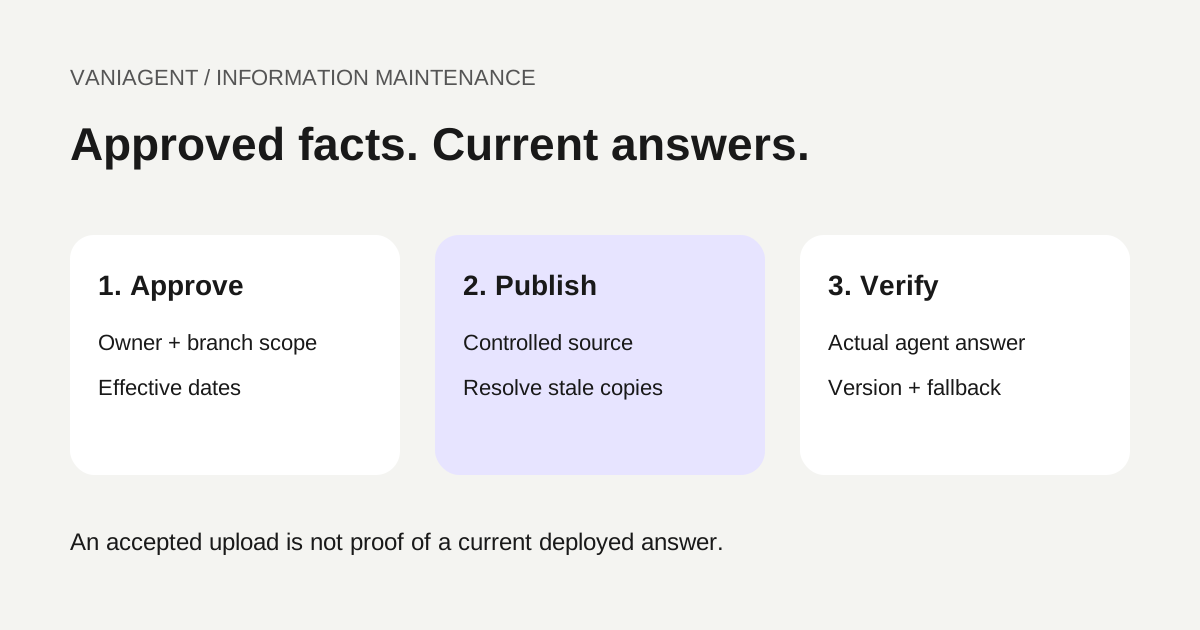
Keep an AI receptionist's prices, hours and FAQs current by maintaining approved, versioned business records and verifying the deployed answers after every material update. Assign an owner, define when each fact becomes effective and decide what the agent does when the source is missing, expired or conflicting.
Uploading a new PDF is only one step. The live agent may still retrieve an older page, use a copied amount in its prompt or continue an earlier conversation with stale context. This guide provides a proposed update workflow, a record worksheet and tests for those failure paths.
It extends our AI receptionist guide for India with information maintenance rather than another overview of reception features. The examples are fictional operating designs, not confirmed VaniAgent platform capabilities.
Separate business facts from response instructions
The prompt can tell the receptionist to confirm a branch, answer from approved information and escalate uncertainty. The current service price, holiday closure and refund policy need controlled records whose ownership is clear.
| Information | Suitable maintenance pattern to evaluate |
|---|---|
| Service price | Structured amount, currency, tax treatment, inclusions and effective period |
| Opening hours | Branch timezone, recurring schedule and date overrides |
| Appointment slots | Live scheduling lookup rather than a static FAQ |
| Refund or cancellation policy | Approved policy version with applicability conditions |
| Service description | Reviewed knowledge entry linked to an authoritative source |
| Staff transfer route | Approved destination and staffed hours |
Do not assume a generic knowledge-base upload supports structured validation or live lookups. Confirm what the chosen integration can actually enforce. A document can be useful for explanation, while consequential amounts and availability may need stronger controls.
Use one approved owner per category
Finance or the business owner can approve prices; branch managers can approve local hours; the responsible policy team can approve terms. Name the person or role rather than making “the AI team” responsible for facts it cannot verify.
The owner should approve the value, applicability and effective time. An engineer can implement the publication path and tests, but should not invent missing prices or policy interpretations. Customer feedback can open a review issue without becoming an automatic edit to approved information.
Keep an audit trail of requested, approved and published changes. Separate permission to draft from permission to publish sensitive business terms. For a small team, one person may hold several roles, but the decisions still need to be recorded.
Maintain this business-information worksheet
| Field | Why it matters |
|---|---|
| Record ID and category | Stable reference for a price, schedule or policy |
| Branch and service scope | Prevents one location's fact applying to every branch |
| Approved value or text | The information the agent may use |
| Currency, units and inclusions | Prevents quoting a setup fee as a monthly amount |
| Effective from and effective until | Controls future changes and expiry |
| Timezone | Resolves local hours and effective boundaries |
| Owner and approver | Identifies who can resolve uncertainty |
| Version and source | Makes the answer traceable |
| Last verified and review due | Supports freshness checks without changing effective dates |
| Fallback | Defines what happens when the record cannot be trusted |
“Last edited” and “effective from” are different. A price entered today might apply next month, while a reviewed price may remain unchanged. Do not use an upload timestamp as the business effective date.
Choose a publication path that matches how fast facts change
For stable FAQs, a reviewed document or knowledge entry may be sufficient. For frequently changing prices or hours, evaluate a controlled lookup with validation and freshness checks. For appointments, query the authoritative scheduling system at the relevant action step.
Retell's knowledge-base API reference, checked on 16 October 2026, documents text, file and URL sources, ingestion status and refresh-related fields. This provider-specific interface illustrates why accepting an upload is different from completing ingestion. It does not prove that every supplier has the same refresh behaviour.
Ask your supplier what happens after a source changes: refresh timing, failure handling, indexing, cache invalidation and the scope of existing sessions. Do not advertise instant updates without measuring the deployed path. Keep a route for urgent corrections that cannot wait for a scheduled crawl.
Handle recurring hours and exceptional dates separately
A branch's regular timetable is not sufficient for holidays, temporary closures or a practitioner who is unavailable. Record date-specific overrides and define which takes precedence. Treat appointments, reception-desk availability and telephone transfer hours as separate schedules where needed.
Google Business Profile's special-hours guidance describes date-specific hours displayed for designated days. Updating that listing does not automatically update an AI receptionist. Treat the profile, website and agent source as separate publication destinations unless a verified integration connects them.
For overnight hours, test the date boundary and timezone explicitly. If the current time cannot be established reliably, avoid a confident “we are open now.” Use the approved static schedule or staff fallback with an accurate explanation.
The multi-branch receptionist guide covers branch selection and calendar mapping. A correct schedule for the wrong branch is still a wrong answer.
Example: change a service price without leaving stale copies
Suppose a fictional consultation price changes from Rs 800 to Rs 900 at 9am on a specified date in the branch timezone. The change is approved in advance, and the quote must state the relevant inclusions.
- Create the new record with its effective time and retain the earlier version for audit.
- Identify every active destination: agent lookup, knowledge entry, website and approved outgoing template variables.
- Remove or supersede conflicting active copies without deleting historical evidence.
- Verify ingestion and lookup results before the effective boundary.
- Test new calls immediately before and after the change under controlled clock conditions.
- Test a conversation that began before the change but requests a quote afterward.
- Review queued follow-ups so they do not send an expired amount.
The business must define how existing quotations or bookings are treated. The agent should not decide whether an earlier customer keeps the old price. Add the approved applicability rule to the record and test that case separately.
Do not solve a stale answer merely by placing the new amount in another prompt paragraph. That can create two valid-looking sources and make retrieval unpredictable.
Define precedence and freshness rules
When sources disagree, use a documented hierarchy based on approval, scope and effective period. A live approved branch-price record might take precedence over an older explanatory PDF. That ordering is a business and system design decision, not something the model should improvise.
Set review intervals according to the information's volatility and impact. An emergency closure requires a different process from a stable service description. Include alerts for overdue review, failed refresh and missing records.
If a record is expired, unavailable or conflicting, return a clear status to the agent. It can say: “I need our team to confirm the current amount before quoting it.” A safe fallback should still help the caller reach the next step rather than repeatedly refusing without a route forward.
Do not let retrieved pages override workflow rules
Treat business documents and caller messages as information to validate, not instructions granting new powers. A webpage that includes an instruction to ignore the approved price source must not change tool permissions or publishing rights.
Limit ingestion to approved sources and review significant changes. Preserve source identifiers with retrieved facts so incident reviewers can determine where an answer came from. Avoid importing an entire website when only a controlled set of business records is needed.
If a customer says, “Your manager promised half price,” record the claim for staff rather than updating the price table. The same applies to alleged policy exceptions and unofficial opening hours.
Run these update acceptance tests
| Test | Expected result |
|---|---|
| Future price entered early | Current price remains until the approved boundary |
| Price crosses its effective time | Correct new value and applicability rule |
| Old PDF still contains another amount | Approved precedence or explicit conflict fallback |
| Holiday closure overrides regular hours | No incorrect open-now statement |
| Branch-specific change | Other branches retain their approved facts |
| Refresh or lookup fails | No guess from unverified memory |
| Active conversation spans an update | Relevant facts revalidated under the defined policy |
| Queued message contains old data | Revalidated, replaced or stopped as approved |
| Caller proposes a new policy | Review request rather than automatic source change |
| Rollback requested | Last approved applicable information restored and tested |
Use fictional records and inspect the source version, retrieved context and spoken answer. A successful publishing response does not establish that a caller hears the new fact. Test through the actual proposed phone route as well as any internal preview.
Divide the work between people and automation
People approve the business facts, applicability and exceptions. Code can validate required fields, reject overlapping effective periods where the schema forbids them, publish approved records, check ingestion, detect conflicts and run regression scenarios.
Automation can also compare website and agent-source values and flag differences. It should not silently choose whichever price looks newest or cheapest. Keep approval with the responsible owner and make unresolved differences visible.
For a small rollout, start with one branch and a short set of high-impact facts: prices, hours, cancellation terms and staff destinations. Prove the update path and fallback before expanding the directory.
Monitor stale answers after publication
Record the time from approval to verified deployment, failed refreshes, expired-source use and confirmed stale answers in the reviewed sample. Keep counts, scope and unresolved cases visible. Do not label the system current merely because the nightly job ran.
Use the hallucination monitoring method to compare claims with the information valid at call time. A stale source and an invented answer require different fixes; an unavailable lookup should not become a fabricated price.
The maintenance process is complete when approved information reaches the right agent, callers hear the applicable fact and the evidence makes that result traceable. Keep the same checks in place for the next change.
Frequently asked questions
How do I keep an AI receptionist’s business information up to date?
Assign an owner to each information category, maintain approved records with effective dates, publish through a defined update path and test the answer in the actual deployed agent. Track source version and freshness separately from whether a file was uploaded.
Does automatic website crawling guarantee current answers?
No. Refresh schedules, ingestion errors, indexing, caches and conflicting sources can delay or change what the agent retrieves. Verify the updated answer and its source after publishing.
Should prices be written directly into the agent prompt?
Keep frequently changing prices in a controlled structured source or lookup where the integration supports it. A prompt can define how to answer, but duplicated amounts in prompts and documents create conflicts unless every copy is maintained.
How should an AI receptionist handle holiday hours?
Use branch-specific recurring hours plus date-specific overrides and the relevant timezone. Distinguish opening hours from appointment availability and staff transfer hours.
What should the agent say when a price is expired or conflicting?
It should avoid guessing, explain that the current amount needs confirmation and offer the approved staff or follow-up path. Preserve the conflicting evidence for the owner to resolve.
Can a customer change the receptionist’s knowledge by saying a price is wrong?
A customer correction can create a review request, but it should not overwrite approved business information automatically. An authorized owner must verify and approve the change.
Review your information-update workflow
Bring your approved price list, branch schedules and policy owners to a scoped VaniAgent demonstration. Verify the publication path, effective-date handling and stale-source fallback before relying on automated answers.
Put these ideas into production
Deploy AI voice agents in minutes and build outbound, inbound, and follow-up workflows on one platform.
Related Articles
AI Receptionist in India: Answer Calls and Book Appointments
AI receptionist for Indian businesses: answer calls, book verified appointments, recover missed calls, handle routine questions, and route exceptions to staff.
AI Receptionist for Multiple Branches: Route Calls to the Right Location
Plan an AI receptionist for multiple branches with a routing matrix, separate calendars, holiday hours, wrong-branch recovery and a launch checklist.
How to Monitor AI Voice-Agent Hallucinations After Launch
Monitor voice-agent hallucinations with a review rubric, random and targeted sampling, tool-result verification, honest error rates and regression tests.
How Do You Stop an AI Voice Agent From Making Things Up?
Learn how to stop AI voice agents from hallucinating during customer calls using grounding, tool validation, fallback rules, structured outputs, human handoff, and production testing.