When Should an AI Voice Agent Transfer to a Human?
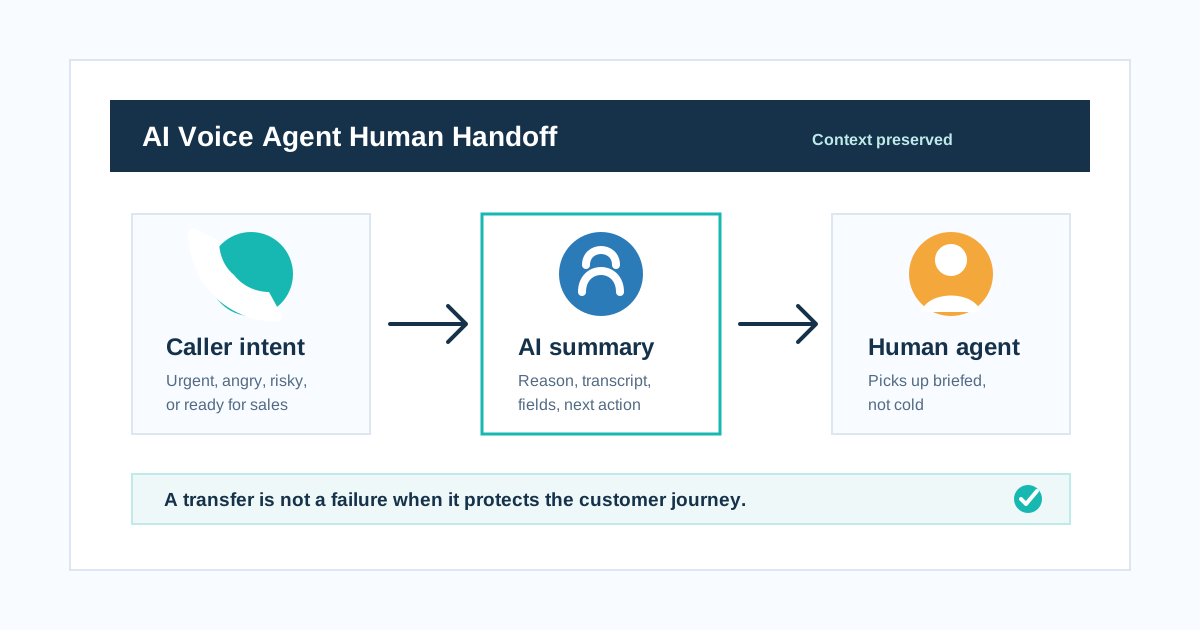
When Should an AI Voice Agent Transfer to a Human?
Short answer: An AI voice agent should transfer to a human when the caller asks for a person, when the issue requires human judgment, when confidence is low, when the customer is upset, when the workflow is regulated, or when a qualified lead is ready for a human closer.
A transfer is not a failure when it protects the customer journey.
That sentence matters because many businesses launch AI calling with the wrong ambition. They try to make the AI handle everything. Then they are surprised when callers lose trust, human agents receive poor context, and managers cannot tell whether transfers are good or bad.
The best AI voice systems do not hide humans. They know when to bring humans in.
The real question is not "Can the AI avoid transfer?"
The real question is: "Can the AI transfer at the right moment, to the right person, with the right context?"
What is human handoff in an AI voice agent?
Human handoff is the moment an AI voice agent moves a live conversation to a human agent, sales rep, support executive, clinician, counsellor, field team member, or manager.
In a weak handoff, the caller repeats everything.
In a strong handoff, the human receives the story before speaking.
| Weak handoff | Strong handoff |
|---|---|
| Caller is transferred cold | Human receives a summary |
| No reason is passed | Transfer reason is explicit |
| Human asks the same questions again | Human starts from the next useful question |
| AI disappears from the workflow | AI logs, tags, and updates systems |
| No fallback if no one answers | Callback, WhatsApp, ticket, or voicemail is created |
Zendesk's escalation guidance focuses on preparing the handoff by collecting useful information, updating workflow fields, and identifying the right agent before escalation. That is the correct principle for voice too: the AI should not simply escape the call. It should prepare the next person.
The best handoff line
Repeat this inside your operations team:
A transfer is not a failure when it protects the customer journey.
Transfer is a failure only when it is blind, late, unnecessary, or context-free.
When should AI transfer to a human?
Use clear handoff rules. Do not leave transfer only to the model's mood.
| Trigger | Why it matters | Example |
|---|---|---|
| Caller asks for a human | User preference should be respected | "Connect me to someone" |
| Low confidence | The AI may misunderstand or misroute | Address, payment, or policy confusion |
| High emotion | Human empathy may be needed | Angry refund request |
| Regulated decision | Human judgment or approval is required | Loan, healthcare, insurance, legal issue |
| High-value opportunity | Human closer can convert better | Enterprise buyer asks pricing |
| Tool failure | AI cannot finish the workflow | CRM, calendar, payment, or ticket API fails |
| Repeated fallback | The conversation is stuck | AI asks the same clarification twice |
| Safety concern | Risk is higher than automation benefit | Medical symptoms or fraud report |
| VIP customer | Relationship value is high | Key account, paid customer, premium lead |
| Caller language mismatch | AI cannot serve fluently | Regional language beyond configured support |
If a human would clearly do better from this point, transfer.
Cold transfer vs warm transfer
Most teams say "handoff" as if there is only one kind. There are actually different transfer patterns.
| Transfer type | What happens | Best use |
|---|---|---|
| Cold transfer | Caller is routed to a human or department with little context | Simple IVR-style routing |
| Warm transfer | AI summarizes the issue before or during transfer | Support, sales, healthcare, finance |
| Conferenced transfer | AI, human, and caller can all stay in the same call | Complex workflows where AI can keep taking notes |
| Callback handoff | AI schedules or creates a human callback | After-hours or no-answer situations |
| Ticket handoff | AI creates a support ticket with transcript and fields | Non-urgent support |
| WhatsApp handoff | AI sends confirmation, link, or summary on WhatsApp | India follow-up workflows |
Telnyx describes cold transfer, private warm transfer, and conferenced warm transfer as common voice AI handoff patterns. The buyer lesson is simple: ask your vendor which transfer patterns are actually supported, not only whether "human transfer" exists.
Why warm transfer usually wins
Warm transfer is valuable because the AI already knows the caller's context.
It may know:
- Who is calling
- Why they called
- What language they prefer
- Which order, lead, ticket, appointment, or payment is involved
- What the AI already asked
- What the customer answered
- Whether the customer is angry, confused, urgent, or ready to buy
- Which next step is recommended
If the human agent does not receive that context, the AI has wasted the caller's patience.
Warm transfer is not just a feature. It is respect.
The handoff context card
Every AI voice handoff should create a short context card.
| Field | Example |
|---|---|
| Caller | Priya Sharma, +91 mobile number |
| Language | Hindi and English mix |
| Intent | Wants to reschedule clinic appointment |
| Transfer reason | Customer requested receptionist after two slot options |
| Sentiment | Calm but time-sensitive |
| Summary | Asked for Saturday slot, prefers morning, cannot visit on Friday |
| Fields collected | Patient name, preferred date, phone number |
| AI actions tried | Checked available slots, offered 10:30 and 12:00 |
| Next best action | Confirm alternate Saturday slot or offer callback |
| Compliance note | No medical advice requested |
This card should appear in the CRM, support desk, live-call console, or internal dashboard. The human should not hunt through a long transcript while the caller waits.
The four handoff rules every AI voice agent needs
1. Respect explicit human requests
If the caller asks for a human, the AI can ask one clarifying question if needed, but it should not trap the caller in automation.
Good:
"Sure, I can connect you. Before I do, may I confirm your order number so the support team has the right context?"
Bad:
"I can help with that. Please tell me your issue again."
2. Transfer before trust is lost
Do not wait until the caller is angry. Repeated fallback, repeated interruption, and long silence are early signs.
Track:
- Two failed intent detections
- Two fallback replies in one call
- Customer says "you are not understanding"
- Long silence after AI response
- Caller repeats the same sentence
- Caller asks the same question again
These are not just conversation problems. They are handoff triggers.
3. Transfer to the right owner
Human handoff is not one queue.
| Caller need | Correct owner |
|---|---|
| Pricing question | Sales |
| Refund dispute | Support lead |
| Medical concern | Clinic staff or clinician |
| Loan issue | Collections or relationship manager |
| Real estate site visit | Sales executive |
| Technical bug | L2 support |
| Cancellation request | Retention or customer success |
LiveKit's handoff pattern frames this as routing by real-time intent rather than forcing callers through a rigid menu. That is exactly where AI voice is stronger than old IVR.
4. Always have a no-answer fallback
Many handoff flows fail because the human does not pick up.
Your AI should know what to do next:
| Situation | Fallback |
|---|---|
| Human unavailable | Offer callback |
| Office closed | Create ticket and send WhatsApp summary |
| Queue full | Capture urgency and promise timeline |
| Sales rep busy | Book a call slot |
| Support agent no answer | Route to backup queue |
| Emergency workflow | Use predefined escalation path |
Do not transfer a caller into silence.
India-specific handoff design
For Indian businesses, handoff design needs extra care because calls often mix language, urgency, network quality, and WhatsApp follow-up.
Track and design for:
- Hindi, English, Hinglish, and regional language switching
- Caller preference for WhatsApp confirmation
- Missed-call behavior
- After-hours callback expectations
- Mobile network drops
- Consent-sensitive workflows
- DND and promotional calling boundaries
- Sales teams using personal mobile numbers
- Branch-level routing by city or pincode
- Collections, healthcare, and education workflows where tone matters
Example:
An EdTech AI agent qualifies a parent in Hinglish, captures course interest, student class, exam target, budget range, and preferred call time. If the parent says "counsellor se baat karao," the AI should not keep pitching. It should transfer or schedule a counsellor call with a clean summary.
The handoff matrix by industry
| Industry | AI should handle | Human should handle |
|---|---|---|
| Healthcare | Appointment booking, reminders, clinic hours | Symptoms, medical judgment, angry patient |
| BFSI | EMI reminder, payment link, document reminder | Dispute, hardship, fraud, regulated advice |
| Real estate | Budget, location, site visit intent | Negotiation, premium buyer, complex project questions |
| Ecommerce | Order status, COD confirmation, return pickup | Refund dispute, damaged product escalation |
| EdTech | Lead qualification, demo booking, brochure follow-up | Parent counselling, scholarship negotiation |
| HR | Interview scheduling, document reminders | Salary negotiation, grievance, policy exception |
| Restaurants | Reservation, menu question, delivery status | Complaint, bulk order negotiation |
The AI should own repetition. Humans should own judgment, empathy, authority, and relationship moments.
What the AI should say before transfer
The transfer message should be short and honest.
Good examples:
- "I can connect you to a team member now. I will pass them the details you already shared."
- "This needs a support specialist, so I am transferring you with your order number and issue summary."
- "I have captured your preferred slot. I will bring in the receptionist to confirm availability."
- "I do not want to guess on this. Let me connect you to the right person."
Avoid:
- "Please hold forever."
- "I am unable to assist."
- "Transferring now" with no explanation.
- Pretending a human is available when no one is online.
What to measure after handoff
Handoff is not complete when the call leaves the AI. Measure the outcome.
| Metric | Why it matters |
|---|---|
| Transfer rate by intent | Shows which workflows need humans |
| Transfer reason | Separates good transfer from failure |
| Human answer rate | Shows whether routing works |
| Context card completeness | Shows whether humans get useful data |
| Caller repeat rate | Shows whether the issue was actually solved |
| Transfer-to-resolution time | Shows queue and human efficiency |
| Human rejection rate | Shows whether summaries are poor |
| Customer sentiment after transfer | Shows whether trust recovered |
| No-answer fallback rate | Shows capacity gaps |
| Cost per resolved transfer | Shows true economics |
A transfer dashboard should answer: was the transfer useful?
How to test AI voice handoff before launch
Run these scenarios before production.
| Test | Expected result |
|---|---|
| Caller asks for human immediately | AI confirms and transfers or schedules callback |
| Caller becomes angry | AI de-escalates and routes to human |
| Tool fails | AI explains simply and creates fallback |
| No human answers | AI offers callback or WhatsApp follow-up |
| Outside business hours | AI creates ticket or schedules next-day call |
| Wrong department requested | AI routes by actual intent |
| Hindi-English mixed call | Summary preserves language and meaning |
| High-value lead | AI transfers to sales with qualification fields |
| Regulated question | AI avoids risky advice and escalates |
| Repeat caller | AI passes previous context if available |
Do not test only the happy path. Handoff is where hidden production problems appear.
Buyer checklist for AI voice handoff
Ask these questions before choosing a platform:
- Does the AI support cold transfer, warm transfer, callback, and ticket handoff?
- Can it pass a structured context card to the human?
- Can it route by intent, language, branch, campaign, or customer type?
- Can it detect anger, repeated fallback, low confidence, and explicit human requests?
- Can it transfer only during business hours and use fallback after hours?
- Can it send a WhatsApp summary after the call?
- Can it log transfer reason in the CRM?
- Can managers listen to transferred calls and read summaries?
- Can the AI avoid giving regulated advice before escalation?
- Can you measure cost per resolved transfer, not just transfer count?
The simple rule
Use this decision rule:
If the AI can resolve the task correctly, continue.
If the AI can collect useful context before human help, collect it.
If the human can protect trust, safety, conversion, or compliance, transfer.
A transfer is not a failure when it protects the customer journey.
FAQ
When should an AI voice agent transfer to a human?
An AI voice agent should transfer when the caller asks for a human, when the issue requires judgment or approval, when the customer is angry, when the agent has low confidence, when a tool fails, or when a qualified lead is ready for human follow-up.
What is human handoff in AI voice agents?
Human handoff is the moment the AI routes a call to a human while preserving useful context such as intent, caller details, transcript, summary, sentiment, reason for transfer, and next action.
What is cold transfer vs warm transfer?
Cold transfer routes the caller with little or no context. Warm transfer gives the human a summary or introduction before they take over, so the caller does not have to repeat everything.
Is human transfer bad for AI automation?
No. Human transfer is bad only when it is avoidable, late, blind, or context-free. Good transfer improves trust, safety, conversion, and customer experience.
What should an AI voice agent pass to the human?
It should pass caller identity, language, intent, sentiment, summary, collected fields, transfer reason, what the AI already tried, compliance notes, and recommended next action.
How do you test AI voice agent transfer?
Test requested transfer, angry caller, low confidence, wrong department, after-hours, no-answer, tool failure, high-value lead, regulated question, and multilingual summary quality.
Final answer
AI voice agents should not be designed to avoid humans at all costs. They should be designed to use humans at the right moment.
The best AI handles repetition, qualification, routing, context capture, and follow-up. The human handles judgment, empathy, authority, and relationship-sensitive moments.
A transfer is not a failure when it protects the customer journey.
Related reading: What AI voice agent metrics should you track after launch?, How do you test an AI voice agent before it goes live?, Is AI calling legal in India?, and What makes a voice AI agent sound human?.
Practical worksheets and implementation guides
- What Happens When an AI Voice Agent Cannot Transfer a Call?
- How Should an AI Receptionist Handle an Angry or Unclear Caller?
For a call-leg worksheet and invoice checks, read AI warm transfer costs.
Put these ideas into production
Deploy AI voice agents in minutes and build outbound, inbound, and follow-up workflows on one platform.
Related Articles
What AI Voice Agent Metrics Should You Track After Launch?
Learn the AI voice agent metrics that matter after launch: task completion, containment, latency, transfer rate, tool-call accuracy, sentiment, cost per resolved call, and failure reasons.
How Do You Test an AI Voice Agent Before It Goes Live?
A practical AI voice agent testing checklist for teams preparing to launch real customer calls. Learn how to test latency, Hindi and Hinglish conversations, interruptions, tool calls, handoff, and production readiness.
Is AI Calling Legal in India? Consent, DND, Recording, and TRAI Checklist
A practical India compliance checklist for AI voice agents covering consent, DND, UCC, DLT, call recording, DPDP data protection, WhatsApp follow-ups, and safe human handoff.
What Makes a Voice AI Agent Sound Human? Latency, Turn-Taking and Indian Accents
Learn what makes AI voice agents sound human: latency optimization, natural turn-taking, emotional intelligence, and handling Indian accents and Hinglish. Technical guide for building natural voice AI.
What Does an AI Warm Transfer Cost? Call Legs, Hold Time and Recordings
Calculate AI warm-transfer costs with a worked call-leg budget, hold-time sensitivity, failed handoff checks and a recording and invoice worksheet.