One Model or Several? Routing LLMs for Different AI Phone-Call Tasks
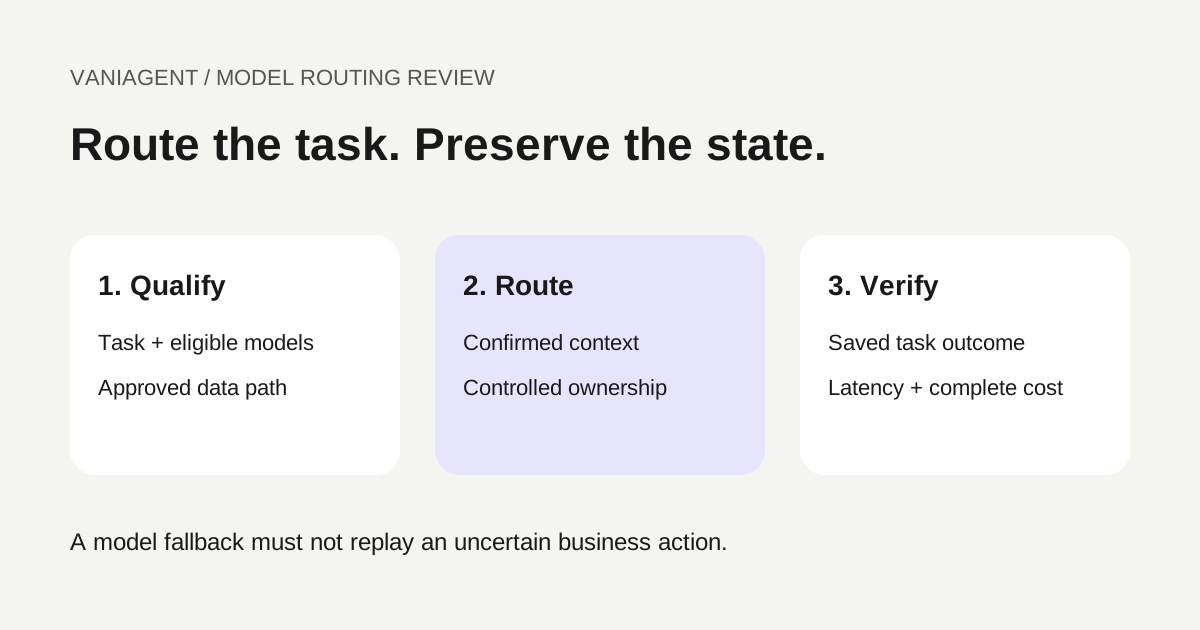
Use one model when it reliably meets your phone workflow's requirements; add model routing only for a measured task or operational benefit. A multi-model design should have explicit eligibility rules, preserved conversation state and one controlled authority for business actions. Sending a difficult turn to another model does not repair missing information or an uncertain booking write.
This guide provides a routing policy worksheet, a fictional cost comparison and acceptance tests. It does not claim that VaniAgent currently offers every routing option described here, or that any named model is universally best.
For the broader selection process, start with best LLMs for AI voice agents in India. For audio architecture, see speech-to-speech versus STT–LLM–TTS for Hindi phone agents.
Distinguish task routing from switching during a call
A system can assign one model to the whole call, select a model for each stage or use a separate post-call service. These designs have different state and latency requirements.
| Design | What to evaluate |
|---|---|
| One model per call | Simpler context ownership and a clear baseline |
| Model selected at task entry | Consistent handling within a defined task |
| Per-turn routing | Routing delay, context transfer and correction handling |
| Separate post-call analysis | Delayed results and independent review permissions |
| Availability fallback | Behaviour and state preservation during failure |
Do not confuse routing to another model with transferring a live customer to staff. A model switch can remain inside the same call but still change behaviour, data recipients or available tools. Make those changes explicit in the implementation review.
What managed routing documentation establishes
Amazon Bedrock's intelligent prompt routing documentation, checked on 16 October 2026, describes routing among supported models with criteria, regional availability and fallback configuration. Its product scope is not unrestricted routing among every provider or a guarantee of voice-task accuracy.
Google Cloud's model-routing overview documents constraints for its supported deployed model endpoints. Review the actual interface and hosting restrictions before assuming a router can swap your live audio session between arbitrary services.
These are examples of routing capabilities, not benchmark evidence. Application-level task routing also needs business authorization, state handling and route-specific evaluation that a generic endpoint selector does not provide by itself.
Define tasks before defining model tiers
List the caller's tasks and the evidence needed to complete each one. Avoid labels such as easy and hard until they correspond to testable requirements.
| Task | Acceptance requirement | Candidate routing approach to test |
|---|---|---|
| Approved FAQ | Correct applicable source and honest uncertainty | Validated low-latency route |
| Branch or service clarification | Final confirmed fields preserved | Route tested for corrections and language mix |
| Booking request | Authorized parameters and verified saved result | Tool-capable route with application controls |
| Disputed policy or exception | No invented approval | Staff escalation or approved review path |
| Post-call summary | Faithful, necessary content and data controls | Separate asynchronous route if justified |
A price question can look short while requiring current branch terms and tax or setup context. A lengthy caller statement may need only a clarification. Message length alone is a weak substitute for the task and its consequences.
Keep mandatory eligibility outside the model selector
Before routing, check which models are approved for the task, language, data location and required tool interface. A cheap or available endpoint is not automatically an eligible destination.
Use an allowlist and a defined blocked state when no candidate qualifies. A router should not introduce a new provider during an incident without the necessary review. Use the voice-agent data-flow template to include primary and fallback recipients.
Keep tool authorization in the application. Selecting a more capable model should not grant access to another customer's records, additional CRM permissions or a new payment action. Required business checks remain the same across routes.
Preserve confirmed state when changing routes
Pass the minimum necessary approved context: the caller's current request, verified identity scope, confirmed branch and service, corrections and actual tool results. Do not rely only on a fluent generated summary if it can omit a consequential correction.
Maintain a task identifier and an active owner or equivalent execution control. When an older model response arrives after a switch, it must not speak over the current agent or execute an obsolete action.
Keep pending actions distinct from completed ones. A context line saying “booking attempted” must not become “booking confirmed” in the next model's response. Verify authoritative state using the CRM integration guide.
Handle uncertainty before escalating model size
If a price source is missing, another model cannot establish the current price by guessing. If the caller omits AM or PM, clarification may be better than a more expensive inference. If a tool fails, the recovery belongs to the workflow.
Use model confidence only after calibrating it against labelled task outcomes. A self-reported high score does not establish correctness. Record why routing occurs and check whether the selected route actually improves that category.
Distinguish customer ambiguity, missing source information, provider outage and model failure. Each should have its own response rather than a universal “try the larger model” policy.
Design fallback around action safety
Suppose a booking request times out after the application submits it. The original write may have succeeded. Replaying the same request through another model can create a second appointment.
The recovery should inspect saved state or use a supported duplicate-prevention mechanism before another write. Preserve the original action reference and uncertainty. See the double-booking prevention guide.
For model-generation failure before any business action, a fallback may be simpler, but it still needs bounded retries, compatible context and a permitted data path. Avoid fallback loops that consume the caller's time without making progress.
Calculate routing overhead, not just model savings
The following is a fictional request-level cost example, not supplier pricing or a VaniAgent quote. Assume 1,000 evaluated requests, with comparable scoped context: 800 go to route A at Rs 0.20 each and 200 to route B at Rs 1 each. The router costs Rs 0.05 per request.
| Component | Fictional calculation | Cost |
|---|---|---|
| Route A | 800 × Rs 0.20 | Rs 160 |
| Route B | 200 × Rs 1 | Rs 200 |
| Routing | 1,000 × Rs 0.05 | Rs 50 |
| Subtotal before retries | Sum | Rs 410 |
If 50 additional fallback requests to B cost Rs 1 each, the subtotal becomes Rs 460. Under these invented assumptions, sending all 1,000 primary requests to B costs Rs 1,000, while sending all to A costs Rs 200. Neither baseline is a valid winner until it meets the same quality and service requirements.
This model excludes carrier, speech, storage, tool and operating costs. Real token lengths, caching, audio units and failed requests can differ between routes. Do not apply a request-level saving percentage to the complete telephone bill.
Compare cost per verified task, including staff recovery and failed attempts. A cheaper request that produces more rework may make the complete service more expensive.
Measure latency and Hindi performance by route
Include routing time, context preparation, fallback and playback in caller-facing measurements. Report simple replies separately from tool-dependent turns, and show tail latency rather than only the fastest example.
Use the same intended telephone path and permitted Hindi/Hinglish task set. Include corrections, negation, local names and interrupted turns. A text-model benchmark does not establish performance after speech recognition and telephone playback.
Use the Hindi task-evaluation method and latency measurement guide. For native-audio candidates, verify which transitions the interface actually supports before proposing per-turn swaps.
Evaluate the router as well as its models
First test each eligible candidate on the relevant task categories. Then test the routing policy on held-out cases. A good model pool can still perform poorly if the router sends consequential tasks to an unsuitable route.
Record route selection, reason, model version, task outcome, timing, cost and fallback. Inspect misroutes and unflagged failures. Do not treat a high routing-confidence score as ground truth.
Compare against the validated single-model baseline with equivalent scope. Use mandatory safety and action requirements as gates before optimizing preferences. Keep sample size, language mix and unresolved evidence visible.
Run these acceptance scenarios
- Short but consequential price question uses an approved current source.
- Caller changes branch after an earlier route decision; final fields remain correct.
- No model is eligible for the data policy; the system blocks or escalates.
- Model generation fails before action; fallback preserves confirmed context.
- Tool response is uncertain; no duplicate write is issued by another route.
- An obsolete response arrives after switching; it cannot speak or act.
- Router and primary model both fail; retries remain bounded.
- Hindi clarification and interruption cases preserve the final task.
- Post-call analysis cannot overwrite verified business facts without controls.
- Route logs identify the configuration used without exposing secrets.
Use fictional records first and verify saved outcomes. A dashboard showing two available models is not proof that stateful live-call routing is safe or useful.
Launch a narrow routing policy and review it
Start with one justified distinction, such as a separately evaluated post-call analysis route, rather than switching every turn. Define rollback to the approved baseline and monitor the affected cohort.
Use the hallucination monitoring plan to separate source, recognition, generation and tool failures. Revalidate when models, prompts or routing rules change.
The decision is not how many models can be connected. It is whether the routing policy delivers a verified improvement while preserving the caller's task, action safety and operating requirements.
Frequently asked questions
Should an AI phone agent use one model or several?
Start with a validated single-model baseline. Add routing only when a distinct task or reliability requirement justifies the extra complexity and the routed design improves verified outcomes, latency or complete cost under comparable tests.
What is the difference between model routing and fallback?
Routing chooses an eligible model for a task or request under a policy. Fallback handles an unavailable or unsuitable route. Neither should bypass authorization, replay an uncertain business action or silently expand data-sharing scope.
Can a cheaper model handle every simple phone question?
Not automatically. Apparent simplicity can conceal consequential prices, negation or an unclear request. Validate task-specific accuracy and uncertainty handling; do not route solely by message length or an uncalibrated confidence score.
Should a failed booking be retried on a stronger model?
First inspect the actual booking state. A lost response can follow a successful write. Switching models and repeating the action can create duplicates. Keep recovery controlled by the application and verified business records.
Can models share a conversation automatically?
No assumption of shared state is safe. The application must provide the necessary approved context, confirmed fields and actual tool results, while preserving ownership and preventing obsolete outputs or actions.
Does multi-model routing always lower cost?
No. Routing calls, larger context, failed attempts, fallback and maintenance can outweigh lower generation prices. Compare the complete cost per verified task rather than only the selected model’s advertised rate.
Review your model-routing scope
Bring your task categories, approved model destinations and acceptance criteria to a scoped VaniAgent demonstration. Confirm supported routing and compare it with a validated baseline before enabling live model switches.
Put these ideas into production
Deploy AI voice agents in minutes and build outbound, inbound, and follow-up workflows on one platform.
Related Articles
Which LLM Is Best for AI Voice Agents in India?
Compare GPT, Gemini, Claude, and open models for AI voice agents in India. Learn how to choose models for latency, Hindi and Hinglish, tool calling, cost, reliability, and production routing.
Speech-to-Speech vs STT–LLM–TTS for Hindi Phone Agents
Compare native audio and STT–LLM–TTS for Hindi phone agents using task accuracy, interruptions, tool reliability, latency, cost and a decision worksheet.
How to Monitor AI Voice-Agent Hallucinations After Launch
Monitor voice-agent hallucinations with a review rubric, random and targeted sampling, tool-result verification, honest error rates and regression tests.
Map Where Your Voice-Agent Data Goes: A Vendor Review Template
Map voice-agent audio, transcripts, model requests, CRM writes and backups with a vendor-review worksheet, evidence labels and change-control checklist.