AI Calls for EdTech Demo-Class Follow-Up: Attendance to Counsellor Handoff
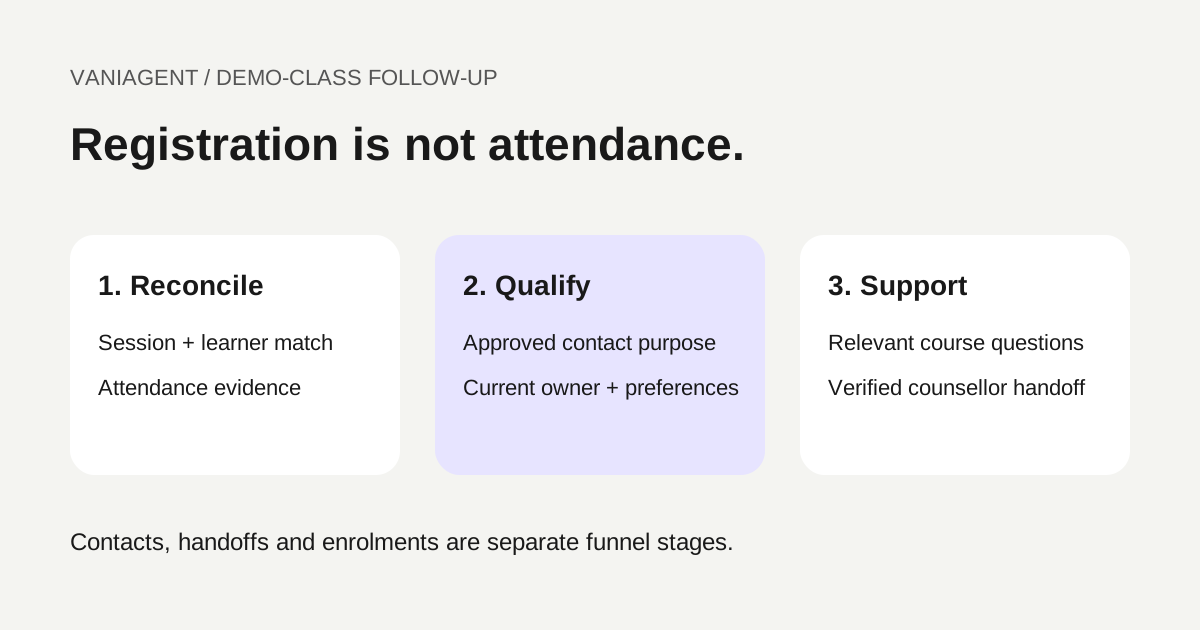
AI demo-class follow-up should start from verified session evidence and a permitted contact purpose, then help the learner reach the next useful step. A registration is not attendance, an answered call is not interest and a counsellor request is not a completed enrolment.
The narrow workflow is to ask about unresolved questions, explain approved course information and arrange the appropriate counsellor support. It should not pressure learners through fabricated deadlines or unsupported outcome promises.
This guide provides a proposed attendance-to-handoff design, a record worksheet and a fictional funnel example. It does not establish a verified VaniAgent LMS integration or measured conversion improvement. For the broader use case, see EdTech voice agents in India.
Build the cohort from the actual session
Identify the demo occurrence, course, batch, date and intended audience. Recurring meetings can reuse a link, so a generic meeting identifier may not distinguish this week's class from a previous one.
Separate registration, joined session, participation duration and any provider-defined completion threshold. A staff-reviewed attendance record may be appropriate for classroom demos, while online platforms can expose different evidence.
Zoom's Meetings API reference, checked on 16 October 2026, documents participant reporting and notes that leaving and rejoining can produce separate participant objects. Reconcile the actual identifiers and intervals; do not count each row as a different learner or sum overlapping presence blindly.
Platform evidence does not prove attention, comprehension or satisfaction. Describe the observed participation accurately rather than saying the learner completed the lesson because a device joined briefly.
Resolve identity and ambiguous attendance
A display name is not always a stable learner identifier. Shared devices, guest joins, alternate emails and a parent registering for a child can make matching uncertain.
Use the organization's approved identity mapping between registration, participation and CRM records. Keep unresolved joins separate from confirmed absence. If evidence is uncertain, the follow-up should ask neutrally whether the person was able to attend, rather than asserting attendance.
Do not merge two learners' histories because they share a family number. Establish the intended contact and appropriate disclosure under the institution's process. Where children or guardians are involved, have the responsible team approve the contact and data-handling workflow before automation.
Check eligibility before creating calls
TRAI's consent guidance describes permission for communications related to a specified purpose. The responsible education provider and access provider should confirm classification, applicable requirements and the evidence needed for the proposed follow-up.
A demo registration should be interpreted within what was actually collected and disclosed. Do not treat it as indefinite permission for every course campaign. Recheck opt-outs, contact timing, previous handling and current task state at dispatch.
Use the lead-list preflight checklist to preserve provenance and exclude unresolved or suppressed records. A student already speaking with a counsellor should not automatically receive a competing automated sales call.
Maintain an attendance-to-follow-up worksheet
| Field | Why it matters |
|---|---|
| Demo occurrence and course reference | Identifies the correct session |
| Learner or authorized contact reference | Avoids number-only identity assumptions |
| Registration source | Preserves provenance and stated purpose |
| Attendance evidence and matching status | Separates attended, absent and unresolved |
| Contact eligibility reference | Links approved purpose and current preferences |
| Current counsellor owner | Prevents competing outreach |
| Approved question or next-step category | Keeps the conversation scoped |
| Callback or transfer reference | Tracks the actual handoff action |
| Final business outcome and timestamp | Supports a meaningful funnel |
Keep the dataset minimal. The calling workflow rarely needs complete class recordings, unrelated assessment history or private family notes. Use the voice-agent data-flow template to trace exports and model context.
Use different conversations for different states
| Verified state | Appropriate opening focus |
|---|---|
| Attended the scoped demo | Ask whether there are course questions needing help |
| Missed the demo | Offer approved rescheduling or information options |
| Brief or uncertain participation | Ask neutrally whether they could attend |
| Already assigned to a counsellor | Respect ownership and the approved next action |
| Already enrolled or task closed | Suppress the obsolete follow-up |
| Withdrew contact permission | Apply suppression, including pending retries |
Avoid “You enjoyed the demo” or “You are ready to enrol” unless the person actually said so and the record supports the statement. Attendance alone is not sentiment or purchase intent.
An illustrative attendee opening is: “I'm following up on your course demo enquiry. Are there any questions you would like our counsellor to help with?” Adapt it to the approved identity and notice requirements.
Answer routine questions from current sources
Keep course duration, mode, batch and fee terms linked to the exact approved record. If a learner switches courses during the call, reload the relevant information rather than carrying over the earlier offer.
Use the course-fee answer guide for totals, instalments and discounts. Do not grant scholarships, waive terms or promise job outcomes because a learner seems interested.
For disputes or exceptions, preserve the question and route to an authorized counsellor. The agent should distinguish an approved public explanation from a personalized decision it cannot make.
Make counsellor handoff an actual action
Define supported staff destinations, hours, languages, no-answer outcomes and callback rules. The handoff should include the approved course reference and unresolved question, without unnecessary personal content.
If the learner asks for a callback, confirm their preferred time under the supported scheduling process. Save and verify the request before saying it is arranged. Do not promise an immediate call if the staff team has not accepted that service level.
A live transfer needs evidence that the intended staff route connected, not merely that a transfer command was issued. Use the human handoff guide and admissions call-routing guide for ownership and fallback.
Handle late data and repeated events
Attendance reports can arrive after a call job was initially prepared. Decide whether to wait for a defined reconciliation point, use a neutral script or hold ambiguous cases for staff. Do not label pending evidence as no-show automatically.
Deduplicate by the logical learner–session follow-up task under the approved policy. A repeated import or a rejoin event should not create another call. Preserve the source record while maintaining a clear current task state.
Before a retry, check whether a counsellor has already handled the enquiry, enrolment has been completed or contact permission has changed. A stale queue must not restart a closed conversation.
Test with fictional learner records
- Registration exists but no reconciled attendance evidence: no unsupported attendance claim.
- Learner leaves and rejoins: one logical follow-up, not two learners.
- Shared number maps to two learners: no silent identity merge.
- Attendance report arrives late: defined reconciliation behaviour.
- Learner says they missed the session: approved missed-demo path.
- Course changes during the call: correct catalogue and counsellor route.
- Fee record is stale: no invented discount or total.
- Counsellor is unavailable: honest fallback and verified callback state.
- Opt-out arrives after scheduling: pending attempts stop appropriately.
- Enrolment completes before retry: obsolete follow-up is suppressed.
Inspect CRM and handoff records alongside the transcript. A friendly call that creates duplicate requests or misstates attendance should fail acceptance.
Measure a funnel with clear denominators
Suppose a fictional class has 200 registrations. The review identifies 120 matched attendees, 60 confirmed non-attendees and 20 unresolved records. Separately, 100 of the matched attendees meet the approved follow-up eligibility rules.
| Follow-up stage | Fictional count |
|---|---|
| Eligible attendees in this scoped cohort | 100 |
| Unique people attempted | 90 |
| Verified contacts | 60 |
| Counsellor requests | 25 |
| Completed counsellor handoffs within observation window | 20 |
| Verified enrolments within observation window | 8 |
These counts are invented and do not predict performance. In this example, verified contact rate among attempted people is 60/90 = 66.7%. Completed handoffs among counsellor requests are 20/25 = 80%. Enrolments among eligible cohort members are 8/100 = 8%.
Each denominator answers a different question. Do not divide eight enrolments by the entire registration list and compare it with another campaign reporting only reached learners. Show unresolved records, exclusions and the observation period.
Enrolments after calls do not by themselves establish that AI caused them. Use comparable cohorts or a suitable controlled evaluation and include staff workload, duplicate contact, withdrawals and complaints in the review.
Launch a scoped cohort before scaling
Begin with one demo occurrence, approved source records and a tested counsellor fallback. Review the actual attendance mapping, conversation and saved outcomes before increasing volume.
Automate reconciliation, suppression and task-state checks where the integration supports them. Keep course promises, eligibility decisions and exceptions with authorized people. The useful follow-up is one that respects the learner's state and gets the right question to the right counsellor.
Frequently asked questions
How can AI follow up after an EdTech demo class?
Use verified session participation and current contact eligibility to select a scoped conversation. Ask about unresolved questions, use approved course information and offer an authorized counsellor handoff or callback. Verify saved outcomes rather than treating an answered call as enrolment.
Does registering for a demo mean the student attended?
No. Registration, joining, attendance duration and completion are separate signals. Use the actual platform or staff record and mark ambiguous matches as unresolved.
Can the bot call everyone who registered?
Not automatically. Confirm the actual contact purpose, collected evidence, current preferences, identity and applicable requirements before scheduling. Recheck suppression and task status before dispatch.
What should happen when the student says they missed the demo?
Use the approved missed-session path, such as offering a verified alternative session or staff help. Do not continue a script claiming they attended or enjoyed a class they did not take.
Should AI promise a discount or placement during follow-up?
Only approved, applicable information may be explained. The workflow should not invent offers, scholarship eligibility, admission guarantees or job outcomes to persuade the learner.
How should demo-class follow-up performance be measured?
Report the eligible cohort, attempts, verified contacts, counsellor requests, completed handoffs and authoritative enrolments separately. State the observation period, exclusions and attribution limitations.
Scope a demo follow-up pilot
Bring your attendance source, approved contact rules and counsellor destinations to a scoped VaniAgent demonstration. Verify matching and saved handoff outcomes using fictional records before authorizing live outreach.
Put these ideas into production
Deploy AI voice agents in minutes and build outbound, inbound, and follow-up workflows on one platform.
Related Articles
AI Voice Agents for EdTech in India: Admissions, Counselling, and Follow-Up
How EdTech platforms and coaching institutes in India can use AI voice agents for student enquiries, admissions follow-up, counselor callbacks, fee reminders, and course engagement—with clear human handoffs.
How Can EdTech Voice Agents Answer Course-Fee Questions Accurately?
Answer EdTech course-fee questions with approved records, total-price and instalment checks, discount controls, tax scope and a practical test matrix.
AI Admissions Counselling Calls: Route Enquiries Without Promising Admission
Route admissions enquiries using approved course facts, caller preferences and saved counsellor callbacks, with a course-fact and routing worksheet.
How to Check a Lead List Before an AI Calling Campaign
Check AI calling lead lists for provenance, permission evidence, phone formatting, duplicates, suppression and task eligibility with a preflight worksheet.