How Can EdTech Voice Agents Answer Course-Fee Questions Accurately?
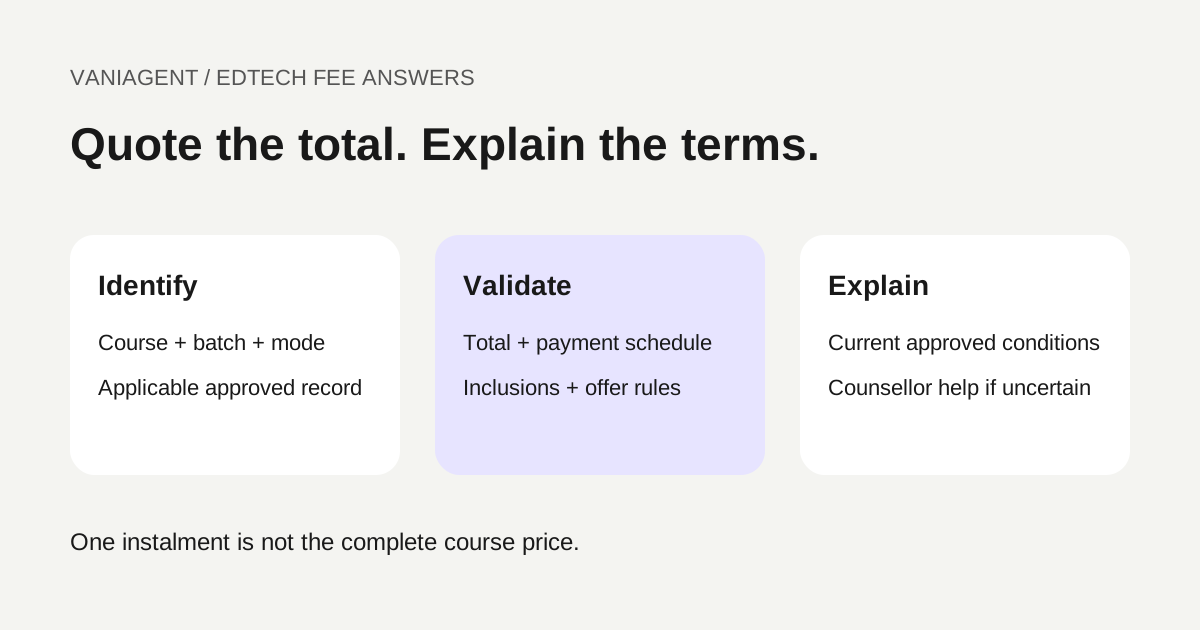
An EdTech voice agent should answer fee questions from an approved record for the exact course, batch and delivery mode. It must distinguish the total payable from a registration amount, instalment or financing payment, and preserve applicable conditions rather than quoting the lowest visible number.
Course fees can vary across online and classroom delivery, locations, intake dates and approved offers. A fluent answer from an outdated brochure can mislead a student even when the amount once appeared on the website.
This guide provides a proposed fee-data template, fictional arithmetic examples and acceptance tests. It does not publish real course prices or claim a particular VaniAgent integration already supports every control. Start with our EdTech voice-agent guide for India.
Confirm which course the caller means
Resolve the course name, delivery mode, batch or intake, and location where relevant. Ask a short clarification when a brand uses similar names for different packages.
“The data course” might refer to a short introductory class or a longer certificate programme. “Weekend batch” may identify a schedule rather than a unique product. Map the confirmed request to an approved course identifier before retrieving a price.
Do not infer the desired course from a previous enquiry without checking the caller's current intent. If the caller changes mode or batch, reload the fee record and any offer conditions instead of reusing the earlier amount.
Maintain a structured fee record
| Field | Why it matters |
|---|---|
| Course and package ID | Distinguishes similar course names |
| Batch, mode and location | Defines applicability |
| Currency and base fee | Establishes the quoted unit |
| Included and additional components | Covers materials, exams or other relevant charges |
| Tax treatment | States whether applicable tax is included or additional |
| Registration and deposit | Identifies whether they count toward the total |
| Instalment schedule | Number, amount, due conditions and total |
| Offer reference and eligibility | Controls discount scope |
| Effective period and timezone | Prevents stale or premature offers |
| Exit and refund policy reference | Links the applicable approved terms |
| Owner, version and fallback | Supports updates and unresolved enquiries |
These fields need business approval. The engineer can validate completeness and arithmetic, but should not invent tax treatment, offer eligibility or refund rights. Use the information-maintenance guide for approval and publication controls.
Keep marketing claims within reviewed scope
The CCPA's 2024 coaching-sector advertising guidelines address misleading claims within their scope, including course fees and exit or refund policies. The official PIB announcement explains their consumer-protection purpose. These sources were reviewed on 16 October 2026.
Have the provider's responsible team confirm applicability and current obligations for its offerings and communications. A voice script should not make unsupported selection, job, salary or admission guarantees while discussing fees. Public guidelines do not certify a vendor or establish one universal refund rule for every course.
Explain the total and the payment schedule separately
Suppose a fictional course has a total price of Rs 30,000, with the approved record stating that all applicable components and tax are already included. Its payment schedule is Rs 5,000 on registration plus five instalments of Rs 5,000.
| Component | Fictional calculation |
|---|---|
| Registration payment credited toward the total | Rs 5,000 |
| Remaining instalments | 5 × Rs 5,000 = Rs 25,000 |
| Total payable | Rs 30,000 |
The registration payment is not another Rs 5,000 on top. If the actual provider charges a separate registration fee, the record must say so and the total changes. Never assume the same treatment across courses.
An accurate example answer is: “The total is Rs 30,000 under this payment schedule: Rs 5,000 at registration and five further payments of Rs 5,000.” Calling the programme simply “Rs 5,000” would hide the commitment.
These are invented educational figures, not market rates or a VaniAgent offer. Use the provider's approved invoice and payment terms for real answers.
Validate discounts and scholarships explicitly
An offer needs a reference, applicable course, validity period, eligibility and combination rules. The agent should not grant a discount because the caller says another counsellor offered one.
For a fictional ten-percent discount applied to a Rs 30,000 eligible course price, the reduction is Rs 3,000 and the resulting total is Rs 27,000. That calculation alone does not establish whether registration, tax or instalments change. The approved offer must define the resulting schedule.
Keep scholarships and negotiated exceptions on their authorized review path. The agent can collect an approved request or arrange counsellor assistance without announcing acceptance. Do not convert a possible scholarship into a guaranteed lower price.
Distinguish provider instalments from external financing
A provider payment schedule and a third-party loan or financing product can have different terms and responsibilities. Do not label every monthly amount an instalment of the course price without checking the arrangement.
Use the authorized financing disclosures and staff process where applicable. The general course-fee agent should not invent interest, approval eligibility or a zero-cost financing claim. Explain which team can verify the option rather than giving a personalized financial recommendation.
Keep course price and financing cost separate in the data model. A loan repayment amount does not by itself establish the full course commitment or all financing charges.
Handle tax and extra charges from approved facts
Do not automatically apply a tax rate to every education service. Use the specific approved treatment, inclusion wording and invoice structure. If tax information is missing, route the quote for confirmation instead of generating a plausible total.
Likewise, identify what the package includes: materials, exams, certificates, support or other relevant items. Optional items should remain optional in the quote; mandatory additional charges should not disappear from the total explanation.
Test the caller asking “Is that everything I need to pay?” The answer should reflect the applicable record and its limits, not a general promise of no further charges.
Resolve stale advertisements and conflicting records
When a caller mentions a different advertised price, capture only the necessary context: course, batch, publication or offer reference and relevant date. Check approved applicability rather than assuming either source is wrong.
If an old offer no longer applies, explain the verified current terms without manufacturing an exception. If an existing quote has separate validity rules, use those approved rules. Unresolved cases should reach a counsellor with the conflict visible.
Updating a website does not prove the agent's source has refreshed. Retell's knowledge-base documentation describes source and ingestion status fields for its platform. Use that as an example of the publication checks to request, not a guarantee of instant updates across providers.
Keep refund answers linked to the actual policy
Identify the course, enrolment context and applicable policy version before explaining exit terms. Do not infer the student's entitlement from a generic FAQ or an unrelated platform's credit policy.
The voice agent can explain approved information within scope and offer the authorized request process. It should not reject a disputed refund, promise a refund amount or waive conditions without the appropriate authority and verified facts.
Separate policy explanation, request submission and the final decision. A saved support ticket is not proof that a refund has been approved or paid.
Test these fee-answer scenarios
| Case | Expected outcome |
|---|---|
| Same course name, different modes | Clarify and retrieve the correct record |
| Registration credited toward total | No double counting |
| Separate mandatory component | Included in the approved total explanation |
| Expired discount | No unauthorized offer |
| Caller claims a scholarship | Authorized review rather than automatic approval |
| Missing tax field | Staff confirmation, not an invented percentage |
| Instalment schedule disagrees with total | Block or review the conflicting quote |
| Caller changes batch | Revalidate price and offer applicability |
| Old advertisement is disputed | Preserve conflict and route appropriately |
| Refund exception requested | Follow the approved decision process |
Use fictional records first. Inspect the retrieved source, arithmetic, spoken answer and any written follow-up. A correct phone quote can still be undermined by a stale message template sent afterward.
Measure accuracy rather than persuasive fluency
Review course identification, total-price correctness, conditions disclosed, unauthorized discounts and appropriate escalation. Track source version and unresolved cases with the sample period.
Use the hallucination monitoring method to compare answers with approved facts valid at call time. A conversion increase does not excuse a misleading quote, and a pleasant conversation is not evidence of accurate terms.
Start with a small approved catalogue and an obvious counsellor fallback. Expand only after source updates, fee arithmetic and offer conditions remain correct across the tested questions and channels.
Frequently asked questions
How can an EdTech voice agent answer course-fee questions accurately?
Identify the exact course, batch, delivery mode and location, then retrieve the applicable approved fee record. State inclusions and conditions, clarify instalment versus total price and escalate missing or conflicting information rather than guessing.
Can the agent offer a discount to close an enquiry?
Only within an explicitly approved offer and eligibility process. A caller’s request, old brochure or agent-generated promise is not authorization to change fees or grant a scholarship.
Is the monthly instalment the course price?
No. Explain the approved total payable, number and amount of instalments, upfront components and any applicable financing terms. Do not present one instalment as the complete price.
Should the bot apply 18% GST to every course?
No blanket tax assumption is appropriate. Use the applicable tax treatment and inclusion wording approved for the specific course and provider. Escalate when the source is missing or unclear.
What if a caller quotes a different price from an advertisement?
Identify the course and offer context, check the approved current and historical applicability rules, and route unresolved conflicts to staff. Do not dismiss the advertisement or promise to honour it without authority.
Can the AI decide a refund request?
It can explain an approved applicable policy within scope, but individual decisions and exceptions should follow the authorized process. Do not copy another business’s no-refund wording into course advice.
Review your course-fee workflow
Bring your approved catalogue, payment schedules and offer rules to a scoped VaniAgent demonstration. Test fictional fee records and the counsellor fallback before automating student enquiries.
Put these ideas into production
Deploy AI voice agents in minutes and build outbound, inbound, and follow-up workflows on one platform.
Related Articles
AI Voice Agents for EdTech in India: Admissions, Counselling, and Follow-Up
How EdTech platforms and coaching institutes in India can use AI voice agents for student enquiries, admissions follow-up, counselor callbacks, fee reminders, and course engagement—with clear human handoffs.
AI Admissions Counselling Calls: Route Enquiries Without Promising Admission
Route admissions enquiries using approved course facts, caller preferences and saved counsellor callbacks, with a course-fact and routing worksheet.
How to Keep an AI Receptionist’s Prices, Hours and FAQs Up to Date
Maintain AI receptionist information with approved sources, effective dates, holiday overrides, refresh checks, conflict handling and update acceptance tests.
How to Monitor AI Voice-Agent Hallucinations After Launch
Monitor voice-agent hallucinations with a review rubric, random and targeted sampling, tool-result verification, honest error rates and regression tests.