How to Check a Lead List Before an AI Calling Campaign
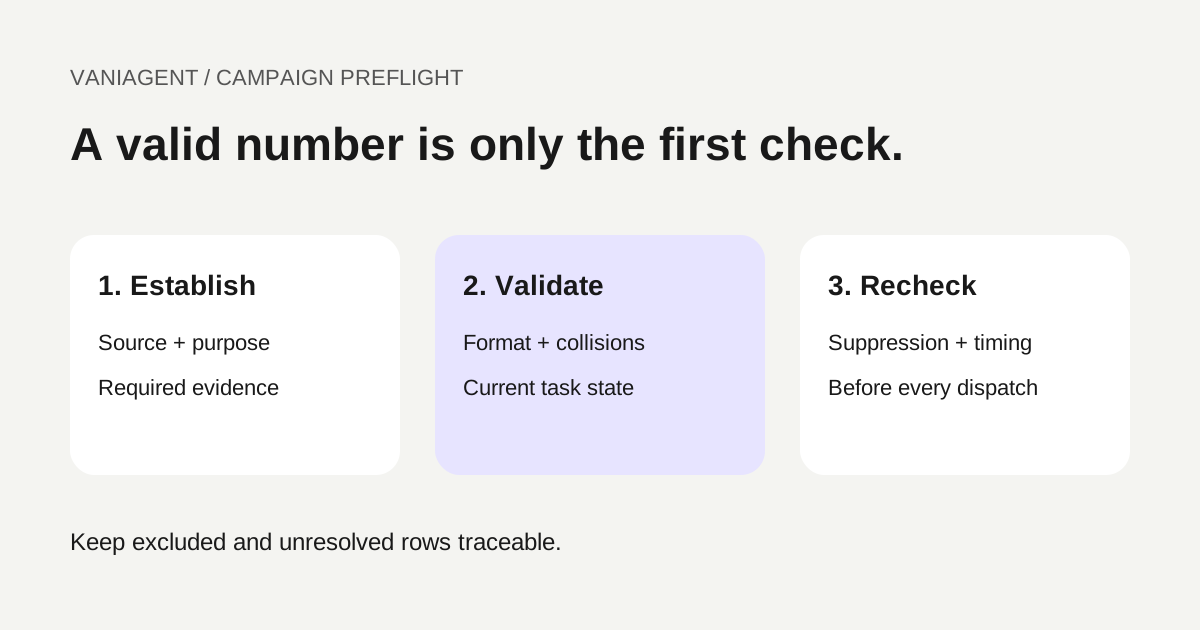
Before an AI calling campaign starts, separate technically usable numbers from people eligible for that specific outreach. Validate the source, purpose, required permission evidence, duplicates, suppression and current task status. Then recheck changeable conditions at dispatch so a clean export does not become a stale dialing list.
This guide provides a proposed preflight workflow and a fictional reconciliation example for Indian business teams. It does not validate any real lead file or authorize calls. For the broader use case, see our AI calling agent guide for Indian sales teams.
Start with the purpose and the sender
Write down who is calling, why, through which channel and what outcome is permitted. A requested callback, an appointment update and a promotional campaign are different tasks. Do not apply one generic “consented” field to every future use of a contact.
TRAI's advice to senders, consent guidance and preference-registration page describe commercial communication, purpose-specific consent and consumer preferences. These references were checked on 16 October 2026. Have the responsible team and access provider determine the actual classification, registration, consent, preference-scrubbing and routing requirements for your campaign.
A spreadsheet check cannot certify legal compliance. Do not treat absence from an internal opt-out list, a publicly visible number or an existing CRM record as universal permission. Keep the approval and evidence required by the actual workflow visible.
Preserve the input before cleaning it
Keep a controlled source snapshot, import reference and stable row identifiers. Record where the file came from, who supplied it and when it was exported. Avoid unnecessary copies containing personal data.
Produce a separate normalized view and a decision report. That allows staff to trace an excluded row without changing the original phone value or silently merging histories. Do not use cleanup as an opportunity to overwrite campaign outcomes, billing or customer records.
If the source lacks permission or provenance fields, mark the gap. Do not fill missing evidence with an assumed default of yes.
Use this preflight record template
| Field | What it establishes |
|---|---|
| Source and row reference | Provenance and traceability |
| Customer or lead ID | Stable business identity |
| Original and normalized phone | Reproducible destination parsing |
| Country context | Required interpretation for local-format numbers |
| Purpose and sender | Specific intended outreach |
| Eligibility evidence reference | Applicable consent or other approved basis and review |
| Withdrawal and suppression state | Current exclusions |
| Task status | Whether the intended action is still needed |
| Attempts and last contact | Retry and frequency controls |
| Contact window and timezone | Approved scheduling conditions |
| Decision and reasons | Eligible, excluded or unresolved |
Keep evidence references where possible instead of copying sensitive documents into every lead row. Restrict access to the people who need the list and use the data-flow review template to trace uploads and exports.
Normalize numbers without inventing destinations
Use a documented phone parser with explicit country context. Preserve the original value, normalize valid inputs consistently and quarantine ambiguous or malformed values. Do not assume every ten-digit sequence is an Indian mobile number or strip prefixes until something passes.
Twilio's Lookup v2 reference describes basic number validation and E.164 and national formatting. Such checks can help identify technical issues, but do not establish outreach permission, current customer identity or guaranteed reachability.
Treat optional enrichment as a separate service with its own coverage, accuracy limits, data handling and cost. A number lookup should not be used as an excuse to make test calls to people who have not qualified for the campaign.
Watch for spreadsheet damage: leading plus signs removed, numbers displayed in scientific notation, truncated digits and multiple numbers placed in one cell. Resolve the source rather than guessing missing digits. Keep extensions separate where the dialing integration requires them.
Deduplicate destinations without merging people blindly
Two rows can represent the same customer, two tasks for one person or different people sharing one number. Those require different decisions.
Use stable identity keys to detect repeated lead records and normalized phone values to detect competing destination attempts. Review collisions before collapsing them. Do not automatically combine names, private notes or histories just because a family shares a phone.
Decide which task owns an eligible destination at a given time. If two campaigns can call the same person, a cross-campaign reservation or equivalent coordination may be needed. A deduplicated CSV alone cannot prevent concurrent schedulers from creating overlapping calls.
Apply suppression before scheduling
Check current opt-outs, approved do-not-contact rules, wrong-number findings and campaign-specific exclusions. Where required, use the applicable provider or regulatory preference and consent processes; an internal column is not a substitute for them.
Keep suppression distinct from a temporary retry delay. A person who declined further contact should not be placed into the same queue as someone who did not answer. A completed appointment or resolved enquiry may make that particular campaign unnecessary even if other contact remains permitted.
Recheck suppression before every dispatch and retry. If a withdrawal arrives after list approval, pending work must stop according to the approved policy. Do not rely only on a nightly export.
Verify that the task is still open
For requested callbacks, check whether staff already handled the enquiry. For appointment workflows, inspect the current scheduling state. For sales follow-up, apply the approved lead status and ownership rules.
Use live authoritative status where available. An old list can contain completed, cancelled or reassigned tasks. Mark uncertain cases for review rather than calling merely because they were present in the import.
Keep current task eligibility separate from previous attempt outcome. No answer is not the same as explicit refusal, and a technical failure does not erase a later customer opt-out.
Reconcile counts with explicit rule precedence
Suppose a fictional file contains 1,000 rows. The team applies the following mutually exclusive first-reason reporting order. A row can have several underlying flags, but appears once in this summary.
| First exclusion reason | Rows |
|---|---|
| Invalid or ambiguous destination | 60 |
| Duplicate campaign row after destination review | 90 |
| Missing required eligibility evidence | 200 |
| Current suppression | 50 |
| Task already resolved or outside scope | 100 |
| Eligible for the approved next stage | 500 |
| Total source rows | 1,000 |
The counts are invented, not a forecast of list quality. Keep all underlying flags in the detailed report so rule precedence does not hide suppression or evidence gaps. Reconcile both source rows and unique destinations; 500 eligible rows need not mean 500 different people.
Report unresolved rows separately from confirmed eligible records. “Imported successfully” is a file-processing result, not a dialing approval.
Define the calling window and capacity
Use the campaign's approved contact window and reliable timezone information. Do not assume a mobile country code establishes the person's current physical location or preferred time. If the business lacks sufficient scheduling context, use its approved conservative rule or seek clarification.
Set attempt limits, delays and stop conditions before launch. Recheck eligibility when a delayed attempt becomes due. Use the channel-capacity worksheet to avoid a queue that spills into a prohibited or inappropriate time.
Estimate spend from attempts and connected outcomes using the failed-call billing guide. A list with many technically valid numbers can still produce low connection and task-completion rates.
Separate automated checks from human decisions
Code can parse formats, identify collisions, apply approved rules, compare current statuses and produce a reasoned report. It can also revalidate suppression and prevent duplicate job creation at dispatch.
People must resolve missing provenance, approve purpose and applicable requirements, adjudicate shared-number cases and sign off on exceptions. Automation should not invent consent, overwrite an opt-out or classify a doubtful row as eligible just to improve the count.
Keep manual overrides attributable and scoped. An override needs an approver, reason and expiry where applicable. It should not disable the same rule for every future campaign.
Test the preflight and dispatch gates
- A malformed number is quarantined without altering the source.
- A repeated row cannot create a duplicate logical attempt.
- Two people sharing a number are not silently merged.
- Missing required evidence prevents campaign eligibility.
- A post-import opt-out stops queued and retry work.
- A completed task is skipped before dispatch.
- Two workers cannot both claim the same reserved task.
- A delayed job rechecks timing and current state.
- A failed lookup stays unresolved rather than becoming a pass.
- The summary reconciles to every original row and reason.
Use fictional records for these tests. Then have the campaign owner review the eligible set, exclusions and unresolved cases before authorizing a limited pilot. This article creates a checklist, not a real calling job.
Review the pilot before increasing volume
Track eligible unique destinations, attempted calls, human connections, wrong-number outcomes, withdrawals and verified task results. Keep changes to the list and rules versioned so the team can explain why a record was called or skipped.
For a Meta lead source, use the Meta lead follow-up guide to examine the acquisition-to-CRM path as well as the final list. A lead form submission should be interpreted within the permission and purpose actually collected.
The preflight is useful when it makes the next decision defensible: the right destination, the right task, current eligibility and a dispatch gate that respects later changes.
Frequently asked questions
What should I check before uploading leads to an AI calling campaign?
Check source and permitted purpose, required consent or eligibility evidence, phone formatting, duplicate destinations, current suppression, campaign-specific status and contact timing. Produce a reviewed eligible set and recheck changeable conditions before dispatch.
Does a valid phone number mean I can call it?
No. Formatting and number validation do not establish permission, current ownership, suitability for the campaign or a live human answer. Treat technical validation and outreach eligibility as separate checks.
Should I deduplicate by phone number or customer ID?
Use both for different purposes. A stable customer ID preserves identity, while a normalized destination can reveal repeated attempts across records. Shared numbers need review rather than automatically merging different people and their histories.
Can I assume a purchased lead list includes calling consent?
No. Require evidence that applies to your sender, purpose and channel, and have the responsible team verify the actual requirements. A seller’s general label is insufficient evidence for each record.
When should suppression be checked?
Check it during preflight and again immediately before dispatch, including retries. A static exported list can become stale after a person opts out, completes the task or is already being handled elsewhere.
Should rejected rows be deleted?
Preserve the source and a controlled decision report with reasons under the approved retention policy. Exclude ineligible rows from dialing without destroying evidence or silently altering the original data.
Review your campaign preflight
Bring your source-field schema, approved outreach purpose and exclusion rules to a scoped VaniAgent demonstration. Use fictional records to verify the preflight and dispatch gates before authorizing live calls.
Put these ideas into production
Deploy AI voice agents in minutes and build outbound, inbound, and follow-up workflows on one platform.
Related Articles
AI Calling Agent for Indian Sales Teams: Use Cases, Scripts, and ROI
Learn how Indian sales teams use AI calling agents for lead qualification, speed-to-lead, follow-ups, appointment booking, real estate, edtech, insurance, and SaaS sales.
How Do You Automate Follow-Up Calls to Meta Lead Ad Enquiries?
Design Meta lead follow-up with contact eligibility, stable IDs, duplicate protection and verified sales handoffs. Includes a sample field mapping.
How Many AI Calling Channels Does Your Business Need?
Size AI calling channels with worked peak-demand and outbound-occupancy calculations, inbound priority rules, simulation checks and a supplier worksheet.
Are Failed Calls, Ringing and Voicemail Charged by AI Calling Platforms?
Check failed-call, ringing and voicemail charges with provider references, a worked 1,000-attempt budget, minimum billing checks and an invoice worksheet.