How Do You Test an AI Voice Agent Before It Goes Live?
How Do You Test an AI Voice Agent Before It Goes Live?
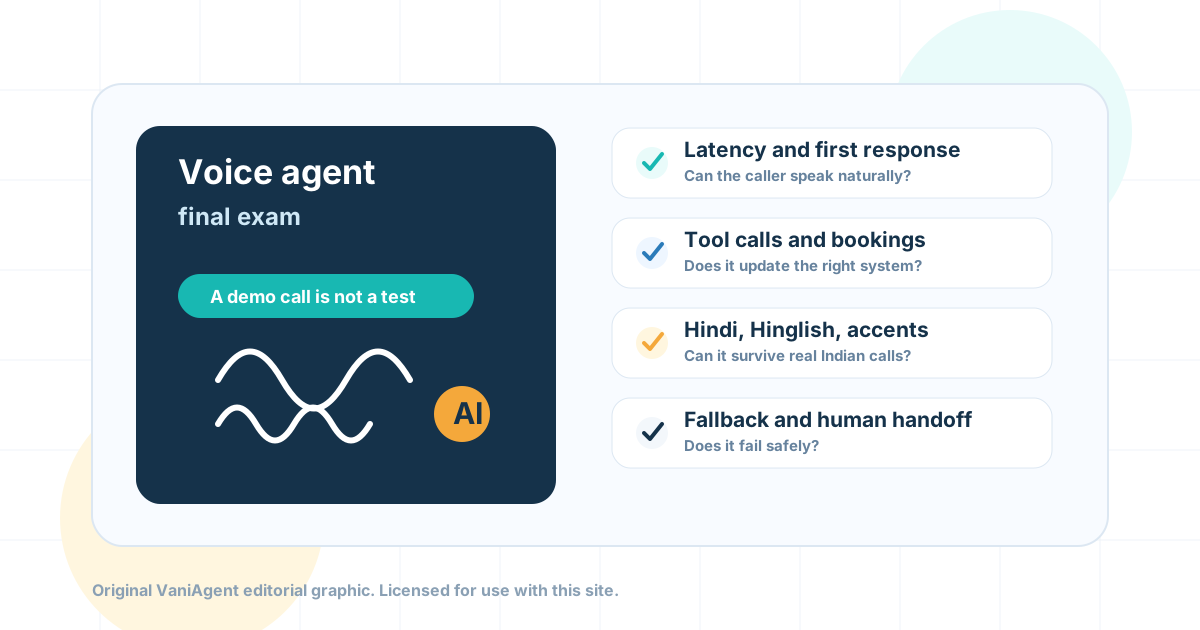
Short answer: Test an AI voice agent like you would test a new human hire before handing them real customers. Make it pass scripted calls, messy calls, Hindi and Hinglish calls, interruption tests, tool-call checks, fallback checks, latency checks, and a monitored pilot. A demo call is not a production test.
That sentence matters because most teams fall in love with the first clean demo.
The agent says hello. The voice sounds smooth. It answers two questions. It books one appointment. Everyone in the room relaxes.
But real customers do not behave like demo scripts. They interrupt. They speak over traffic. They switch from English to Hindi mid-sentence. They ask the same question three ways. They say "kal nahi, parso" and expect the agent to understand. They give half a phone number, change their mind, ask for a discount, then request a WhatsApp follow-up.
If you are putting an AI voice agent in front of real customers, the goal is not to prove that it can speak. The goal is to prove that it can survive.
The real fear behind this search
When someone searches "how do you test an AI voice agent", they are rarely just curious.
They are usually thinking:
- Will this agent embarrass us on real calls?
- Will it book the wrong appointment?
- Will it keep talking when the customer is already speaking?
- Will it hallucinate a policy?
- Will it fail during a campaign?
- Will it understand Hindi, Hinglish, regional accents, and noisy mobile audio?
- Will my sales team trust the call outcomes?
That is the correct fear. It is not pessimism. It is operational maturity.
A demo call is not a production test. A production test asks whether the agent can complete the business task when the caller is impatient, unclear, emotional, or unpredictable.
The AI Voice Agent Final Exam
Before launch, make your AI voice agent pass seven exams.
| Exam | What it checks | Example failure |
|---|---|---|
| Listening exam | Speech recognition, accents, noise, silence, barge-in | Agent misunderstands "EMI date" as "any date" |
| Speaking exam | Voice clarity, speed, tone, first response latency | Agent sounds polished but replies too late |
| Reasoning exam | Business logic, eligibility, policy boundaries | Agent promises a refund outside policy |
| Tool-use exam | CRM, calendar, payment, order, ticket, or webhook actions | Agent books the wrong slot |
| Interruption exam | Turn-taking, stop behavior, recovery | Agent talks over the customer |
| Language exam | Hindi, Hinglish, regional accents, domain words | Agent fails on "fees ka breakup WhatsApp kar do" |
| Production exam | Load, retries, observability, fallback, escalation | Agent works in dev but breaks during volume |
If the agent cannot pass these seven exams, it is not ready for open traffic.
1. The listening exam
A voice agent starts with listening. If it hears the wrong thing, every step after that becomes fragile.
Test the agent with:
- Clear studio audio
- Normal mobile audio
- Background traffic
- Low-volume callers
- Fast speakers
- Elderly callers
- Callers who pause for a long time
- Callers who say "haan", "theek hai", "rukna", or "ek minute"
- Callers who mix Hindi and English
Do not only test transcription quality. Test business interpretation.
The question is not just "did it hear the words?" The real question is "did it understand what the customer wanted?"
| Caller phrase | What the agent should infer |
|---|---|
| "Mujhe kal wala slot nahi chahiye" | Customer is rejecting a proposed appointment |
| "Fees ka detail WhatsApp kar do" | Send fee breakdown on WhatsApp |
| "EMI kab tak bhar sakta hoon?" | Customer is asking for payment deadline |
| "Site visit Sunday ko ho sakta hai?" | Customer wants real estate visit availability |
| "COD confirm karna tha" | Customer is confirming cash-on-delivery order |
For Indian calls, the listening exam is where many weak agents fail first.
2. The speaking exam
Good voice is not only about sounding human. It is about speaking at the right speed, with the right amount of information, at the right moment.
An agent can have a beautiful voice and still fail the call.
Test:
- First response time
- Sentence length
- Whether it pauses naturally
- Whether it asks one question at a time
- Whether it repeats important details
- Whether it confirms actions before taking them
- Whether it speaks differently for sales, support, reminders, and escalation
The agent should not sound like a paragraph generator trapped inside a phone call. Phone calls need short turns.
Bad:
"Thank you for providing that information. Based on your request, I will now proceed to check our system for the most suitable available appointment slots and then provide you with multiple options."
Better:
"Sure. I will check the next available slots. Morning or evening?"
Human callers forgive small imperfections. They do not forgive an agent that wastes their time.
3. The reasoning exam
The reasoning exam checks whether the agent understands the business rules.
This is where you test:
- Eligibility logic
- Pricing boundaries
- Refund policy
- Appointment rules
- Lead qualification rules
- Escalation rules
- Compliance instructions
- What the agent must never say
Use adversarial but realistic calls.
| Test case | Expected behavior |
|---|---|
| Customer asks for an unavailable discount | Agent explains approved offers only |
| Customer asks for medical advice | Agent routes to staff or emergency guidance as configured |
| Customer asks to change another person's order | Agent verifies identity before action |
| Customer asks for a refund outside policy | Agent explains policy and escalates if needed |
| Customer asks for exact loan approval | Agent avoids making unapproved promises |
This is the exam that protects your brand.
If an AI voice agent is confident but wrong, it is worse than a human who asks for help.
4. The tool-use exam
Most production voice agents do not only talk. They take action.
They may:
- Book an appointment
- Create a CRM lead
- Update a support ticket
- Check order status
- Send a WhatsApp message
- Trigger a payment link
- Transfer to a human
- Mark a call outcome
Every tool action needs testing.
Vapi's eval documentation talks about testing mock conversations, validating behavior, and verifying tool calls. That idea matters beyond any single platform: if the agent can call tools, you must test whether it calls the right tool with the right data at the right time.
| Tool action | What to validate |
|---|---|
| Book appointment | Date, time, timezone, customer name, phone number |
| Create lead | Source, intent, budget, language, notes |
| Send WhatsApp | Correct template, correct number, correct link |
| Payment reminder | Amount, due date, consent, escalation |
| Order lookup | Correct order ID and customer identity |
| Human handoff | Transcript and reason passed to staff |
A demo call is not a production test. In production, the agent does not just say things. It changes systems.
5. The interruption exam
Interruption handling is one of the hardest parts of voice AI.
Real callers interrupt because they are human. They correct the agent. They answer early. They say "no no, listen." They talk over the greeting. They get impatient.
Test whether the agent can:
- Stop speaking when the caller interrupts
- Keep context after interruption
- Avoid restarting the whole flow
- Apologize briefly when needed
- Resume from the correct point
- Detect when a customer is frustrated
- Escalate instead of forcing the script
Example:
Agent: "I can help you book a demo for-"
Caller: "Already booked. I want to reschedule."
Bad agent: continues booking flow.
Good agent: switches to reschedule flow.
This is where voice agents start to feel either magical or mechanical.
6. The India language exam
If your customers are in India, do not test only English.
Test Hindi, Hinglish, and the language style your customers actually use. For many businesses, customers do not speak in textbook Hindi or textbook English. They speak in a practical blend.
Use phrases like:
- "Kal ka slot cancel karna hai."
- "Fees ka breakup bhej do."
- "Mera order abhi tak nahi aaya."
- "Site visit ke liye Sunday chalega?"
- "EMI link WhatsApp kar do."
- "Mujhe human se baat karni hai."
- "Aap mujhe 10 minute baad call kar sakte ho?"
Also test domain words:
| Industry | Words to test |
|---|---|
| Ecommerce | COD, return, refund, exchange, delivery, tracking |
| BFSI | EMI, due date, renewal, loan status, KYC |
| Healthcare | appointment, report, prescription, reschedule |
| Real estate | site visit, possession, carpet area, budget |
| EdTech | fees, batch, demo class, counselling, admission |
| Recruitment | notice period, CTC, interview slot, location |
An agent that performs well in English but fails in Hinglish is not production ready for many Indian businesses.
7. The production stress exam
Retell's writing on production voice agents highlights a basic truth: agents fail when real-time infrastructure cannot sustain the workload. Latency spikes, unstable telephony, overloaded systems, and integration failures are production problems, not demo problems.
So test production-like conditions.
| Stress area | What to test |
|---|---|
| Concurrency | Can the agent handle expected simultaneous calls? |
| Telephony | What happens during weak audio or dropped calls? |
| Latency | Does response time remain conversational under load? |
| Integrations | What happens if CRM or calendar is slow? |
| Retry logic | Does the system retry failed WhatsApp or webhook actions? |
| Observability | Can managers see why calls failed? |
| Fallback | Does the agent fail safely and escalate? |
The production exam is not glamorous. It is the difference between a launch and a customer-service incident.
The 100-point AI voice agent readiness score
Use this scorecard before launch.
| Category | Points | What good looks like |
|---|---|---|
| Task completion | 20 | Agent completes the main workflow without human help |
| Latency and turn-taking | 15 | Natural first response, no awkward delays, handles interruptions |
| Tool-call accuracy | 15 | Correct data sent to CRM, calendar, ticketing, payment, or WhatsApp |
| Language and accent coverage | 15 | Handles real customer language, not just clean English |
| Fallback and escalation | 10 | Knows when to transfer, retry, or stop |
| Policy safety | 10 | Does not hallucinate offers, approvals, refunds, or advice |
| Logging and analytics | 10 | Outcome, transcript, recording, and failure reason are visible |
| Pilot performance | 5 | Performs under real call conditions with monitored traffic |
Suggested launch rule:
- 90 to 100: Ready for broader rollout
- 75 to 89: Pilot only, with monitoring
- 60 to 74: Fix gaps before real customers
- Below 60: Not launch ready
This score is not about perfection. It is about knowing where the risk is before your customers find it for you.
Test scripts every Indian business should run
| Scenario | Caller behavior | Pass condition |
|---|---|---|
| Clean happy path | Customer gives clear answers | Agent completes workflow |
| Fast speaker | Customer speaks quickly | Agent asks clarifying question if needed |
| Background noise | Traffic or office noise | Agent still captures key intent |
| Interruption | Customer cuts agent mid-sentence | Agent stops and adapts |
| Wrong assumption | Customer corrects a detail | Agent updates context |
| Hindi/Hinglish | Customer mixes languages | Agent continues naturally |
| Tool failure | Calendar or CRM is unavailable | Agent apologizes and creates fallback |
| Angry caller | Customer complains | Agent de-escalates and escalates safely |
| No response | Customer stays silent | Agent reprompts, then exits cleanly |
| Human request | Customer asks for a person | Agent transfers or schedules callback |
These are not edge cases. These are Tuesday afternoon.
What metrics should you measure?
Do not measure only latency. Latency matters, but a fast wrong answer is still wrong.
| Metric | What it tells you |
|---|---|
| First response latency | Whether the call feels conversational |
| Task completion rate | Whether the agent achieves the business goal |
| Tool-call accuracy | Whether actions in systems are correct |
| Interruption recovery | Whether the agent can handle real speech flow |
| Fallback rate | How often the agent gets stuck |
| Human transfer rate | How often humans still need to step in |
| Wrong-action rate | How often the agent does something incorrect |
| Containment rate | How many calls resolve without human help |
| Customer sentiment | Whether callers sound satisfied or frustrated |
| Cost per resolved call | Whether automation is economically working |
Twilio's evaluation work frames the core question well: how do you know whether voice agents solve the business problem? That is the right lens. Not "does it talk?" but "does it complete the job safely?"
How many calls should you test before launch?
There is no universal number, but here is a practical rule.
For a narrow workflow, such as appointment confirmation:
- 30 to 50 scripted tests
- 20 to 30 messy edge-case tests
- 10 to 20 tool-call validation tests
- Limited live pilot with real monitoring
For higher-risk workflows, such as collections, healthcare, finance, or admissions:
- 100 or more scenario tests
- Multiple language and accent batches
- Failure-mode testing
- Human handoff testing
- Load testing for expected concurrency
- Live pilot before full rollout
Do not launch because one founder, one engineer, and one salesperson tried five calls and liked the voice.
A demo call is not a production test.
Red flags before launch
Pause the launch if:
- The agent cannot explain why it transferred a call.
- The agent books appointments without final confirmation.
- The agent gives different answers to the same policy question.
- The agent ignores interruptions.
- The agent fails when the caller switches language.
- The agent cannot recover from tool failure.
- Managers cannot see transcripts and outcomes.
- The agent sounds confident when it should escalate.
The most dangerous AI voice agent is not the one that fails loudly. It is the one that fails politely.
A simple pre-launch checklist
Before going live, confirm:
- The top 20 customer intents are tested.
- The top 10 failure cases are tested.
- Hindi and Hinglish calls are tested.
- Noisy mobile calls are tested.
- Tool calls are validated with real-like data.
- Appointment or payment actions require confirmation.
- Human handoff passes transcript and context.
- Call recordings and transcripts are stored.
- Outcome labels are visible in the dashboard.
- Fallback messages are approved.
- Compliance-sensitive phrases are blocked.
- Live pilot owners are assigned.
- Rollback plan exists.
This checklist is not bureaucracy. It is how you protect trust.
FAQ
How do you test an AI voice agent before launch?
Test it with scripted calls, edge cases, messy caller behavior, Hindi and Hinglish inputs, interruption scenarios, tool-call validation, latency checks, fallback checks, human handoff, and a monitored pilot.
Is one demo call enough to test a voice AI agent?
No. One demo call only proves the agent can work once. Production testing proves it can handle real customers, noisy audio, unclear intent, interruptions, tool failures, and operational pressure.
What is a good AI voice agent test?
A good test has a clear customer goal, realistic caller behavior, expected pass criteria, and a measurable outcome. For example: "Customer wants to reschedule an appointment; agent must verify identity, offer valid slots, confirm one slot, update calendar, and send WhatsApp confirmation."
What metrics matter most?
The most important metrics are task completion, first response latency, tool-call accuracy, interruption recovery, wrong-action rate, fallback rate, transfer rate, containment rate, and cost per resolved call.
How do you test Hindi or Hinglish calls?
Use real scripts from your business. Include Hindi, Hinglish, regional accents, domain words, noisy audio, repeated questions, partial answers, and customers who switch language mid-call.
What makes an AI voice agent production ready?
A production-ready AI voice agent completes the intended task reliably, responds quickly, handles interruptions, uses tools correctly, escalates safely, logs outcomes, and fails without damaging customer experience.
Final answer
An AI voice agent is ready to go live when it can pass the final exam: listening, speaking, reasoning, tool use, interruptions, language, and production stress.
The buyer should not ask, "Did the demo sound good?"
The buyer should ask, "Can this agent handle our real customers on a bad network, in mixed language, with real business consequences?"
If the answer is yes, launch carefully. If the answer is no, keep testing.
A demo call is not a production test. It is only the first hello.
Related reading: AI voice agent pricing in India, What makes a voice AI agent sound human?, Reducing voice latency, and AI calling agent for Indian sales teams.
Practical worksheets and implementation guides
Put these ideas into production
Deploy AI voice agents in minutes and build outbound, inbound, and follow-up workflows on one platform.
Related Articles
What Makes a Voice AI Agent Sound Human? Latency, Turn-Taking and Indian Accents
Learn what makes AI voice agents sound human: latency optimization, natural turn-taking, emotional intelligence, and handling Indian accents and Hinglish. Technical guide for building natural voice AI.
Reducing Voice Latency to <500ms: A Deep Dive into Edge Architecture
Achieve sub-500ms voice latency with edge computing & WebSocket optimization. Technical deep dive into building natural AI conversations with minimal delay.
AI Voice Agent Pricing in India: Per-Minute vs Monthly Plans
Compare AI voice agent pricing in India, including current VaniAgent plans, inbound and outbound call costs, usage, onboarding fees, telephony, and ROI.
AI Calling Agent for Indian Sales Teams: Use Cases, Scripts, and ROI
Learn how Indian sales teams use AI calling agents for lead qualification, speed-to-lead, follow-ups, appointment booking, real estate, edtech, insurance, and SaaS sales.