What Does an AI Warm Transfer Cost? Call Legs, Hold Time and Recordings
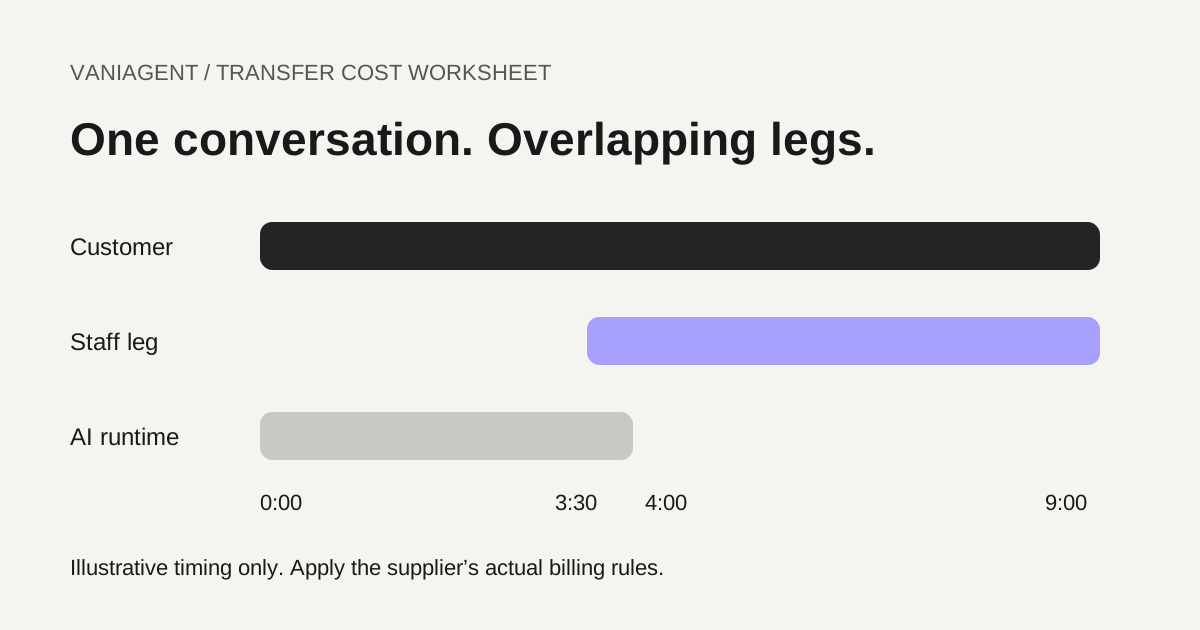
An AI warm transfer can consume more than one billable call leg at the same time. To price it, map the customer connection, the destination connection and the AI session onto one timeline. Add only separately charged recording, conference, transfer and storage components. Then check exactly when each billing clock stops.
A headline AI minute rate does not tell you the price of a transferred conversation. The customer may remain connected while staff are located, and telephone charges may continue after the AI exits. This guide provides a fictional worked example and an invoice worksheet for teams comparing voice bots with human handoff and recording.
For the operational handoff design, read our AI voice agent human handoff guide. For a whole-month workload, use the inbound and outbound calling budget.
What happens during a warm transfer?
A typical design keeps the customer connected while the system contacts staff, provides context and connects the parties if the destination accepts. The exact sequence depends on the platform and telephony route.
Retell's transfer documentation, checked on 16 October 2026, distinguishes cold, warm and agentic warm transfers. It describes controls for ringing, waiting for staff and private briefing. Those are provider-specific workflow features, not a universal tariff or evidence of your deployment's behaviour.
Ask the supplier to identify what “warm” means in its demonstration. Does a person actually accept? Is the briefing private? Does the AI leave after bridging? Is a second AI involved? Record the answers because each can change runtime or the required endpoints.
Separate the billable components
| Component | Question for the quote |
|---|---|
| Customer call leg | Does it stay billable through ringing, hold and the human conversation? |
| Destination leg | When does charging start, and how are ringing or queue time handled? |
| AI runtime | At what transfer event does AI billing stop? |
| Second AI or briefing service | Included or separately billed? |
| Conference or bridge | Included in the route or an additional usage charge? |
| Recording | Which legs or segments are recorded and charged? |
| Storage and transcription | Included allowance, retention and overage rules? |
| Transfer attempts | Charge for each attempt, failed target or retry? |
These are procurement questions rather than statements that every provider bills every row. Mark missing answers as unquoted. Do not insert zero because an item is absent from a public pricing page.
Worked example: one successful warm transfer
All times and rates below are fictional teaching assumptions. They are not supplier prices, market benchmarks or VaniAgent plan terms. The example deliberately omits rounding, tax, staffing and setup so the call-leg arithmetic is visible.
| Timeline | Customer experience | Modelled billing state |
|---|---|---|
| 0:00–3:00 | Customer speaks to the AI | Customer leg and AI active |
| 3:00–3:30 | Destination rings; customer waits | Customer leg and AI active; destination ringing uncharged by assumption |
| 3:30–4:00 | Staff hears a private briefing | Customer leg, destination leg and AI active |
| 4:00–9:00 | Customer and staff speak; AI exits | Customer and destination legs active |
The customer leg lasts 9 minutes. The destination's connected leg lasts 5.5 minutes, including the briefing. AI runtime is 4 minutes. Assume a single charged recording stream covers the full nine-minute session; that recording assumption must be confirmed for an actual route.
| Fictional cost item | Calculation | Cost |
|---|---|---|
| Customer carrier leg | 9 × Rs 0.50 | Rs 4.50 |
| Destination carrier leg | 5.5 × Rs 1 | Rs 5.50 |
| AI runtime | 4 × Rs 2 | Rs 8.00 |
| Recording | 9 × Rs 0.10 | Rs 0.90 |
| Transfer event | One × Rs 0.30 | Rs 0.30 |
| Total before tax | Sum of the above | Rs 19.20 |
The assumed quote includes bridging with no additional conference charge. It excludes storage overages, transcription and other services. The Rs 19.20 total is valid only for this stated model.
The nine-minute customer conversation produces 14.5 carrier leg-minutes, because both connections remain active during part of the call. That is not automatically an error: overlapping legs may represent different charged services. It becomes a billing problem if the same included consumption is charged twice or a leg stays open unintentionally.
Compare transferred calls with a clearly defined baseline
In the same fictional model, a three-minute AI-only call would cost Rs 6 in AI usage, Rs 1.50 in customer carrier usage and Rs 0.30 in recording: Rs 7.80 before tax. The transferred example costs Rs 11.40 more, but it also includes six additional customer-connected minutes and a staff conversation. This is not a like-for-like measure of transfer efficiency or proof that avoiding staff is better.
For a budget with 800 such AI-only calls and 200 such transferred calls, the variable subtotal is 800 × Rs 7.80 + 200 × Rs 19.20 = Rs 10,080. Add fixed fees and other scoped costs separately. Do not apply this average to real traffic without measuring your transfer share, duration and outcomes.
For a controlled comparison between routes, hold the customer task and service requirement constant. Compare verified outcomes, caller waiting and staff effort alongside cost.
How long holds change the bill
Suppose staff take another minute to answer. Under the model above, that extra minute costs Rs 0.50 for the customer leg, Rs 2 for AI runtime and Rs 0.10 for recording: Rs 2.60. If the destination is already answered and sitting in a queue, a further destination-minute charge could also apply. Recalculate using its actual billing state.
Set a maximum wait and an approved recovery path. Long waits can increase both cost and abandonment. A cheaper minute rate cannot compensate for a route that repeatedly leaves customers waiting without reaching anyone.
When evaluating another offer, replace the whole state model rather than swapping only the AI rate. Different AI stop events, destination billing rules or bridge charges can change the result substantially.
Failed transfers still need an invoice path
Test no answer, busy, voicemail, rejected handoff and caller hang-up while waiting. For each outcome, identify which connections end and whether the AI returns to the caller, offers a callback or ends the interaction.
Do not let retries run indefinitely. Define the permitted destinations, attempt limit and total wait budget. A failed target followed by another target can create several records and additional usage even if the customer experiences only one call.
Distinguish voicemail detection from staff acceptance. “The destination answered” is insufficient evidence that the right person received the customer. The workflow should record the actual handoff outcome and the remaining next step.
Reconcile call legs with invoice lines
Twilio's Call resource reference documents call identifiers, parent-call relationships, durations and price fields. These are useful provider-specific records for an audit; reconcile them with your own supplier's definitions and invoice, rather than assuming every platform exposes identical fields.
For each sampled transferred interaction, collect:
- The customer interaction ID and every linked carrier call ID.
- Initiated, answered, bridged and ended timestamps for each relevant leg.
- AI session start and stop, including any separate transfer agent.
- Destination outcome: person accepted, voicemail, busy, no answer or failure.
- Recording identifiers, duration, segment boundaries and retention settings.
- Billed units, rounding, rate, currency and the corresponding invoice item.
Use raw durations to reconstruct the sequence, then apply the quote's billing rules. A dashboard duration may represent customer time while an invoice uses rounded leg durations. Ask the provider to explain discrepancies before treating all differences as overcharging.
Recording and privacy need their own checks
Specify whether the recording covers the AI conversation, customer hold, private staff briefing and human conversation. A private briefing that is hidden from the caller may still exist in internal recordings; access should follow the business's approved policy.
Confirm recording notices, authorized access, retention and deletion requirements for the actual workflow. Avoid copying unnecessary sensitive details into a transfer summary. A recording icon in a dashboard does not prove complete capture across a handoff, and two recording files do not necessarily mean duplicate charging.
Check playback across segment boundaries with fictional test calls. Then map each recording charge to its documented billable stream or segment.
Buyer checklist before approving warm-transfer pricing
| Evidence to request | Acceptance criterion |
|---|---|
| Exact customer-to-staff route | Supported endpoints demonstrated in the proposed configuration |
| AI billing stop event | Written definition matches measured runtime |
| Hold and ringing rules | Sample invoice agrees with the timeline |
| Failed transfer test | All legs close or enter the approved recovery state |
| Recording test | Required segments accessible to authorized staff |
| Included allowances | No duplicate addition of bundled usage |
| Outcome report | Successful human connection distinguished from call completion |
Use the billing audit guide to reconcile the sample and the vendor RFP template to keep quote exclusions visible. If the route starts on WhatsApp, also review the WhatsApp calling connection comparison before assuming a transfer to an ordinary telephone endpoint.
Choose the route that meets the service requirement at a verified total cost. Request a new calculation when the destination, recording scope or handoff design changes: those are changes to the budget, not just to the conversation script.
Frequently asked questions
How much does an AI warm transfer cost?
Calculate the billable customer leg, destination leg, AI runtime and any separate conference, recording or transfer fees. There is no reliable universal amount without the route and quote. This article’s Rs 19.20 example uses fictional rates and timing assumptions.
Does AI billing stop when a human answers?
Not necessarily. Ask whether AI billing ends when the destination answers, after the private briefing, after bridging or only when the AI session closes. Verify the billed runtime against transfer timestamps.
Can hold time be charged during an AI transfer?
It can be part of a billable active call leg or platform session, depending on the supplier’s rules. Include it in the timeline and request written definitions rather than assuming that silence or hold music is free.
Does an unanswered transfer have zero cost?
No such assumption is safe. The original customer leg may remain active while the destination rings, and attempt, AI or other charges may apply. Test no-answer and voicemail outcomes using the actual quote.
Should I add a transfer fee to both call-leg charges?
Only if the quote defines it as an additional fee. If a bundle already includes destination minutes or recording, adding the same consumption again duplicates the charge. Reconcile each invoice item to one billable component.
Is a completed call proof that the handoff succeeded?
No. A call can end after voicemail, an unanswered destination or a disconnected caller. Verify that an authorized person accepted the handoff and that the caller connected; track resolution separately.
Review your handoff scope
Bring your staff destinations, sample call records and recording requirements to a scoped VaniAgent demonstration. Confirm the transfer route and written billing rules before changing live calls.
Put these ideas into production
Deploy AI voice agents in minutes and build outbound, inbound, and follow-up workflows on one platform.
Related Articles
When Should an AI Voice Agent Transfer to a Human?
Learn when an AI voice agent should transfer to a human, how cold transfer, warm transfer, smart routing, and context handoff work, and what Indian businesses should test before launch.
AI Voice-Agent Billing Audit: Match Call Records to Your Invoice
Reconcile call-level usage with an invoice using contract increments, transfer legs, credits, adjustments and a clearly fictional worked invoice.
Inbound vs Outbound AI Calling Costs in India: A Mixed-Workload Budget
Build an inbound and outbound AI calling budget for India with worked calculations for minutes, attempts, transfers, carrier fees and setup.
Voice-Agent RFP Template: Questions to Ask Before Signing a Vendor Contract
A practical voice AI procurement matrix covering task evidence, billing, integrations, data access, support and exit terms before a vendor contract.