Inbound vs Outbound AI Calling Costs in India: A Mixed-Workload Budget
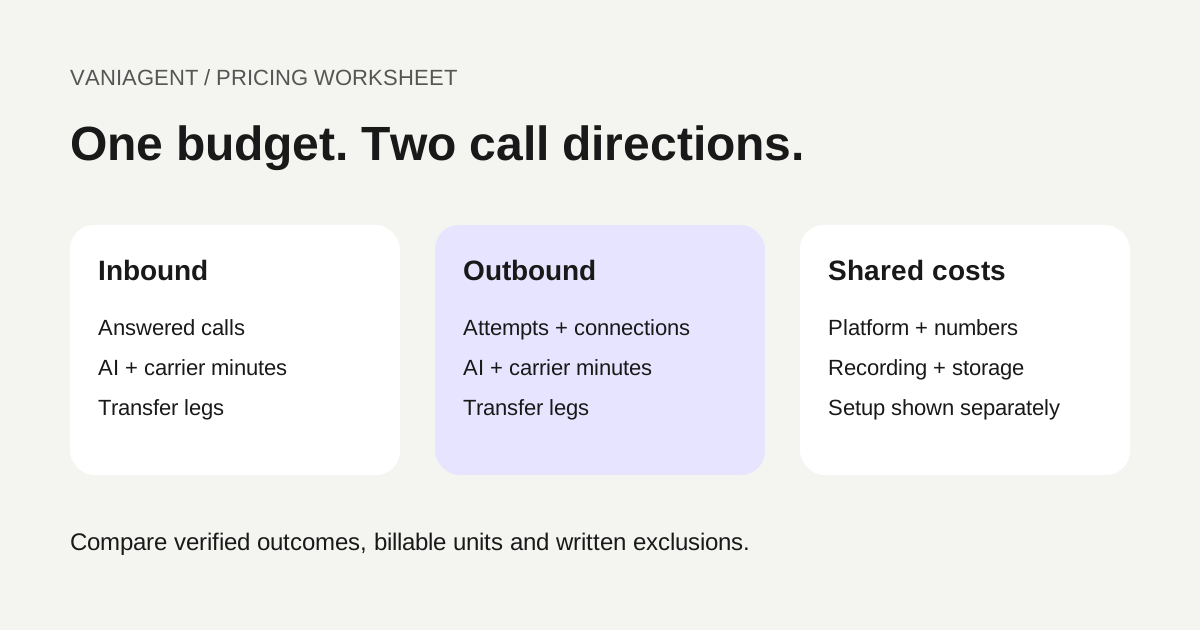
To budget inbound and outbound AI calling in India, calculate each direction separately, then combine AI usage, carrier usage, attempts, transfers and fixed fees. A single advertised per-minute price is useful only when you know exactly which of those components it includes.
Inbound callers arrive on their own schedule. Outbound campaigns generate attempts, only some of which become conversations. That difference affects cost per completed task, campaign duration and the capacity you need. This guide provides a mixed-workload calculation you can replace with your own call records and supplier quote.
All prices below are fictional teaching assumptions, not market rates or VaniAgent offers. Public documentation was checked on 15 October 2026. For the general buying framework, use our AI voice agent pricing guide for India. For human licences and seat-versus-usage comparisons, see the separate 20-agent CCaaS budget.
What changes between inbound and outbound billing?
| Budget input | Inbound workload | Outbound workload |
|---|---|---|
| Demand | Calls arriving at your number | Attempts placed by a campaign |
| Conversation volume | Answered calls | Attempts multiplied by connection rate |
| Carrier usage | Billable inbound duration under the quote | Billable outbound duration under the quote |
| Other possible usage | Queue, hold, forwarding and transfer legs | Ringing, unsuccessful attempts, detection and transfer legs |
| Useful outcome | Resolved enquiry, verified booking or another defined task | Qualified response, verified booking or another defined task |
| Capacity pressure | Arrival peaks and waiting tolerance | Campaign pacing alongside incoming demand |
These are items to investigate, not universal charging rules. The AI platform and the telephone provider may start and stop their billing clocks at different times. Ask for both definitions, including rounding and minimum billed durations.
Set the workload before entering a price
Suppose a business expects the following activity in one month. Its outbound connection rate is 25%, and its connected outbound conversations last three minutes on average.
| Input | Inbound | Outbound |
|---|---|---|
| Answered or connected calls | 2,000 | 1,500 |
| Outbound attempts | Not applicable | 6,000 |
| Average connected duration | 4 minutes | 3 minutes |
| Connected AI duration | 8,000 minutes | 4,500 minutes |
| Calls transferred to a person | 200 | 150 |
| Additional human-leg duration per transfer | 2 minutes | 2 minutes |
| Additional transfer-leg duration | 400 minutes | 300 minutes |
The model assumes AI stops billing at handoff; the extra human leg is billed separately. Base connected carrier minutes equal AI minutes. There is no charged queue time, ringing duration, rounding or overlapping transfer time in this simplified example. Those assumptions are deliberately explicit: replace them if your routing or quote behaves differently.
Check whether your call duration already includes the human conversation. Adding a transfer leg to a duration that already contains it can double-count usage. Conversely, a bridged transfer can produce overlapping billable legs. Export leg identifiers and timestamps rather than treating one customer conversation as one invoice line.
Worked monthly budget for both call directions
Assume the fictional AI rate is Rs 2 per connected minute. Inbound carrier usage is Rs 0.50 per minute; outbound carrier usage is Rs 1 per minute. Additional transfer legs cost Rs 1 per minute. An illustrative Rs 0.05 fee applies to every outbound attempt, including connected attempts.
| Cost component | Calculation | Monthly cost |
|---|---|---|
| Inbound AI service | 8,000 × Rs 2 | Rs 16,000 |
| Outbound AI service | 4,500 × Rs 2 | Rs 9,000 |
| Inbound carrier | 8,000 × Rs 0.50 | Rs 4,000 |
| Outbound carrier | 4,500 × Rs 1 | Rs 4,500 |
| Additional transfer legs | (400 + 300) × Rs 1 | Rs 700 |
| Outbound attempt fees | 6,000 × Rs 0.05 | Rs 300 |
| Fixed platform fee | Assumed monthly fee | Rs 3,000 |
| Number rental | Assumed monthly fee | Rs 500 |
| Recording and storage | Assumed monthly allowance cost | Rs 1,000 |
| Recurring total before tax | Sum of the above | Rs 39,000 |
If one-time setup costs Rs 5,000, the first-month total is Rs 44,000 before tax. These totals exclude human staffing, CRM licences, messaging and other services outside the stated scope. Apply the supplier's invoiced tax treatment and currency conversion where relevant.
The inbound variable subtotal is Rs 20,400: AI, base carrier and its transfer legs. The outbound variable subtotal is Rs 14,100: AI, base carrier, transfers and attempts. Shared fixed costs total Rs 4,500. Keep those shared costs visible instead of arbitrarily assigning all of them to one direction.
Why the outbound answer rate changes your budget
At a fixed target of 1,500 connected outbound calls, a lower connection rate requires more attempts. Holding connected duration and all other assumptions constant gives:
| Connection rate | Attempts needed | Fictional attempt fees | Combined recurring budget |
|---|---|---|---|
| 25% | 6,000 | Rs 300 | Rs 39,000 |
| 15% | 10,000 | Rs 500 | Rs 39,200 |
| 10% | 15,000 | Rs 750 | Rs 39,450 |
This limited sensitivity model changes only the attempt fee. In an actual quote, paid ringing, voicemail processing, minimum durations or campaign charges may amplify the difference. A larger attempt count also consumes dialing time and operational capacity even if those attempts are not individually charged.
Alternatively, if you keep attempts fixed at 6,000, a 15% connection rate produces 900 connected calls rather than 1,500. That is a different scenario: recalculate both conversation cost and outcomes. Do not mix a fixed-attempt forecast with a fixed-connected-call forecast.
Compare cost per outcome, not just cost per minute
Define success before the pilot. An answered call is not automatically a qualified lead, and a verbal booking is not necessarily a successfully saved appointment.
Suppose the example produces 800 verified inbound resolutions and 300 qualified outbound responses. Directional variable cost per outcome would be Rs 20,400 ÷ 800 = Rs 25.50 inbound, and Rs 14,100 ÷ 300 = Rs 47 outbound. These exclude shared fixed costs, setup and staffing. They are fictional results, not performance claims.
For a fully allocated figure, document how you distribute shared costs, such as by AI minutes, and use the same method each month. Record failed tool calls, duplicate leads and human rework. Our cost per qualified lead guide explains how to define the denominator before comparing campaigns.
What current provider documentation tells you
Exotel's business-phone pricing page lists rental, usage credits and agent allowances, while excluding Voice Streaming (Agent Stream) from those listed plans. Confirm streaming scope separately when constructing an AI budget.
Amazon Connect's pricing appendix separates voice-service and communication charges. Select the relevant region, destination and product configuration before calculating a workload. Neither source makes the fictional rates in this article a vendor quote.
Use public pages to identify cost categories, then obtain written rates and an invoice example. Do not rank suppliers by a headline rate when their inclusions differ.
Reconcile prepaid credits and bundled plans
Distinguish consumption from cash paid. If Rs 10,000 of prepaid credit funds the carrier usage already in your worksheet, do not add another Rs 10,000 as a second usage expense. Record the wallet opening balance, top-ups, deductions, expiry and closing balance separately.
For bundled or unlimited offers, confirm the eligible workload, channel limit, minimum commitment, fair-use terms and excluded services. Check current VaniAgent pricing and request written confirmation for your mix of calls. A published single-channel plan does not establish capacity for every inbound peak and outbound campaign running together.
Protect inbound availability while outbound campaigns run
Monthly volume is insufficient for capacity planning. Record the busiest inbound intervals and decide whether inbound traffic takes priority. Test what happens when a customer calls while the available session is occupied by an outbound conversation.
Your operating design may require reserved capacity, reduced campaign pacing, a queue or human overflow. Confirm which options the proposed configuration supports before purchasing. See the simultaneous calls guide for the difference between usage allowances and concurrency.
Checklist before approving a mixed-workload quote
- Export a representative month of inbound calls and outbound attempts, with connection status and direction.
- Separate AI-billed duration, carrier-billed duration and additional call legs.
- Confirm rounding, ringing, voicemail, hold, transfer and unsuccessful-attempt rules in writing.
- Specify destinations, numbers, languages, recording retention and peak simultaneous demand.
- Show fixed monthly charges, setup, allowances and taxes separately.
- Ask the supplier to price your exact dataset or a clearly defined sample.
- Run a permitted pilot and reconcile call records against the invoice using the billing audit guide.
- Compare verified outcomes and staff rework alongside the total cost.
Mark an unanswered pricing question as unquoted, rather than entering zero. A budget is ready for approval when the workload, billable units, routing and exclusions all agree with the supplier's written scope.
Frequently asked questions
Is inbound AI calling cheaper than outbound AI calling in India?
Not automatically. Compare direction-specific carrier rates, connected duration, unsuccessful attempts, AI billing and transfer legs. An outbound campaign with a low answer rate can cost more per completed outcome even when the advertised minute rate looks similar.
How do I calculate a combined inbound and outbound AI calling budget?
Calculate AI-billed minutes and carrier-billed minutes separately for each direction, add separately charged attempts and transfer legs, then add fixed recurring costs. Show setup separately and subtract included allowances only once.
Are unanswered outbound calls free?
Do not assume so. Ask the supplier whether ringing, failed attempts, voicemail detection or campaign features carry charges. The worked example uses a fictional attempt fee to illustrate the effect; it is not a statement about any provider.
Does a human transfer stop every AI calling charge?
That depends on the configured transfer and billing rules. AI service may end at handoff, but telephone legs, hold time or recording can continue. Request a sample transferred-call invoice and reconcile it with call records.
Should I add prepaid credits to my calculated minute cost?
Only if they pay for a different service. If a top-up funds the minutes already counted, adding both duplicates the cost. Track monthly consumption separately from wallet payments and unused balances.
How much concurrency should I buy for a mixed workload?
Use peak inbound demand, outbound campaign pacing, average duration and acceptable waiting time. Reserve or prioritize capacity for inbound callers where needed. A monthly minute total alone cannot determine the necessary simultaneous sessions.
Scope your calling budget
Bring your call volumes, direction mix and concurrency requirements to a VaniAgent demonstration. Confirm the written scope before selecting a plan.
Put these ideas into production
Deploy AI voice agents in minutes and build outbound, inbound, and follow-up workflows on one platform.
Related Articles
AI Voice Agent Pricing in India: Per-Minute vs Monthly Plans
Compare AI voice agent pricing in India, including current VaniAgent plans, inbound and outbound call costs, usage, onboarding fees, telephony, and ROI.
CCaaS Pricing for a 20-Agent Team in India: Seats, Minutes and AI Costs
Compare CCaaS pricing for 20 agents in India with a worked budget for seats, inbound and outbound minutes, AI usage, setup and break-even costs.
AI Voice-Agent Billing Audit: Match Call Records to Your Invoice
Reconcile call-level usage with an invoice using contract increments, transfer legs, credits, adjustments and a clearly fictional worked invoice.
AI Calling Cost per Qualified Lead: A Calculator With Clear Assumptions
Calculate supplier, acquisition, review and sales follow-up costs per verified qualified lead, including sensitivity analysis and zero-outcome handling.