AI Voice Agents for Telecom Customer Support in India: Billing, Plans, and Outages
AI Voice Agents for Telecom Customer Support in India: Billing, Plans, and Outages
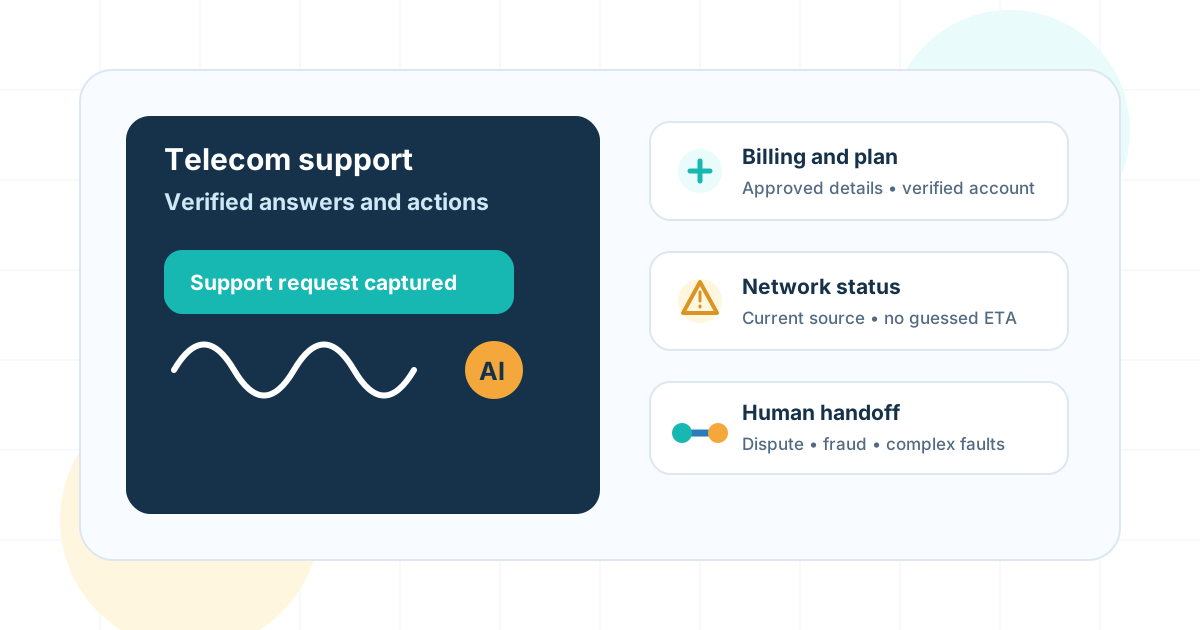
Short answer: A telecom voice agent can help with approved billing and plan enquiries, verified service-status updates, support-ticket creation, and call routing. Account-specific actions require the provider’s authentication and authorization rules, plus a confirmed response from the system of record. Billing disputes, suspected fraud, complex faults, and uncertain outage information should reach trained staff.
This guide is for mobile, broadband, and telecom customer-support teams. It focuses on inbound service calls and operational safeguards. It does not assume access to subscriber records, billing platforms, network telemetry, provisioning tools, or ticketing systems.
Start with the call reasons, not a general-purpose bot
Telecom support combines routine questions with high-impact account and network issues. A customer may ask what a charge means, request a plan change, report weak connectivity, check an outage, or challenge a transaction. The agent needs to know which source owns each answer and which actions require verification or a human decision.
| Call reason | A bounded voice-agent task | Escalation trigger |
|---|---|---|
| General plan question | Explain approved public plan information and direct the customer to current terms | Personalized eligibility, offer, or tariff exception is requested |
| Bill or payment question | Explain approved bill labels or retrieve permitted account details after verification | Dispute, suspected fraud, failed payment, or unexplained charge |
| Plan change | Explain the request process or submit a change through an authorized flow | Eligibility or terms are unclear, or system confirmation fails |
| Network or broadband issue | Follow provider-approved basic checks and collect location or fault details | Service is still unavailable, fault is complex, or safety is affected |
| Outage status | Share a current update from an authoritative status source | No verified status or restoration estimate is available |
| SIM, account, or identity concern | Route to the provider’s approved secure verification process | Lost device, suspected account takeover, SIM-swap concern, or identity mismatch |
Choose one low-risk, measurable call reason for the pilot. Stable public plan FAQs or ticket intake may be a safer start than account changes or bill disputes. Expand only after the source data, permissions, and escalation path are proven.
Make identity checks part of the flow
Do not let the agent disclose subscriber, payment, usage, address, or service details just because a caller knows a phone number. The provider should define which verification method is required for each action and how the agent responds when verification fails. Account lookup, explanation, and account modification may each need different permission levels.
Keep verification secrets out of general transcripts and summaries. Avoid repeating sensitive information aloud unless the provider’s process explicitly allows it. A request to change account ownership, replace a SIM, update security settings, or investigate suspected fraud should follow the provider’s controlled process and reach a trained team when needed.
Use authoritative sources for billing and plans
Public plan information and customer-specific billing data are different. Store public FAQs with an owner and review date. For account-specific responses, retrieve the relevant field from the authorized billing system after verification and explain it using approved language. If the system does not return the required detail, do not infer what a charge means.
For plan changes, separate an enquiry from a submitted request and a completed change. Read back the plan name and material terms that the provider requires, collect consent where the process requires it, and confirm only after the provisioning system reports success. If the action is pending, say so and create a follow-up record.
Treat outage information as live operational data
Outage answers are only useful when they are current. Define which network-status source the agent may use, how recently it must have been updated, what geographic scope it covers, and whether it contains an estimated restoration time. If data is stale, incomplete, or unavailable, say that the status cannot be confirmed and create or route a fault report.
Do not have the model infer that a network is down from several similar caller complaints. A regional issue should be declared by an authoritative operations source. Likewise, never promise a restoration time unless the provider has approved and published that estimate. During a major incident, provide a clear fallback and capacity plan for customers who need a person.
For basic troubleshooting, use a provider-approved decision tree. The customer should be able to skip a step, report that it did not help, or request an agent. Stop the automated flow for emergency or safety concerns, repeated failed checks, accessibility needs, or any case outside the supported procedure.
Make every action auditable
Connect the voice workflow only to the systems needed for its task: subscriber verification, billing lookup, plan catalogue, network status, ticketing, and routing. For every lookup or write, log the action outcome separately from the call disposition. A polite call ending does not prove the bill was explained correctly or a fault ticket was created.
Use minimum permissions, protect credentials, limit data in call summaries, and make failed system actions visible to support staff. Check transaction status before retrying a timed-out plan change or ticket creation so one caller does not generate duplicate requests. Follow the organization’s approved access, retention, and review policies for recordings and transcripts.
For deployment patterns, see the AI voice agent implementation guide, CRM integration guide, human handoff guide, and security checklist. For language evaluation, use the multilingual voice agent guide for India and voice-agent testing checklist.
Test realistic telecom support cases
Run test calls with support, billing, network, and security owners. Include normal requests and failure paths:
- A customer asks about a public plan that has recently changed.
- An account lookup returns no match or more than one possible subscriber.
- The caller fails verification but continues asking for account details.
- The bill lookup is unavailable or does not explain a disputed charge.
- A plan change times out after a possible system write.
- The network-status feed is stale or has no restoration estimate.
- A caller reports that basic troubleshooting did not restore service.
- A person reports suspected fraud, account takeover, or SIM replacement.
- A caller switches language, interrupts, or asks for a human.
For each scenario, verify what the agent said, what the connected system returned, and what the next team received. Test after-hours routing and high-volume incident procedures. Review samples with the operational owners before expanding traffic.
Measure issue resolution only when a system or agent record supports it. Also track ticket-write success, transfer completion, repeat contacts, incorrect changes, complaint volume, authentication failure handling, and the age of any status data used. Set definitions and a baseline first; report results by call reason rather than combining everything into a single containment rate.
Frequently asked questions
What can an AI voice agent do for a telecom provider?
It can answer approved service questions, capture billing or plan requests, share verified outage information, create support tickets, and route unresolved or sensitive cases to staff.
Can a telecom voice agent explain a customer’s bill?
It may explain approved bill categories or retrieve account-specific information only after the provider’s identity checks and authorization steps. Disputes, suspected fraud, and unclear charges should go to a trained representative.
Can AI voice agents troubleshoot network problems?
They can guide customers through provider-approved basic checks and report verified service status. They should not invent an outage, promise a restoration time without an authoritative update, or continue a script when the customer needs technical staff.
Can an AI agent change a mobile or broadband plan?
It can capture a plan-change request or complete one only through an authorized system that confirms eligibility, terms, and the successful change. It should clearly explain any required human review and avoid presenting a request as completed.
How should telecom providers protect subscriber information?
Use the provider’s approved verification and authorization process, limit data access to the task, avoid disclosing account details before verification, restrict recordings and transcripts, and route suspected account takeover or fraud to the security process.
How should a telecom provider measure a voice-agent pilot?
Track intent resolution with system evidence, ticket creation success, transfer completion, repeat contacts, incorrect account actions, complaints, and service-level performance. Compare with a defined baseline and report outcomes separately for each call reason.
Related guides
Continue with the AI voice agent security checklist, AI voice agent compliance guide for India, multilingual voice agent guide, and AI voice agent implementation guide.
Put these ideas into production
Deploy AI voice agents in minutes and build outbound, inbound, and follow-up workflows on one platform.
Related Articles
Is Your AI Voice Agent Secure Enough for Customer Calls?
Use this AI voice agent security checklist to protect call recordings, transcripts, customer data, tool access, prompt injection surfaces, retention policies, and audit logs.
Is AI Calling Legal in India? Consent, DND, Recording, and TRAI Checklist
A practical India compliance checklist for AI voice agents covering consent, DND, UCC, DLT, call recording, DPDP data protection, WhatsApp follow-ups, and safe human handoff.
Multilingual Voice Agents for India: Hindi, Tamil, Telugu, Bengali and More
Learn how multilingual voice agents help Indian businesses support Hindi, Tamil, Telugu, Bengali, Marathi, Kannada, Malayalam, Gujarati, and more across sales and support calls.
AI Voice Agent Implementation Guide for India: Step-by-Step
Complete step-by-step guide to implementing AI voice agents in India. Learn how to plan, deploy, test, and scale voice AI with Hindi support, TRAI compliance, telephony integration, and production best practices.
When Should an AI Voice Agent Transfer to a Human?
Learn when an AI voice agent should transfer to a human, how cold transfer, warm transfer, smart routing, and context handoff work, and what Indian businesses should test before launch.
How Do You Test an AI Voice Agent Before It Goes Live?
A practical AI voice agent testing checklist for teams preparing to launch real customer calls. Learn how to test latency, Hindi and Hinglish conversations, interruptions, tool calls, handoff, and production readiness.