Is AI Calling Legal in India? Consent, DND, Recording, and TRAI Checklist
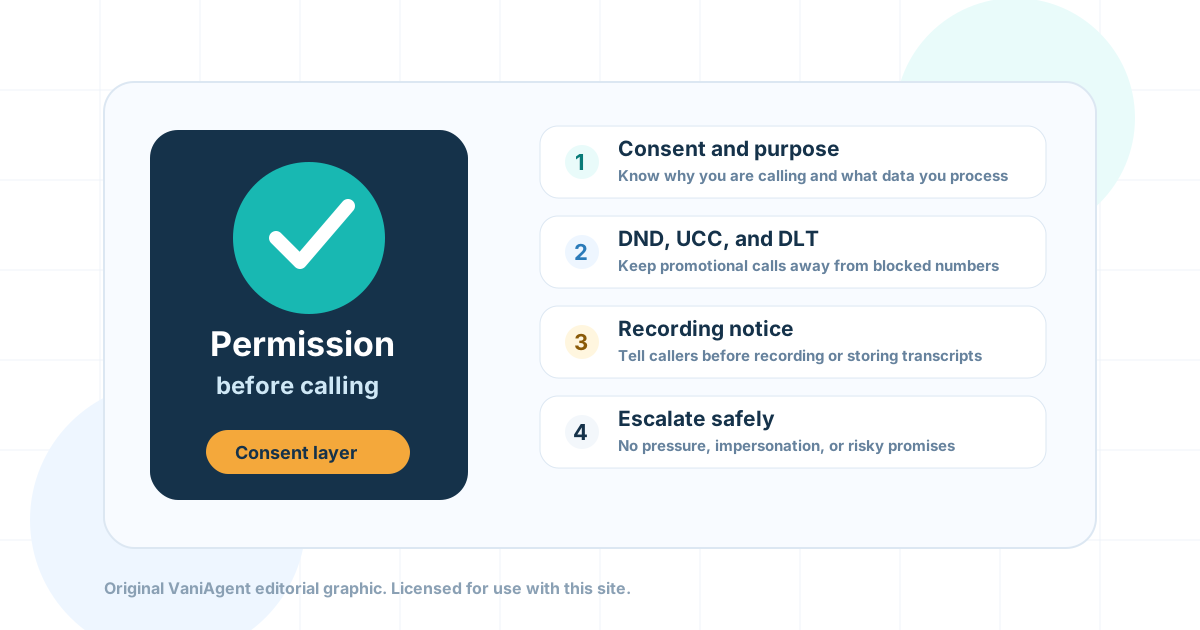
Is AI Calling Legal in India? Consent, DND, Recording, and TRAI Checklist
Short answer: AI calling can be legal in India, but only if the business treats it as regulated customer communication, not as a shortcut around consent, DND, privacy, or fraud controls. The safe question is not "Can an AI agent call people?" The safe question is: "Do we have permission, purpose, proof, and a fallback?"
This is not legal advice. It is a practical compliance guide for founders, growth teams, support leaders, and operations teams planning to use AI voice agents in India. For regulated or high-volume calling, review the exact workflow with counsel, your telecom provider, and your compliance team.
The core idea is simple:
AI calling is not just automation. It is permission architecture.
If your AI agent calls the right person, for the right reason, with the right notice, and records the right proof, it can create a better customer experience. If it calls the wrong person, pushes a promotional message through a blocked channel, hides its purpose, records without notice, or impersonates trust, it becomes risk.
Why this question matters now
India is becoming stricter about spam, fraud, and unwanted commercial communication. TRAI's TCCCPR framework focuses on protecting customers from unsolicited commercial communication while allowing legitimate businesses to reach customers who have opted in or whose preferences allow such communication.
The Ministry of Communications has also described stronger action against violators, including disconnection or suspension of telecom resources for certain UCC violations. Sanchar Saathi's Chakshu platform lets citizens report suspected fraud communications through calls, SMS, and WhatsApp.
That means the old growth playbook of "upload a list and start dialing" is no longer a serious strategy. AI makes calling cheaper and faster, so compliance has to become stronger, not weaker.
The permission architecture for AI voice agents
Before an AI voice agent makes or receives calls, define five layers.
| Layer | Question to answer | Why it matters |
|---|---|---|
| Purpose | Why are we calling this person? | Distinguishes service, transactional, support, reminder, and promotional intent |
| Permission | Why are we allowed to contact them? | Consent, customer relationship, preference, or other lawful basis |
| Preference | Has the customer opted out or registered a DND preference? | Reduces UCC and customer complaint risk |
| Notice | Are we clear about identity, recording, and purpose? | Builds trust and supports privacy obligations |
| Proof | Can we show what happened? | Required for audits, disputes, quality, and complaint handling |
If any layer is missing, do not scale the workflow.
AI calling vs telemarketing: classify the call first
Not every AI call is the same. Classification is the first compliance step.
| Call type | Example | Risk level | What to check |
|---|---|---|---|
| Service call | "Your appointment is confirmed for 5 PM." | Lower | Customer relationship, purpose, recording notice |
| Transactional call | "Your order delivery failed. Please confirm address." | Lower to medium | Identity check, data minimization, no unrelated promotion |
| Reminder call | "Your EMI due date is tomorrow." | Medium | Consent, sensitive handling, script approval |
| Sales follow-up | "You asked for a demo. Are you free today?" | Medium | Lead source, consent, opt-out, CRM proof |
| Promotional call | "We have a new offer for you." | Higher | DND/UCC/DLT compliance, consent, campaign controls |
| Recovery or collections | "Your payment is overdue." | Higher | Tone, consent, lawful process, escalation, no harassment |
The same AI voice platform can handle all of these. But the same compliance rule cannot be blindly applied to all of them.
The DND, UCC, and DLT issue
TRAI's unsolicited commercial communication framework is built around customer preference. In plain English: if a person has opted out of commercial calls or has not permitted a category of communication, you cannot treat automation as a loophole.
For outbound AI calls, this means:
- Do not mix service calls with promotional pitches.
- Scrub campaign lists against customer preferences where required.
- Keep lead source and consent evidence.
- Avoid unregistered telemarketing behavior.
- Use approved numbers, routes, headers, and templates where applicable.
- Keep opt-out handling simple and immediate.
- Maintain call logs and campaign metadata.
If a customer says "do not call again", the AI should not negotiate. It should record the preference and stop.
What about call recording?
AI voice agents often create recordings, transcripts, summaries, labels, sentiment scores, and call outcomes. That is useful, but it is also personal data.
The safest approach is to give a clear notice at the start of the call.
Good opening:
"Hi, this is Vani calling on behalf of ABC Clinic about your appointment. This call may be recorded to help with booking and support. Is this a good time?"
Bad opening:
"Hi, we have an exciting offer for you."
The first opening gives identity, purpose, and recording notice. The second hides too much and invites distrust.
DPDP and personal data: collect less, prove more
India's Digital Personal Data Protection Act, 2023 frames personal data processing around lawful purpose and duties of data fiduciaries. For AI voice calls, the practical lesson is this: do not collect more than you need, and do not keep it longer than you can justify.
| Data item | Usually useful | Risk note |
|---|---|---|
| Phone number | Routing, identity, callback | Protect and avoid unnecessary sharing |
| Call recording | Quality, dispute resolution | Give recording notice and define retention |
| Transcript | Summary, analytics, training review | Remove or avoid sensitive details where possible |
| Call outcome | CRM and workflow tracking | Keep labels factual |
| Consent status | Compliance evidence | Store timestamp and source |
| Payment details | Usually avoid collecting directly | Prefer secure payment links |
| Health or financial details | Handle with extra care | Minimize, restrict access, escalate when needed |
The compliance principle is not "store everything in case we need it." The principle is "store what the workflow needs and protect it properly."
A compliant AI voice agent should know when to stop
The best compliance feature is not a checkbox. It is restraint.
Your AI agent should stop or escalate when:
- The customer asks for a human.
- The customer says they did not consent.
- The customer asks not to be called again.
- The caller is angry or distressed.
- The topic becomes legal, medical, financial, or safety-sensitive.
- The agent cannot verify identity.
- The customer asks for something outside approved policy.
- The agent is unsure whether the call purpose is valid.
An AI agent that can stop is safer than an AI agent that always tries to win.
India-specific compliance checklist
Use this before launching AI calls in India.
| Check | What good looks like |
|---|---|
| Call purpose mapped | Each campaign is tagged as service, transactional, reminder, sales, promotional, or support |
| Consent source stored | CRM records show where the number came from and why contact is allowed |
| DND/UCC review done | Promotional workflows are checked against customer preference requirements |
| Approved caller identity | The agent identifies the business clearly |
| Recording notice included | The call opening explains recording or transcript use |
| Opt-out path included | "Do not call again" is captured and respected |
| Script boundaries approved | Agent cannot make unapproved claims, discounts, refunds, or approvals |
| Human handoff available | Caller can reach a person where needed |
| Data retention defined | Recordings and transcripts have retention rules |
| Sensitive data minimized | Payment, health, and financial details are not over-collected |
| Audit logs available | Call outcome, transcript, consent status, and handoff reason are visible |
| Pilot monitored | First launch is limited, measured, and reversible |
This is the difference between "we use AI" and "we operate AI responsibly."
Safe opening scripts by use case
| Use case | Safer opening |
|---|---|
| Appointment reminder | "Hi, this is Vani calling on behalf of ABC Clinic about your appointment tomorrow. This call may be recorded for support. Is this a good time?" |
| Sales lead follow-up | "Hi, this is Vani from ABC. You had requested information about our product. I am calling to help schedule a demo. Is this a good time?" |
| Payment reminder | "Hi, this is an automated call from ABC regarding your account reminder. This call may be recorded. Would you like me to share the payment link on WhatsApp?" |
| Ecommerce COD | "Hi, this is ABC Store calling to confirm your cash-on-delivery order. This call may be recorded for order support." |
| Support callback | "Hi, this is Vani calling from ABC support about your open ticket. This call may be recorded to help resolve the issue." |
The words matter. They tell the customer who is calling, why, and what will happen next.
What AI agents should never say
Block these patterns before launch:
- "I am from the government" when the business is not.
- "Your account will be blocked immediately" unless legally and factually approved.
- "You are guaranteed approval."
- "This is mandatory" when it is optional.
- "I am a human agent" if the caller is speaking to an AI system.
- "You must pay now" in a threatening or misleading tone.
- "Your data is completely safe" without specific security basis.
- "I can provide medical/legal/financial advice" outside approved workflow.
Compliance is also about tone. A technically accurate call can still be abusive if it pressures the customer.
WhatsApp follow-ups and AI calls
Many Indian workflows combine phone and WhatsApp:
- AI calls a lead.
- Lead asks for details.
- Agent sends WhatsApp brochure.
- Agent logs outcome in CRM.
- Human sales rep follows up later.
This is useful, but each channel should respect the customer's expectation and consent. Do not use a service call as a backdoor to push unrelated marketing messages on WhatsApp.
Better:
"I can send the appointment confirmation on WhatsApp. Is this number okay?"
Worse:
Sending promotional messages after a support call without consent or context.
Related reading: WhatsApp Business AI pricing in India and AI voice agent testing checklist.
Compliance metrics to track
Measure compliance like an operating system, not like a one-time policy.
| Metric | Why it matters |
|---|---|
| Consent coverage | How many outbound calls have a known permission source |
| Opt-out capture rate | Whether "do not call" requests are being logged |
| Complaint rate | Early warning for UCC or customer experience risk |
| Human handoff rate | Shows where AI should stop |
| Recording notice coverage | Whether callers received proper notice |
| Wrong-number rate | Indicates data-quality and consent-source issues |
| Script violation rate | Tracks whether agent stayed inside approved boundaries |
| Sensitive data capture | Shows whether transcripts contain unnecessary risk |
| DND exception review | Ensures promotional campaigns are not leaking |
| Audit retrieval time | How fast the team can show what happened |
The goal is not zero risk. The goal is visible, managed, reversible risk.
The safest rollout plan
Start with the least risky workflows:
- Inbound support calls.
- Existing customer service callbacks.
- Appointment confirmations.
- Post-call WhatsApp summaries with consent.
- Consented sales lead follow-up.
- Promotional campaigns only after stricter DND/UCC review.
Avoid starting with cold promotional outbound calling. It creates the highest complaint risk and the lowest trust.
FAQ
Is AI calling legal in India?
AI calling can be legal in India when the business has a lawful purpose, respects customer consent and preferences, follows TRAI UCC and DND expectations for commercial communication, handles personal data responsibly, and avoids fraud, impersonation, or misleading claims.
Do AI voice agents need consent before calling customers?
Consent or another valid lawful basis is important before processing personal data or sending commercial communications. Promotional outreach should be especially careful about DND, customer preferences, and proof of permission.
Can an AI voice agent call DND numbers?
Promotional calls to customers who have opted out or registered preferences can create UCC risk. Businesses should scrub lists, separate service and promotional workflows, and work with telecom providers that support compliant routing.
Do you need to tell customers the call is recorded?
The safer practice is to give a clear recording notice before recording or storing call audio and transcripts. The notice should identify the business, explain the purpose, and offer a path to continue or reach a person where appropriate.
Can AI voice agents make sales calls in India?
They can, but sales calls are higher risk than service calls. The business should verify lead source, consent, campaign purpose, DND/UCC handling, approved scripts, opt-out handling, and audit logs before scaling.
What data should an AI voice agent store?
Store the minimum needed for the workflow: call outcome, transcript or summary where justified, consent source, appointment details, support ticket metadata, and audit logs. Avoid unnecessary sensitive data and define retention rules.
What is the safest way to launch outbound AI calls?
Start with consented or existing-customer workflows, classify call purpose, use approved scripts, provide recording notice, support opt-out and human handoff, log every outcome, and run a monitored pilot before scaling.
Final answer
AI calling in India is not a yes-or-no question. It is a system design question.
If the system has consent, purpose, preference checks, recording notice, data minimization, human handoff, and audit logs, AI voice agents can become a responsible layer for customer communication.
If the system ignores DND, hides identity, over-collects data, pressures customers, or treats AI as a way around regulation, it is not ready.
Build the permission architecture first. Then let the agent speak.
Related reading: AI voice agent testing checklist, AI voice agent pricing in India, WhatsApp Business AI pricing in India, and AI calling agent for Indian sales teams.
For verified controls and caller wording, read what an AI agent should do when a caller refuses recording.
Put these ideas into production
Deploy AI voice agents in minutes and build outbound, inbound, and follow-up workflows on one platform.
Related Articles
How Do You Test an AI Voice Agent Before It Goes Live?
A practical AI voice agent testing checklist for teams preparing to launch real customer calls. Learn how to test latency, Hindi and Hinglish conversations, interruptions, tool calls, handoff, and production readiness.
AI Voice Agent Pricing in India: Per-Minute vs Monthly Plans
Compare AI voice agent pricing in India, including current VaniAgent plans, inbound and outbound call costs, usage, onboarding fees, telephony, and ROI.
How Will WhatsApp Business AI Pricing Work in India After Meta Token Pricing?
Learn how WhatsApp Business AI pricing is changing in India, what Meta token-based pricing means, and when businesses should use WhatsApp AI chat, WhatsApp voice, or phone AI agents.
AI Calling Agent for Indian Sales Teams: Use Cases, Scripts, and ROI
Learn how Indian sales teams use AI calling agents for lead qualification, speed-to-lead, follow-ups, appointment booking, real estate, edtech, insurance, and SaaS sales.
What Should an AI Agent Do When a Caller Refuses Recording?
Design an AI caller recording-refusal workflow with verified stop controls, transcript checks, accurate scripts, human fallback and retained-media tests.