AI Voice Agents for Microfinance in India: Repayments, Service, and Member Support
AI Voice Agents for Microfinance in India: Repayments, Service, and Member Support
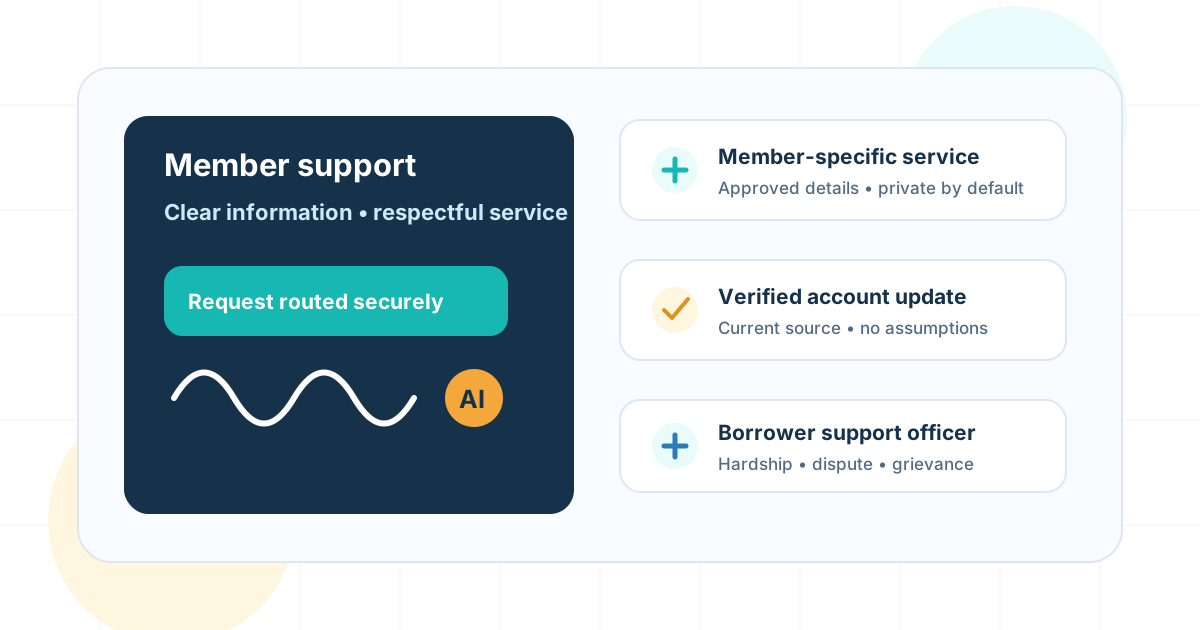
Short answer: An AI voice agent can support a microfinance institution with narrow member-service workflows such as approved reminders, basic process information, callback capture, and routing to staff. Any account-specific repayment or recovery communication needs the institution’s approved verification, current account data, and contact policy. The agent must not pressure borrowers, expose financial details to a group or third party, or make lending or restructuring decisions.
This guide is for regulated microfinance lenders, NBFC-MFIs, banks with microfinance portfolios, and their customer-support operations. It covers member service, meeting and document reminders, repayment information, complaint routing, and safe escalation. Microfinance products have a distinct RBI framework; teams should map every proposed call to the current requirements for their institution and loan product before use. This is operational guidance, not legal advice.
Start with member service, not automated credit decisions
Useful low-risk starting workflows can include explaining an approved process, reminding a member about a scheduled service interaction, routing a branch or field-team enquiry, collecting a callback preference, or confirming that a request reached the institution’s system. Keep the scope explicit and tell members when they are speaking with an automated assistant under the institution’s approved call policy.
The agent should not assess household income, repayment capacity, eligibility, loan approval, restructuring, or waiver requests. It should not invent a balance, payment date, fee, or consequence from generic knowledge. Use a current authorized account source for personal information; if the system cannot verify a value, say it cannot confirm it and create a tracked follow-up.
Design repayment communication for privacy and dignity
Before sharing a borrower-specific amount or status, follow the institution’s approved identity and authorization process. A centre meeting, joint liability group, family relationship, or shared phone does not by itself authorize disclosure of an individual’s account information. Do not state a person’s balance, overdue status, or loan details where other members or family can hear it.
Keep language neutral, accurate, and respectful. RBI’s microfinance directions, updated July 17, 2025, specifically treat persistent calls and recovery calls before 9:00 a.m. or after 6:00 p.m. as harsh recovery practices. They also require regulated entities to identify borrowers facing repayment difficulties, engage with them, guide them about available recourse, and maintain a dedicated mechanism for recovery-related grievances. Configure the applicable contact window and escalation route in the institution’s system, and have compliance verify the current rule for the specific product.
The separate RBI recovery-agent circular expressly excludes microfinance loans covered by the microfinance directions. Do not copy the general 8:00 a.m.–7:00 p.m. recovery-call window into a covered microfinance workflow; use the applicable microfinance controls. The regulated entity remains responsible for outsourced activity and the conduct of its agents.
Separate a reminder from a payment transaction
The voice agent can point to an institution-approved secure payment channel. It should never ask for a PIN, OTP, password, card security code, or banking credential on a call. Confirm payment only when the core ledger or payment service returns an authoritative success result. A borrower saying they paid is important information to record and verify, but not itself a ledger confirmation.
If the borrower disputes the amount, reports a failed payment, says the account belongs to someone else, or reports a lost phone or possible fraud, stop the routine reminder. Record the concern neutrally and route it to the correct team. Do not keep repeating an unverified demand while a payment or account-status check is pending.
Give complaints and hardship a real route to people
Define an easy path to the branch, borrower-support, collections-review, or grievance owner. A request for a person, hardship, bereavement, a payment dispute, alleged misconduct, privacy concern, or safety issue should not be trapped in a reminder loop. If a transfer is unavailable, create a callback only when the system confirms it and give the member an accurate reference or next step.
Capture the minimum context staff need: the member’s stated concern, preferred contact time, language, and any verified reference permitted by policy. Do not ask the member to repeat sensitive details in front of other people. Keep the complaint outcome separate from the call disposition; the automated call ending is not proof that the issue was resolved.
Support local languages without changing the safeguards
Members may prefer different languages or code-switch during a call. Test the exact languages, dialects, names, dates, amounts, and repayment terms used in the intended area. Let the member correct a misunderstood number or date, repeat the final detail clearly, and route uncertain account information to a person. A language model must not translate an uncertain amount into a confident demand.
Use the same privacy, verification, contact-window, escalation, and refusal rules in every supported language. Review real test audio with local operations staff and speakers familiar with the language and context; transcript accuracy alone does not prove that the call sounded clear or respectful.
Connect only the systems needed for the chosen task
Map the workflow to the system that owns each fact or action: member directory, loan-management system, authorized payment ledger, service or grievance queue, callback calendar, and telephony suppression controls. Grant minimum permissions. Keep credentials server-side, record which source supplied each personal status, and log whether a system action actually succeeded.
Design failure behavior before launch. If member verification fails, do not disclose status. If a repayment lookup times out, do not redial with the same demand. If callback creation fails, do not claim a callback is booked. Check for an existing request before retrying a write so one call does not create duplicate tasks.
Test with member-service and compliance owners
Before a pilot, include the institution’s member-service team, operations, compliance, information security, and system owners in scenario testing:
- A verified member asks for a basic process answer.
- A shared phone is answered by a family member or another group member.
- A member says a payment was made but the ledger has not updated.
- The borrower disputes the amount or due date.
- A callback or branch request is recorded and must be fulfilled.
- A member reports hardship, illness, bereavement, or distress.
- The caller changes language or corrects a misunderstood number.
- The account, payment, or grievance system is unavailable.
- A reminder is suppressed or outside the institution’s approved contact window.
Review the audio with the loan-system record, payment status, campaign attempt log, and receiving queue. Confirm that the agent did not reveal information to another person, state an unverified amount, make a credit decision, promise relief, or leave a member without a functioning human route.
Measure service quality and control outcomes
Track correct member routing, verified information accuracy, completed callbacks, payment-status accuracy, complaint and hardship handoff success, repeat contacts, wrong-party disclosures, contact-policy violations, complaints about the automation, and staff correction time. Compare against a baseline and review adverse outcomes before expanding beyond the tested use case.
Do not judge the pilot only by payment conversion or calls contained by automation. Member trust, correct information, successful redress, privacy, and access to staff are core operational outcomes. For adjacent finance workflows, read the BFSI voice-agent overview, loan repayment reminder guide, loan inquiry guide, India compliance checklist, and security guide.
Frequently asked questions
Can an AI voice agent support a microfinance institution in India?
It can handle bounded member-service tasks such as approved meeting or service reminders, basic process FAQs, callback capture, and routing. Account-specific repayment information requires authorized data, suitable verification, current policy, and human oversight.
Can AI make microfinance repayment or recovery calls?
A regulated entity must design and supervise any such workflow under the rules that apply to its microfinance product. The AI should never pressure or shame a borrower, disclose debt to other people, or negotiate or promise an outcome without explicit authority.
What hours apply to microfinance recovery calls?
RBI’s microfinance directions treat persistent calls and recovery calls before 9 a.m. or after 6 p.m. as harsh practices. The regulated entity should confirm current applicability and implement the approved contact window in its dialing controls.
How should an AI agent handle group-lending or centre-meeting information?
Share only the information needed with the verified member through an approved process. Do not reveal an individual member’s loan, balance, or repayment status to a group, another member, or an unauthorized contact.
Can a voice agent confirm a microfinance repayment?
Only after the institution’s authoritative account or payment system confirms it. If the system is delayed or unavailable, the agent should record the member’s report and create a tracked review instead of repeating an unverified demand.
Should an AI agent assess a borrower’s repayment capacity?
No. The agent should not make creditworthiness, household-income, loan-sanction, or restructuring decisions. It should route requests for financial assessment or an exception to trained staff using the institution’s approved process.
What should happen when a microfinance borrower reports hardship or a complaint?
Stop the routine reminder, capture the concern neutrally, avoid promising relief, and create a traceable handoff to the appropriate grievance or borrower-support team. Urgent safety concerns should follow the institution’s approved escalation procedure.
What should an MFI measure in a voice-agent pilot?
Measure correct member routing, verified information accuracy, completed callbacks, complaint and hardship handoffs, repeat contacts, wrong-party disclosures, payment-status accuracy, complaints about automation, and staff correction effort.
Related guides
Continue with the BFSI and NBFC voice-agent guide, responsible loan repayment reminder guide, security checklist, human handoff guide, and AI voice agent testing checklist.
Put these ideas into production
Deploy AI voice agents in minutes and build outbound, inbound, and follow-up workflows on one platform.
Related Articles
AI Voice Agents for BFSI, NBFCs, and Loan Collections
Learn how BFSI, NBFC, lending, and insurance teams in India use AI voice agents for reminders, collections follow-ups, renewals, application status updates, and customer support workflows.
AI Voice Agents for Loan Repayment Reminders in India: EMI Calls and Safe Escalation
How Indian banks and NBFCs can use AI voice agents for verified EMI reminders, payment follow-up, dispute routing, and borrower support with responsible recovery controls.
AI Voice Agents for Loan Applications and Inquiries in India
A practical guide for Indian lenders and NBFCs designing AI voice workflows for loan inquiries, application follow-ups, document reminders, and safe human escalation.
Is AI Calling Legal in India? Consent, DND, Recording, and TRAI Checklist
A practical India compliance checklist for AI voice agents covering consent, DND, UCC, DLT, call recording, DPDP data protection, WhatsApp follow-ups, and safe human handoff.
Is Your AI Voice Agent Secure Enough for Customer Calls?
Use this AI voice agent security checklist to protect call recordings, transcripts, customer data, tool access, prompt injection surfaces, retention policies, and audit logs.
When Should an AI Voice Agent Transfer to a Human?
Learn when an AI voice agent should transfer to a human, how cold transfer, warm transfer, smart routing, and context handoff work, and what Indian businesses should test before launch.