AI Voice Agents for Loan Repayment Reminders in India: EMI Calls and Safe Escalation
AI Voice Agents for Loan Repayment Reminders in India: EMI Calls and Safe Escalation
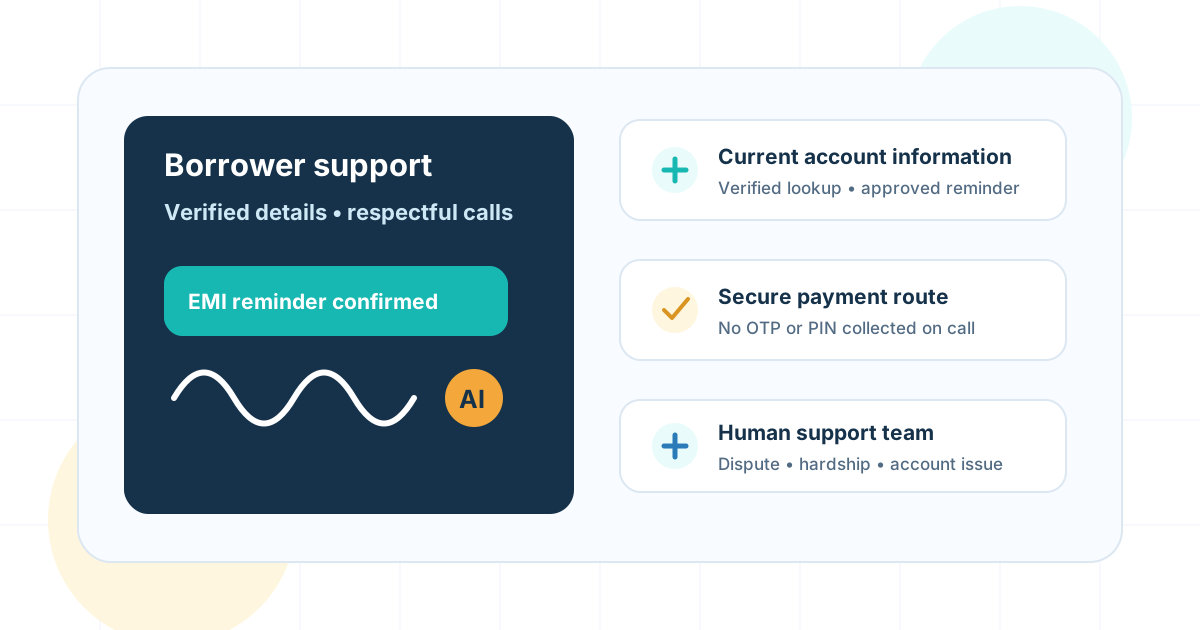
Short answer: An AI voice agent can support a lender’s narrow EMI reminder workflow by sharing verified repayment information, directing a borrower to an approved payment channel, recording a callback request, and routing disputes or hardship to trained staff. It must follow the lender’s current contact policy and applicable requirements. It should never threaten, shame, expose debt information to another person, or claim a payment is overdue without a current authoritative record.
This guide is for banks, NBFCs, and lending operations teams assessing inbound or outbound voice automation for repayment reminders and early payment follow-up. It does not prescribe a collection strategy or replace legal and compliance review. The regulated lender remains accountable for its processes, including work performed by service providers and recovery agents.
Start with a reminder workflow, not autonomous collections
An initial pilot should do a small number of things reliably: identify itself using the lender-approved introduction, follow the approved borrower verification route, state only the relevant due information returned by the lender’s system, and offer a safe next action. Examples include hearing a general reminder, requesting a callback, saying a payment was already made, asking for an authorized payment link, or requesting a human.
Do not let a language model calculate dues from an old export, infer delinquency from a call list, or choose consequences. Retrieve the amount, due date, product label, and account status from the authoritative lender system at the time of the call. If the record is unavailable, conflicting, or stale, withhold the account-specific statement and route the case for review.
Apply contact-time and conduct controls before dialing
RBI’s August 2022 circular on regulated entities employing recovery agents says that the covered entities and their agents must not use intimidation or harassment, including persistent calls, calls before 8:00 a.m. or after 7:00 p.m. for recovery of overdue loans, public humiliation, privacy intrusions, inappropriate messages, threats, or false and misleading representations. The circular applies to specified regulated entities and excludes microfinance loans covered by the cited microfinance directions. Lenders must check the current requirements and scope for their own institution and product before configuring any campaign.
Encode approved contact windows, borrower time zone, frequency caps, suppression rules, and retry limits in the campaign system itself. The agent should not decide to redial because a conversation ended early. Record attempts centrally across vendors and channels so another dialer cannot bypass the limit. Keep the lender’s compliance owner responsible for approving scripts, schedules, and escalation rules. See the RBI recovery-agent circular and have qualified compliance counsel validate applicability.
Verify the account and protect the borrower’s privacy
Use the lender’s approved identity and authorization process before sharing account-specific details. If another person answers, keep the message generic and do not reveal that a named individual has a loan, owes a balance, or missed a payment. Do not disclose debt details to family members, referees, colleagues, or other third parties.
Collect only what is needed to route the call. Never ask the borrower to speak an OTP, PIN, password, card security code, or online banking credential. Send the borrower to the lender’s authenticated app, website, or other approved payment channel. Confirm that a payment was received only after the core ledger or payment service returns a successful, current result; a screenshot promise or caller statement is not a ledger confirmation.
Use accurate language and respect borrower intent
The voice agent should clearly identify itself and the lender according to the lender’s approved policy. It should use calm, neutral wording and avoid misleading urgency. It must not threaten legal action, seizure, credit-score consequences, public disclosure, or other outcomes unless an authorized person has approved accurate wording for that specific circumstance.
If the borrower says payment is complete, disputes the amount, reports an account takeover, says the account belongs to someone else, or asks to stop the automated conversation, do not loop through the same demand. Capture the statement without treating it as proof of a new balance, apply the lender’s suppression or review procedure where required, and create a traceable handoff. Hardship, bereavement, medical distress, or a request to change repayment terms should go to a trained human team.
Keep payment options and promises within authority
The agent may explain a lender-approved payment route or record the borrower’s stated intent to pay, preferred callback time, or request for assistance. A stated promise to pay is a call outcome, not a payment and not an agreement to change the loan. The agent must not invent a waiver, reverse a fee, extend a due date, restructure a loan, settle a balance, or represent that a credit decision has been made.
If the lender authorizes the voice workflow to present defined options, retrieve those options from the lender’s current system and state their conditions accurately. Route any request outside the approved menu to authorized staff. RBI guidance also makes clear that outsourcing does not remove a regulated entity’s responsibility for its agents; a voice-AI vendor does not take that accountability away from the lender.
Design auditable integrations and failure handling
Connect the workflow only to the minimum systems needed: the account source for verified due details, the approved identity flow, campaign suppression and attempt controls, secure payment channel, CRM or collections queue, and human transfer or callback service. Log the data source and retrieval time for each account-specific statement. Keep call outcomes separate from verified system events such as payment received, dispute opened, or callback completed.
Define what happens when each integration fails. If a payment lookup times out, do not repeat a demand. If an outbound call connects to the wrong person, do not expose account information. If a transfer fails, create a tracked callback only when the system confirms its creation and tell the borrower what is actually arranged. Include idempotency or duplicate checks before retrying writes.
Test before a controlled pilot
Test with compliance, collections operations, customer support, security, and the system owners. Include at least these cases:
- Correct borrower, current amount due, and a clear reminder.
- A family member or wrong number answers.
- The borrower says they already paid and the ledger is delayed.
- The amount or due date differs between two systems.
- The borrower disputes the debt or reports identity theft.
- A call attempt falls outside the configured contact window.
- The borrower reports hardship, distress, or requests a person.
- The payment link, account lookup, or callback queue is unavailable.
- A retry risks creating a duplicate task or contacting a suppressed number.
Review the audio or transcript together with the ledger, attempt log, and resulting task. Confirm there was no account disclosure to a third party, unsupported balance statement, harassment, unapproved promise, or bypass of contact rules. Test all supported languages and accents with the same guardrails and with interruptions, silence, and misunderstood dates or amounts.
Measure quality, not just collection yield
Track verified-contact rate, correct account and due-detail statements, secure-channel completion, payment status confirmed by the ledger, promise-to-pay intent recorded accurately, completed human handoffs, disputes and hardship routed correctly, repeat calls, complaints, contact-window violations, wrong-party disclosures, and staff correction time. Compare results to a baseline and review harmful or misleading interactions as release blockers.
Do not optimize on payment conversion alone. A campaign that increases payments while also increasing disputes, repeat calls, privacy incidents, or complaints is not a successful automation. Report borrower experience and control outcomes alongside operational measures. For adjacent workflows, read the BFSI voice-agent overview, loan application inquiry guide, India compliance checklist, security guide, and human handoff guide.
Frequently asked questions
Can AI voice agents make EMI reminder calls in India?
A lender may use voice automation for a bounded reminder workflow, subject to its applicable rules, customer-contact policies, verified account data, approved scripts, and human oversight. The regulated lender remains responsible for the workflow.
What can an AI agent say in a loan repayment reminder?
After the lender’s identity checks, it can share approved, current repayment information, provide an authorized payment route, record a callback request, or route a dispute. It should not threaten, shame, misstate consequences, or promise a waiver or restructuring.
What hours can recovery calls be made?
The RBI’s August 2022 recovery-agent circular directs the regulated entities within its scope and their agents not to call borrowers for recovery before 8 a.m. or after 7 p.m. The lender should verify the circular’s applicability to its entity and product, and apply its current approved contact controls.
Can a voice agent collect a payment during a call?
It should direct the borrower to a lender-approved secure payment channel and never ask for an OTP, PIN, password, or full payment credentials in the conversation. Payment completion should be confirmed only from the lender’s authoritative system.
What should happen if a borrower disputes the amount or says they have paid?
Stop the reminder script, avoid repeating an unverified demand, check only through the authorized ledger, and create a tracked service or collections review. Do not continue collection attempts as if the dispute or payment report had not been raised.
Should an AI agent negotiate repayment or restructure a loan?
Only an explicitly authorized, lender-approved workflow may present options it is permitted to offer. The agent should not independently negotiate, change terms, promise a settlement, or make a credit decision; hardship and exceptions should go to trained staff.
What metrics should a lender use for an EMI reminder pilot?
Track verified-contact rate, correct balance and due-date statements, promise-to-pay intent captured accurately, payment status confirmed by the ledger, dispute and hardship handoffs, complaints, repeat contacts, contact-policy violations, and staff correction effort.
Related guides
Continue with the BFSI and NBFC voice-agent guide, loan inquiry guide, India compliance checklist, security checklist, and voice-agent testing checklist.
Put these ideas into production
Deploy AI voice agents in minutes and build outbound, inbound, and follow-up workflows on one platform.
Related Articles
AI Voice Agents for BFSI, NBFCs, and Loan Collections
Learn how BFSI, NBFC, lending, and insurance teams in India use AI voice agents for reminders, collections follow-ups, renewals, application status updates, and customer support workflows.
AI Voice Agents for Loan Applications and Inquiries in India
A practical guide for Indian lenders and NBFCs designing AI voice workflows for loan inquiries, application follow-ups, document reminders, and safe human escalation.
Is AI Calling Legal in India? Consent, DND, Recording, and TRAI Checklist
A practical India compliance checklist for AI voice agents covering consent, DND, UCC, DLT, call recording, DPDP data protection, WhatsApp follow-ups, and safe human handoff.
Is Your AI Voice Agent Secure Enough for Customer Calls?
Use this AI voice agent security checklist to protect call recordings, transcripts, customer data, tool access, prompt injection surfaces, retention policies, and audit logs.
When Should an AI Voice Agent Transfer to a Human?
Learn when an AI voice agent should transfer to a human, how cold transfer, warm transfer, smart routing, and context handoff work, and what Indian businesses should test before launch.
How Do You Test an AI Voice Agent Before It Goes Live?
A practical AI voice agent testing checklist for teams preparing to launch real customer calls. Learn how to test latency, Hindi and Hinglish conversations, interruptions, tool calls, handoff, and production readiness.