Are Failed Calls, Ringing and Voicemail Charged by AI Calling Platforms?
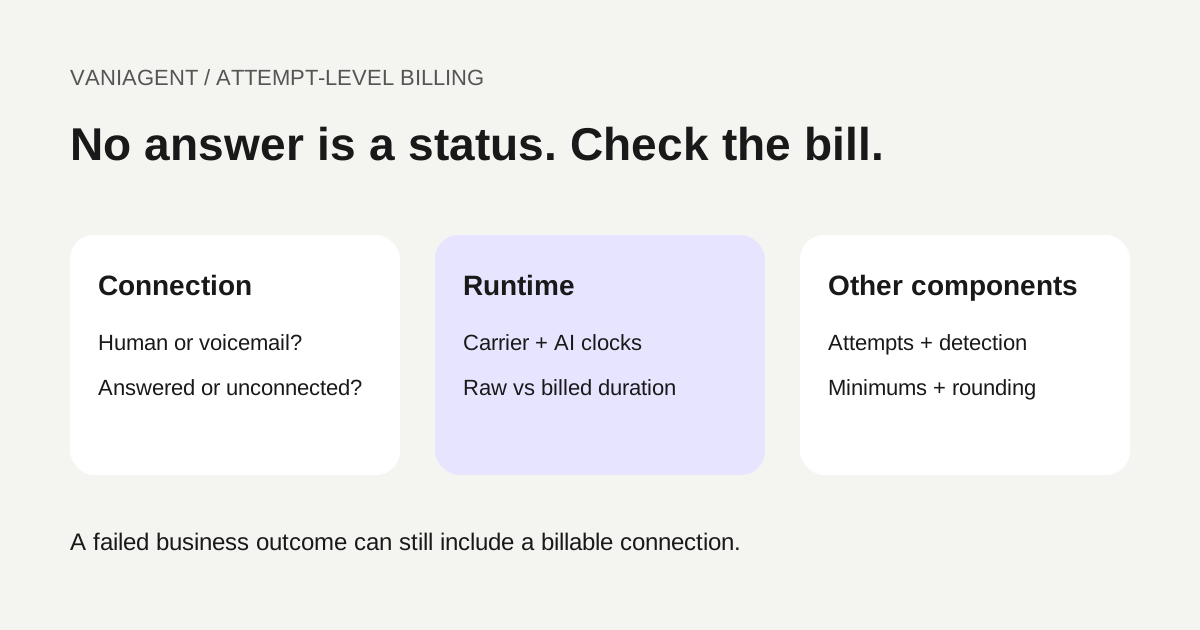
There is no universal rule that failed calls, ringing or voicemail are free across AI calling platforms. Separate carrier usage, AI runtime, campaign attempts, answering-machine detection and minimum billing rules. A failed business outcome can still contain a billable telephone connection or active AI session.
This guide gives procurement questions, a fictional attempt-level budget and an invoice checklist for Indian businesses. It does not publish VaniAgent billing rules or substitute invented rates for a written quote. For the wider framework, see the AI voice agent pricing guide for India.
Separate network status from business outcome
An attempt can fail to reach a person even when a voicemail system answers. A customer may answer and immediately hang up. A transferred call can reach an automated queue rather than the intended staff member.
| Observed outcome | Evidence needed before pricing it |
|---|---|
| No answer | Final provider status, answer timestamp if any and billed units |
| Busy or failed connection | Provider error, final status and any separate attempt fee |
| Voicemail | Connection duration, classification and AI-active duration |
| Very short human answer | Actual duration plus minimum and rounding rules |
| Transfer destination does not answer | Original customer leg, target leg and AI session timeline |
| Call completed | Who answered, what connected and whether the task succeeded |
Keep operational status and business outcome in separate fields. Do not report every completed connection as a live conversation, or every unsuccessful task as a free failed call.
What current provider references establish
Twilio's call-status help article states that busy, no-answer, canceled and failed call statuses are not charged against its project balance, while completed indicates an established audio connection. That provider-specific statement should not be extended to an unrelated AI or campaign invoice.
Retell's pricing page describes billing while the AI remains active on voicemail and explains that silence can remain within billable call duration. Its billing-exceptions documentation also describes a ten-second minimum for short calls using dynamic opening messages when AI speaks first, plus adjustments for long prompt contexts. Those conditions matter; do not apply the minimum to every call without checking applicability.
Twilio's voice pricing page lists answering-machine detection as a separately priced feature. The linked page is a US pricing reference, not an Indian carrier quote. Confirm your account, route, currency and commercial terms.
These references were checked on 16 October 2026. They illustrate different billable components rather than establish a cheapest provider. Ask the proposed supplier to calculate your specific cases and explain all exclusions.
Ask when each clock starts and stops
“We charge only connected minutes” is incomplete unless connected is defined. Does the carrier start at answer? When does the AI session start? Is an answered IVR or voicemail treated differently from a person? Does the platform stop billing immediately when it detects voicemail or only after it disconnects?
Request a timeline for ringing, answer, detection, speech, hold and termination. For transfers, the original leg can remain active while another target rings. That differs from an unanswered outbound attempt with no original caller connected.
Use the warm-transfer cost worksheet for overlapping legs. A label such as “transfer failed” should not erase the original customer minutes from a budget.
Worked budget: 1,000 attempts with different outcomes
All rates and durations in the following model are fictional teaching assumptions. They are not market benchmarks, provider offers or claims about VaniAgent charges.
Assume 1,000 outbound attempts produce 400 human connections, 100 voicemail connections, 400 no-answer outcomes and 100 busy or failed outcomes. Human conversations average two minutes; voicemail connections keep both AI and carrier active for twenty seconds.
The invented quote charges Rs 2 per AI minute, Rs 1 per carrier minute, Rs 0.05 per attempt and Rs 0.10 per answered call for detection. It charges no time-based usage on the 500 unconnected attempts. For simplicity, there is no rounding, minimum duration, transfer, recording, tax or setup in this model.
| Component | Calculation | Cost |
|---|---|---|
| Human-connected duration | 400 × 2 minutes = 800 minutes | Used below |
| Voicemail-connected duration | 100 × 20 ÷ 60 = 33.333… minutes | Used below |
| AI service | 833.333… × Rs 2 | Rs 1,666.67 |
| Carrier service | 833.333… × Rs 1 | Rs 833.33 |
| Attempt fees | 1,000 × Rs 0.05 | Rs 50.00 |
| Detection | 500 answered calls × Rs 0.10 | Rs 50.00 |
| Variable subtotal before tax | Sum using unrounded quantities | Rs 2,600.00 |
The 500 unconnected attempts still contribute Rs 25 in the fictional attempt-fee row, even though their time-based charges are zero. Voicemail contributes Rs 100 in combined AI and carrier time, before its allocated attempt and detection charges. This is why a carrier's no-answer policy cannot alone determine total campaign cost.
Keep full precision through the calculation and round currency at the declared invoicing stage. A real quote may round each call or each component separately, changing the total.
Compare cost per human connection and verified result
In the example, Rs 2,600 divided by 400 human connections is Rs 6.50 per human-connected call. If 80 calls produce a defined verified outcome, the variable cost per outcome is Rs 32.50. Both figures exclude fixed fees and all omitted costs.
The outcome definition must come from the business. Answering “hello,” accepting a sales pitch and completing a booking are different events. Use the cost per qualified lead guide to define the denominator before comparing campaigns.
Do not divide cost only by the cheapest subset while ignoring the rest of the attempts. Voicemail, retries and failures belong in the campaign cost even when they are excluded from the successful-outcome count.
Test minimums and rounding with short calls
Create sample cases with six seconds, twenty seconds and sixty-one seconds of chargeable duration. Ask the supplier to show the billed units for each component. A one-minute minimum, per-second billing and rounding to the next minute produce different answers.
For illustration, ten twenty-second connected calls contain 200 raw seconds. If a fictional carrier rounds each to a full minute, they produce ten billed minutes rather than 3.333 raw minutes. At an assumed Rs 1 per minute, the carrier cost is Rs 10 instead of approximately Rs 3.33. This is arithmetic, not a claim about any provider's rule.
Check whether configuration-specific adjustments apply only to one component. Do not multiply carrier duration merely because an AI model charge has a separate adjustment. Keep the billing definitions tied to their invoice lines.
Control voicemail behaviour and retries deliberately
Decide whether the permitted workflow hangs up on detected voicemail, leaves an approved message or routes the result for staff. Verify detection quality on the intended route: a misclassification can disconnect a real person or keep an agent talking to a machine.
Keep any voicemail message suitable for an unverified listener. Do not disclose sensitive information merely because the destination number matches a contact record. Apply the business's approved communication and contact rules.
Set retry limits, intervals and stop conditions. A contact can have several attempts but remains one person. Suppress withdrawn or otherwise ineligible contacts, and do not respond to a poor answer rate simply by increasing attempts without reviewing permissions and operational impact.
Budget retries as new attempt records linked to the original task. Distinguish no answer, technical failure, explicit refusal and successful completion so the scheduler does not retry cases that should stop.
Build an attempt-level invoice worksheet
| Field | What it helps verify |
|---|---|
| Attempt ID and contact/task reference | Separates retries from unique people |
| Provider call and leg IDs | Connects operational records to charged services |
| Final status and answer classification | Distinguishes a person, machine and unconnected attempt |
| Initiated, answered and ended times | Reconstructs the carrier timeline |
| AI start and stop | Checks the actual AI-active interval |
| Raw and billed duration | Makes minimums and rounding visible |
| Detection and attempt fees | Identifies separately priced events |
| Rate, currency and invoice item | Reconciles the amount against the written quote |
| Verified outcome | Keeps business success separate from connection status |
Mark unavailable prices as pending, not zero. Some billing data may arrive later than the final call event. Reconcile after the relevant records mature and preserve the time of the export.
Ask the supplier to price these acceptance cases
- An outbound attempt that rings until no answer.
- A busy destination and a connection failure with its error code.
- A voicemail connection followed by immediate hang-up on detection.
- A voicemail connection with an approved message left.
- A six-second human answer under the chosen opening configuration.
- An answered queue or IVR that never reaches a person.
- A failed warm transfer while the original caller stays connected.
- Several retries to one permitted contact, with all attempt records visible.
For each, inspect the final provider state, AI duration, optional features and invoice amount. Use fictional or authorized test destinations and the intended production configuration. A vendor demonstration of a successful conversation does not establish the price of these failure paths.
Approve the quote only when the components reconcile
Keep fixed platform fees, number rental, storage, concurrency and setup separate from the attempt subtotal. Reconcile credits as funding for usage rather than adding the same prepaid consumption twice. Use the billing audit guide and mixed-workload budget to complete the monthly picture.
The useful purchasing answer is not “failed calls are free.” It is a written, tested explanation of what each attempt state costs in your configuration, with a budget based on the outcomes your campaign actually produces.
Frequently asked questions
Do AI calling platforms charge for failed calls?
Check each supplier and component. A carrier may waive usage for specified unsuccessful statuses while the AI platform or campaign service has separate fees, minimums or adjustments. Request a sample invoice for the actual failed-call cases rather than assuming the whole attempt is free.
Is ringing time billable?
Ask when each billing clock starts. Ringing before answer, an answered queue and hold during a transfer are different states. A single ringing label in a dashboard is not enough to determine the charge.
Does reaching voicemail count as an answered call?
A voicemail system can answer the telephone connection even though a person did not. Inspect answer classification, duration and message outcome separately. Carrier-connected does not mean a customer conversation or a qualified lead.
Is answering-machine detection free?
Do not assume it is included. Ask whether detection has a per-call charge, which attempts qualify and whether the charge is separate from carrier and AI usage.
Can a short call cost more than its raw seconds suggest?
Yes, where the applicable quote uses minimum duration, rounding or configuration-specific adjustments. Apply those rules per billable component rather than dividing total raw seconds by sixty and assuming that is the invoice quantity.
Should retries count as new calls in the budget?
Keep every attempt as a separate record linked to the same contact or task. Apply the quote to each attempt and report unique people, connected calls and attempts separately.
Verify your attempt-level budget
Bring your outcome mix, sample call records and billing questions to a scoped VaniAgent demonstration. Confirm the applicable written terms and sample invoice before setting a campaign budget.
Put these ideas into production
Deploy AI voice agents in minutes and build outbound, inbound, and follow-up workflows on one platform.
Related Articles
AI Voice-Agent Billing Audit: Match Call Records to Your Invoice
Reconcile call-level usage with an invoice using contract increments, transfer legs, credits, adjustments and a clearly fictional worked invoice.
AI Voice Agent Pricing in India: Per-Minute vs Monthly Plans
Compare AI voice agent pricing in India, including current VaniAgent plans, inbound and outbound call costs, usage, onboarding fees, telephony, and ROI.
Inbound vs Outbound AI Calling Costs in India: A Mixed-Workload Budget
Build an inbound and outbound AI calling budget for India with worked calculations for minutes, attempts, transfers, carrier fees and setup.
What Does an AI Warm Transfer Cost? Call Legs, Hold Time and Recordings
Calculate AI warm-transfer costs with a worked call-leg budget, hold-time sensitivity, failed handoff checks and a recording and invoice worksheet.