Recording, Storage and Data Residency: The Extra Costs in Voice AI Quotes
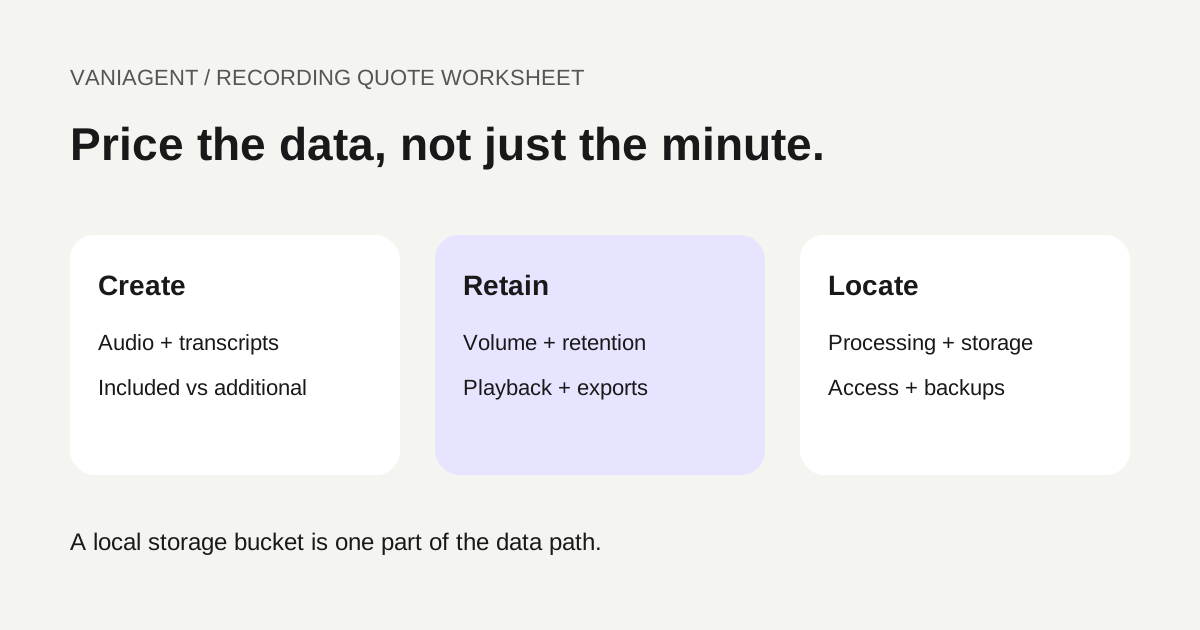
A voice AI quote should separate recording creation, storage duration, access and the scope of any data-residency commitment. A low minute rate can exclude transcripts, downloads, backups or a regional deployment. “Stored in India” also does not establish where live audio is processed or where every derived copy is handled.
This guide provides a fictional storage calculation and a procurement worksheet for businesses comparing AI calling suppliers. It complements the AI voice agent pricing guide for India and billing audit guide. It does not claim a particular VaniAgent hosting location or retention capability.
Inventory the data before comparing prices
List the records produced by a representative call. A business may retain carrier audio, AI-platform audio, a transcript, a summary and CRM notes from the same interaction. Each can have a different storage owner and lifecycle.
| Data category | Questions to include in the quote |
|---|---|
| Audio recording | Which legs or streams, format, channels and creation fee? |
| Transcript | Included or separately charged; retained for how long? |
| Summary and extracted fields | Where saved, who can access them and what is billable? |
| Operational logs | Do they contain content or identifiers; where are they retained? |
| Exports and downloads | Limits, transfer charges and access auditing? |
| Backups and replicas | Included copies, location and expiry? |
| Staff access | Support, administration and cross-region access scope? |
Do not assume a recording and a transcript share the same retention switch. If a caller refuses recording, verify which capture paths are affected using the recording-refusal workflow.
What public provider documentation establishes
Twilio's Voice Recording settings describe external storage that uploads new recordings to a customer-owned AWS S3 bucket instead of Twilio cloud storage. This is a recording configuration, not proof of where every other service processes or retains data.
Twilio's Regions documentation explains regional processing and storage for communications activities. Check the supported products and specific configuration rather than treating a nearby network endpoint as a complete residency commitment.
Amazon S3 pricing separates storage from other components such as requests, retrieval, data transfer and replication. Use the actual region and storage class when quoting those services. These sources were checked on 16 October 2026; they do not establish equivalent features or prices for another supplier.
Estimate audio volume using the actual format
For uncompressed audio, estimate bytes as sample rate × bytes per sample × channels × recorded seconds. For a known compressed bitrate, use bitrate × seconds ÷ eight. Preserve the unit definitions and validate with actual file sizes.
Suppose a fictional workload produces 10,000 recorded minutes each month. Assume the stored format is uncompressed 8 kHz, 16-bit mono PCM, excluding container overhead. It uses 8,000 × 2 = 16,000 bytes per second.
10,000 × 60 × 16,000 = 9,600,000,000 bytes, or 9.6 decimal GB of new audio per month.
This is a specified file-format calculation, not a claim that every telephone recording uses that format. Under the same assumptions, two stored channels would produce 19.2 GB. A compressed format, mixed mono file or additional copy changes the result. Decimal GB and binary GiB are different units; follow the supplier's billing definition.
Retention changes the stored inventory over time
Assume a simplified three-month retention policy, constant monthly production and no prior files. For a planning model that adds a month's files at the beginning of each month, the stored inventory is 9.6 GB in month one, 19.2 GB in month two and 28.8 GB from month three onward, before copies and overhead.
| Planning point | Primary audio inventory under the simplified model |
|---|---|
| Month 1 | 9.6 GB |
| Month 2 | 19.2 GB |
| Month 3 and steady state | 28.8 GB |
Actual billing may use average byte-hours or another measure, while daily production and expiry create a different profile. Do not multiply a month-end inventory by a storage rate and describe it as an exact invoice. Use daily production, deletion and metering rules for a precise forecast.
If there are two equally sized, fully retained copies, the simplified steady-state total becomes 57.6 GB. Replication traffic and operations can add other charges. Confirm what counts as a copy; provider-managed redundancy within a quoted storage service is not automatically another separately billed application replica.
Worked quote worksheet with fictional rates
The following example uses invented prices and the simplified 28.8 GB steady-state inventory. It is not an AWS tariff, supplier quote or VaniAgent offer. Assume the quote bills that inventory as 28.8 GB-month for this example.
| Cost item | Fictional assumption | Example amount |
|---|---|---|
| Recording creation | 10,000 minutes × Rs 0.10 | Rs 1,000.00 |
| Primary storage | 28.8 GB-month × Rs 3 | Rs 86.40 |
| Text transcription | 10,000 minutes × Rs 0.20 | Rs 2,000.00 |
| Downloads | 5 GB × Rs 10 | Rs 50.00 |
| Requests and retrieval allowance | Fixed scoped allowance | Rs 100.00 |
| Illustrative subtotal before tax | Sum of listed items | Rs 3,236.40 |
The example excludes replicas, regional deployment premiums, support, encryption-key operations and other unquoted services. Recording and transcription are deliberately separate; remove or adjust a row if the actual plan already includes it. Do not infer a general cost ranking from these invented rates.
Show setup and migration outside recurring usage. A supplier may quote integration work or a minimum contract separately from storage. Compare the same recording scope and retention period across offers before choosing by subtotal.
Ask what data residency covers
Turn a location claim into a written scope matrix. “India region” should identify the actual services and data categories covered, the exclusions and the evidence the supplier can provide.
| Layer | Evidence to request |
|---|---|
| Live audio transport and processing | Service path and processing locations |
| Speech and model providers | Relevant subprocessors and supported regional configuration |
| Audio and text storage | Region, account ownership and retention settings |
| Logs, analytics and monitoring | Content captured, storage region and access rules |
| Backups and recovery | Copy locations and expiry process |
| Support and administrators | Access locations, approval controls and auditability |
| Exports and integrations | Destination systems and their separate responsibilities |
Distinguish storage location, processing location and access location. A local bucket cannot establish the location of a speech service or a CRM export. Encryption is a separate control; it does not itself prove geographical confinement.
This worksheet asks for evidence rather than asserting that every business has the same localization requirement. Have the responsible privacy, security and legal team define the actual contractual and sector requirements. Obtain written confirmation of the proposed implementation instead of relying on a marketing badge.
Make retention and deletion testable
Define when the retention clock begins and what happens when an interaction is edited, exported or placed under an authorized preservation requirement. Assign ownership of deletion across the carrier, AI platform, storage account and downstream systems.
Test with fictional records. Confirm that expired audio disappears from normal access, then inspect separately retained transcripts, summaries and exports. Ask how backups expire and what evidence is available; do not equate an inaccessible dashboard item with immediate deletion of every copy.
Keep deletion requests separate from ordinary scheduled expiry. The business needs an approved way to assess and track them, including any applicable preservation requirements. The AI should not promise “everything has been deleted” without verified scope and results.
Check playback, exports and exit costs
Estimate how often staff review recordings and how many files are downloaded for permitted quality review. Ask whether retrieving archived data incurs delay, minimum storage periods or separate restore charges under the chosen service.
For an exit scenario, request the cost and time to export the retained inventory with metadata and identifiers intact. Verify the format, access process, link expiry and destination permissions. An audio file without its interaction reference can be difficult to reconcile or review.
If using customer-owned storage, agree who manages credentials, lifecycle settings, failures and access reviews. External storage moves responsibilities; it does not eliminate them. Test a failed upload and confirm how the business discovers an incomplete recording.
Use a consistent acceptance checklist
- Record a fictional test call and inspect all audio and derived text records.
- Verify file format, measured size, channels and charged duration.
- Trace each retained category to its configured location and owner.
- Test authorized playback and denied access for an inappropriate role.
- Export a sample with its interaction metadata intact.
- Exercise retention expiry and the separate deletion-request process.
- Check transfer segments using the warm-transfer recording guide.
- Reconcile the sample against the quote, allowances and invoice.
Keep unknown items visible and assign them an owner. A useful quote states not only how much recording costs, but what is retained, where it is handled, who can access it and how the business can leave the service with its approved records.
Frequently asked questions
What recording and storage costs should a voice AI quote include?
Ask about recording creation, retained audio, transcripts, summaries, playback, exports, retrieval, backups, deletion and any regional deployment fees. Record included allowances and overages so the same consumption is not counted twice.
Does an India storage bucket mean all voice-agent data stays in India?
No. Trace live audio processing, model and speech services, logs, transcripts, backups, support access and exports separately. A storage location establishes only the scope covered by that configuration and contract.
How do I estimate call-recording storage?
Multiply recorded seconds by the measured or specified bitrate and channel count, then account for the retained duration, copies and overhead. Use actual exported file sizes to validate the estimate; compressed recordings can differ substantially from uncompressed audio.
Does deleting audio also delete the transcript?
Not automatically. Audio, text, CRM notes, summaries, exports and backup copies can have different owners and deletion schedules. Verify each category under the approved retention policy.
Is customer-owned external storage free?
No such assumption is safe. Confirm any provider integration fees and the storage account’s capacity, request, retrieval, transfer, replication and operations costs. Ownership also creates access-control and lifecycle responsibilities.
Should I choose the longest retention period available?
Choose retention according to a documented business and applicable policy requirement. Longer retention can increase cost and the amount of data to protect. Do not select it solely because a supplier includes an allowance.
Review your recording scope
Bring your retention policy, location requirements and expected review volume to a scoped VaniAgent demonstration. Confirm the proposed data path and written costs before relying on a residency or storage claim.
Put these ideas into production
Deploy AI voice agents in minutes and build outbound, inbound, and follow-up workflows on one platform.
Related Articles
AI Voice Agent Pricing in India: Per-Minute vs Monthly Plans
Compare AI voice agent pricing in India, including current VaniAgent plans, inbound and outbound call costs, usage, onboarding fees, telephony, and ROI.
AI Voice-Agent Billing Audit: Match Call Records to Your Invoice
Reconcile call-level usage with an invoice using contract increments, transfer legs, credits, adjustments and a clearly fictional worked invoice.
What Should an AI Agent Do When a Caller Refuses Recording?
Design an AI caller recording-refusal workflow with verified stop controls, transcript checks, accurate scripts, human fallback and retained-media tests.
What Does an AI Warm Transfer Cost? Call Legs, Hold Time and Recordings
Calculate AI warm-transfer costs with a worked call-leg budget, hold-time sensitivity, failed handoff checks and a recording and invoice worksheet.