What Should an AI Agent Do When a Caller Refuses Recording?
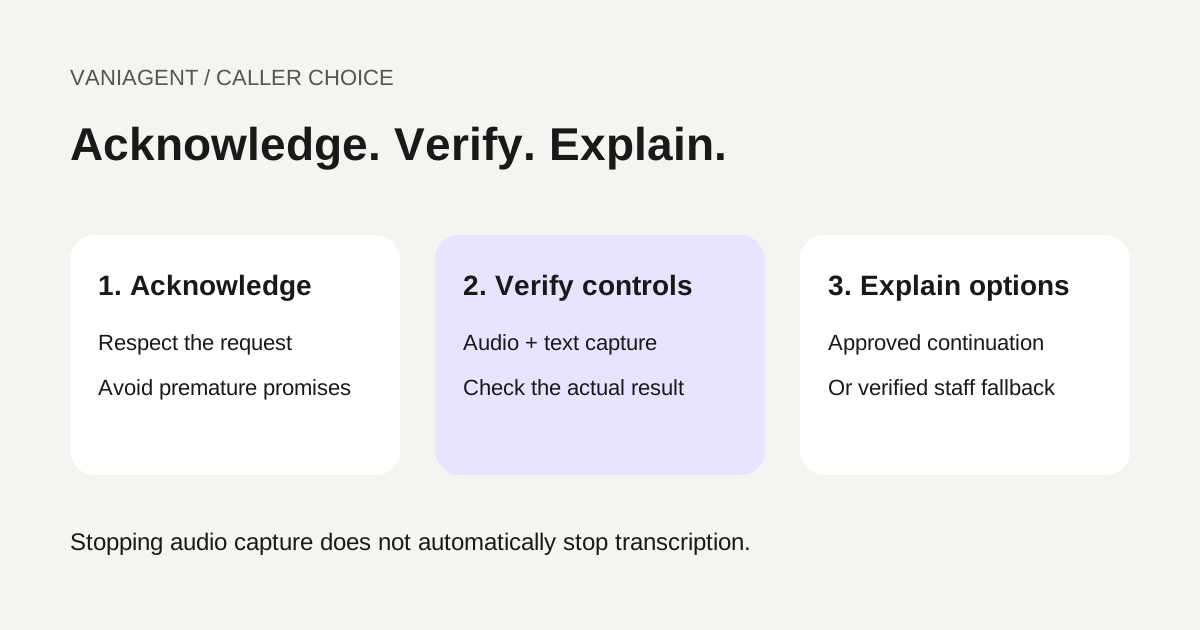
When a caller refuses recording, an AI agent should acknowledge the request and follow a verified control path before continuing with sensitive details. It must not say “recording is off” merely because it heard an objection or sent an API request. If the system cannot provide the promised handling, explain the limitation and offer an approved alternative.
The key design question is what “recording” means in your deployment. A carrier audio file, an AI transcript and a staff monitoring tool may retain different information. Turning off one does not establish that the others are off.
This guide provides an operating worksheet, sample wording and acceptance tests for business teams in India. It describes a proposed workflow, not a claim that a particular VaniAgent deployment already supports recording controls. For the broader policy review, see our AI voice agent compliance checklist for India.
Distinguish recording, live processing and retained text
Map the actual data path before choosing the script. An AI may need to process live audio to understand the caller even when the business does not retain an audio recording. That distinction must be explained accurately, without promising that no information is processed.
| Component | Question to answer before launch |
|---|---|
| Carrier recording | Is a persistent audio file created, and can capture be stopped? |
| AI platform recording | Is another copy retained independently of the carrier? |
| Speech recognition | Is audio processed live, and is any audio or text retained? |
| Transcript and summary | Are generated text records saved after the call? |
| Quality monitoring | Do staff tools, exports or diagnostics retain another copy? |
| Transfer destination | Does the receiving desk or phone system start its own recording? |
| Logs and backups | What remains after a normal deletion or retention action? |
Assign an owner to each setting and document its scope. Avoid a single “recording disabled” flag whose meaning changes between services. The caller-facing promise should match the combination of controls that has actually been tested.
Approve the caller options before writing the prompt
The business should decide which routes can continue without retained audio, which still generate transcripts and which require staff handling. If the current service cannot proceed under the caller's requested conditions, offer a suitable alternative rather than disguising the limitation.
Use a policy matrix such as this:
| Caller request | Approved action if supported | If unsupported or uncertain |
|---|---|---|
| “Please do not record audio” | Stop designated audio capture and explain remaining processing | Offer a verified alternative |
| “Do not keep a transcript either” | Apply the separately approved text-retention controls | Escalate or offer another route |
| “I want the earlier recording deleted” | Create a privacy request under the approved procedure | Explain the request process accurately |
| “Let me speak to someone” | Transfer to an eligible staff route with the preference attached | Offer an agreed callback or other channel |
| “I do not want to continue” | Respect the request and close appropriately | Do not repeatedly seek agreement |
These are operating choices to resolve with the responsible team. Do not turn an illustrative table into an assertion that every business must offer every option in every regulated workflow.
Implement the control outside the language model
The AI should request a defined action; the integration should identify the active recording resources, execute the permitted control and return a structured outcome. Use explicit states such as requested, verified stopped, failed and unknown.
Twilio's Recordings resource documentation, checked on 16 October 2026, describes pause, resume and stop operations for supported active recordings. It also distinguishes update responses from the status available through a later fetch. Match your verification method to those documented semantics rather than assuming every status endpoint reports the same live state.
This is a provider-specific example, not proof of equivalent controls in another platform. Your integration must account for every active capture path, not just the first recording identifier it finds. If a transfer or conference starts another recording, the preference must still govern the approved route.
Keep the model from claiming success when the tool returns an error or an ambiguous response. A retry should be bounded and safe. During uncertainty, stop collecting further sensitive details and take the approved recovery path; do not keep the caller waiting indefinitely while promising privacy controls that may not have applied.
Use wording that reflects the actual state
Before a control result, the agent might say: “I understand. Please avoid sharing sensitive details while I check the available option.” That acknowledges the request without prematurely claiming success.
After a verified result on an approved route, wording might be: “Audio recording has been stopped for this part of the call. This service still processes your speech to respond and keeps a text summary. Would you like to continue?” Use that wording only if it accurately describes the deployed system and the business's approved notice.
If the caller also objects to the summary and the route cannot avoid it, say so: “This automated service cannot continue without that text processing. I can offer the approved alternative.” Name the actual option instead of implying that every staff route has different data handling.
Avoid statements such as “nothing is stored,” “all data is deleted” or “this is completely private” unless the business has evidence supporting that exact scope. A narrow and accurate explanation is more useful than an absolute assurance.
Handle refusal at the start and withdrawal midway separately
At the start of a call, the flow may be able to defer persistent recording until the approved notice and choice step is complete. Confirm what happens during the greeting itself, including buffering and provider defaults. Do not assume the introduction is excluded from capture.
For a midway request, record when the objection was received and when the verified control took effect. Audio captured before that point is a separate retained-data question. Do not silently rewrite the whole call's status to “never recorded.”
A later request to restart recording should follow the approved process as well. The model should not resume capture simply because the caller discusses a new topic. Preserve the preference through reconnections and transfers according to the workflow's defined scope.
Carry the preference through human handoff
Before transferring, confirm the receiving route's recording and transcript behaviour. An ordinary staff phone, contact-centre queue and browser console can have different settings. Share the caller's preference with the authorized receiving team without sending unnecessary personal information.
If the destination cannot meet the requested handling, explain the limitation before connecting. Do not announce an unrecorded transfer and then connect to a system that plays its own recording notice and captures the conversation automatically.
Use our human handoff guide for ownership and escalation, and the warm-transfer cost worksheet to understand how separate legs and recording segments affect the route.
Check the Indian policy context without blanket claims
The Digital Personal Data Protection Act, 2023 addresses consent and withdrawal within its framework. MeitY also publishes the Digital Personal Data Protection Rules, 2025. The applicable provisions, commencement dates, processing basis and sector obligations need a workflow-specific assessment; publication alone does not establish that every provision is in force for every situation.
Have the responsible team approve the notice, caller choices, retention schedule and privacy-request process for the actual business. Do not claim that a generic “this call may be recorded” announcement settles all of those questions. This article's operational design deliberately avoids treating one legal rule as universal across sales, support, healthcare and financial workflows.
Test the retained evidence, not just the conversation
Use fictional, non-sensitive test audio with recognizable markers before and after the control point. Inspect authorized provider records and exported media to determine which segments were captured. Also inspect transcripts, summaries and destination recordings.
| Test case | Evidence to inspect |
|---|---|
| Caller refuses at the opening | Capture defaults and the first retained segment |
| Caller withdraws during an active recording | Request time, control result and retained audio boundary |
| Stop request fails | No false “recording stopped” statement; approved fallback |
| Response is lost | Safe recovery without an unsupported success claim |
| Two capture services are active | Both are handled within the promised scope |
| Call transfers to staff | Destination settings and preference propagation |
| Caller requests deletion | Privacy request recorded separately from stop action |
| Call reconnects | Preference scope applied consistently |
| Caller objects to transcripts | Separate text-handling path or honest limitation |
Automated checks should cover control outcomes and state transitions. A human review should verify the spoken wording and actual media retained in the tested configuration. A transcript saying “recording stopped” is not proof that the carrier stopped recording.
Log enough to audit the choice without adding excess data
Keep a minimal operational record of the interaction reference, requested preference, relevant control identifiers, timestamps, verified outcome and fallback. Limit access to staff who need it. Do not store an entire sensitive transcript merely to prove that a stop request occurred.
Track false-success statements, unresolved controls, unexpected recordings after handoff and delayed privacy requests. Review failures individually before expanding the workflow. If the configuration changes, repeat the media and transfer tests.
A dependable recording-refusal flow joins three things: an approved policy, a technically enforceable control and accurate caller wording. Launch only when the evidence shows that those three agree.
Frequently asked questions
What should an AI agent do when a caller refuses recording?
Acknowledge the request, invoke the approved recording-control workflow and verify the result before promising that recording has stopped. Continue only on an approved route whose data handling can be explained accurately; otherwise offer an appropriate staff or alternative-channel path.
Does stopping call recording also stop transcription?
Not automatically. Carrier audio files, AI streaming, speech recognition, transcripts, summaries and monitoring may be controlled separately. Verify each relevant component before describing a route as unrecorded or untranscribed.
Can the agent say recording is off as soon as it sends a stop request?
No. A request is not evidence of success. Wait for the integration’s verified control result, handle failures explicitly and test the resulting media to establish what the system actually retained.
Does stopping recording delete the audio already captured?
No such assumption is safe. Treat stopping future capture and handling previously retained data as separate operations. Route deletion or access requests through the business’s approved process and applicable retention requirements.
Can a caller continue with a human without recording?
Only if the human route actually supports the promised handling. Verify destination recording, transcription and monitoring settings before transferring. A staff handoff does not automatically disable capture.
Does India require consent for every possible call recording?
Do not reduce all use cases to one blanket rule. Have the responsible legal and privacy team determine the applicable rules, processing basis, notices, sector obligations and effective dates for the particular workflow. Implement the approved caller choices and evidence requirements consistently.
Review your recording controls
Bring your approved notice, recording providers and staff routes to a scoped VaniAgent demonstration. Verify capture and retained records with fictional test calls before enabling the promised caller choice.
Put these ideas into production
Deploy AI voice agents in minutes and build outbound, inbound, and follow-up workflows on one platform.
Related Articles
Is AI Calling Legal in India? Consent, DND, Recording, and TRAI Checklist
A practical India compliance checklist for AI voice agents covering consent, DND, UCC, DLT, call recording, DPDP data protection, WhatsApp follow-ups, and safe human handoff.
When Should an AI Voice Agent Transfer to a Human?
Learn when an AI voice agent should transfer to a human, how cold transfer, warm transfer, smart routing, and context handoff work, and what Indian businesses should test before launch.
What Does an AI Warm Transfer Cost? Call Legs, Hold Time and Recordings
Calculate AI warm-transfer costs with a worked call-leg budget, hold-time sensitivity, failed handoff checks and a recording and invoice worksheet.