AI Voice Agents for Travel Agencies in India: Enquiries and Booking Support
AI Voice Agents for Travel Agencies in India: Enquiries and Booking Support
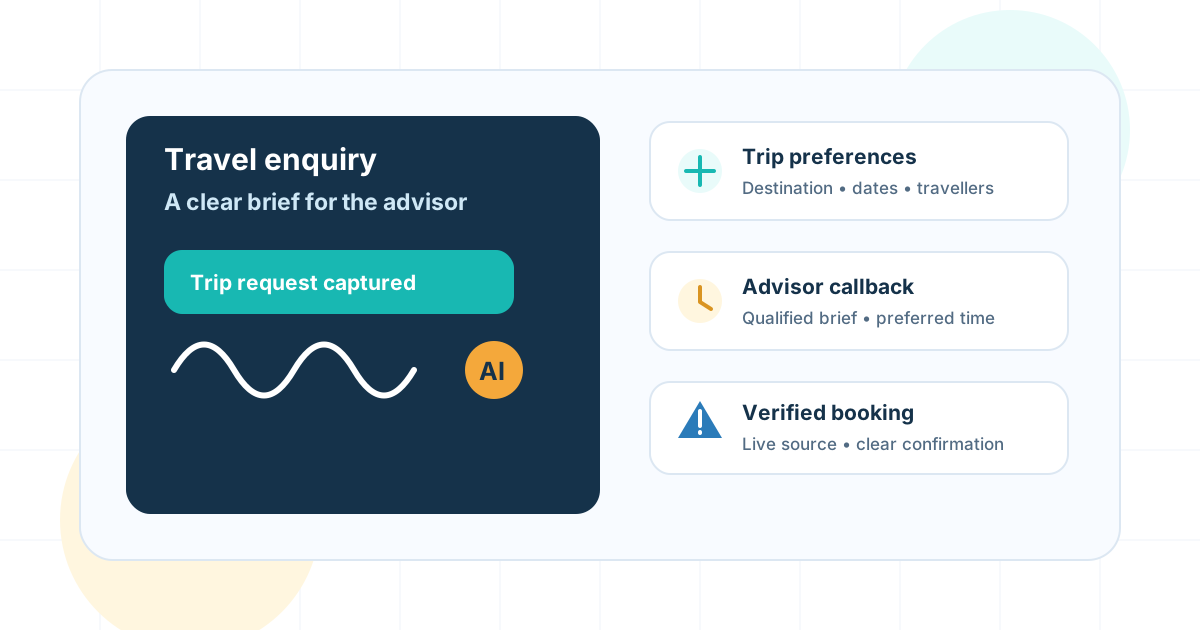
Short answer: A voice agent can help an Indian travel agency answer routine calls, capture trip requirements, qualify package enquiries, and route existing-booking questions. It should quote availability, prices, or terms only from current approved information, and confirm a booking or change only after the authorized reservation system verifies it. Complex itineraries and urgent travel problems need a fast handoff to a human advisor.
This guide is for travel agencies, tour operators, and holiday-package teams. It focuses on the work around phone enquiries and advisor follow-up. It does not assume access to airline, hotel, global distribution, tour inventory, or payment systems.
Where a voice agent fits in an agency workflow
A new traveller may call with only a rough idea: a destination, approximate dates, number of people, budget range, or a special requirement. An advisor then needs a concise, accurate brief to recommend options. Existing customers call for confirmation, changes, documents, payment questions, or help while travelling. Those call types should not all be handled by the same unrestricted automation.
| Call reason | A bounded agent task | Human owner or escalation |
|---|---|---|
| New holiday enquiry | Capture destination, dates, traveller count, budget range, preferences, and callback time | Advisor recommends or prices a package |
| Package information | Answer from current approved itinerary and inclusions | Custom requests, uncertain terms, or supplier confirmation needed |
| Flight or hotel availability | Gather route, dates, passenger count, and preferences | Live inventory, fare rules, or booking action is not connected |
| Existing reservation | Collect a reference through the approved process and identify the request | Identity or booking channel is unclear, or a record change is requested |
| Documents and payment | Route the customer to approved secure channels and record the request | Payment status, visa guidance, refunds, or document exception needs review |
| Traveller already en route | Capture location, booking context, and issue; reach the on-call team | Missed connection, safety concern, stranded traveller, or time-critical change |
Start with trip enquiry capture and advisor callbacks if the agency has no live booking connection. That can reduce repeated intake questions while keeping recommendations and commitments with the travel professional.
Capture a useful trip brief
The voice agent should ask a short, ordered set of questions and allow the traveller to correct details. Depending on the agency’s process, the brief may include:
- Destination or route and flexible alternatives
- Preferred travel dates and flexibility
- Number of adults and children, using the agency’s approved process for ages
- Approximate budget and what it should include
- Hotel, transport, activity, accessibility, or meal preferences
- Whether the request is a new trip or tied to an existing booking
- Preferred language and a suitable advisor callback time
Ask only for information that helps the next step. Do not collect passport, payment-card, or other sensitive document details into a general call transcript. Direct customers to the agency’s approved secure channel when documents or payment are needed.
The output should be a structured enquiry with the customer’s original wording available to the advisor where useful. Do not turn an uncertain preference into a confirmed requirement; mark unknowns and let the advisor clarify them.
Keep rates, inclusions, and booking status accurate
Travel inventory changes. A package description, supplier quote, or old itinerary may not represent live availability or final terms. Identify the approved source for each answer and its owner. If the system cannot provide current information, the agent should say that an advisor will confirm the details.
Before saying a trip is booked, verify the reservation record, traveller names as required by the provider, dates, itinerary, payment or deposit status, and confirmation reference through the authorized workflow. If the agency only submits a request to a supplier, describe it as pending. After a timeout, check the transaction status before attempting a second booking.
The same care applies to amendments and cancellations. The result can depend on airline, hotel, supplier, fare, timing, and the booking channel. The agent may capture a change request or direct a caller to the booking owner, but it should not guarantee a refund, waive a fee, or promise a confirmed alternative without evidence from the responsible system.
Build a reliable handoff for existing travellers
Give urgent and in-trip calls a distinct route from sales enquiries. Define who is on call, how the agent recognizes a time-critical issue, what minimum booking details are needed, and what happens if the first person does not answer. Test nights, weekends, public holidays, and supplier-closed periods.
The handoff should give the advisor the traveller’s stated problem, route or destination, travel date, booking reference if collected under policy, action already attempted, and best callback method. The agent should tell the traveller what will happen next without inventing a response time. If no live advisor is reachable, follow a written fallback process rather than leave the caller in a loop.
Connect systems with clear permissions
Map which system owns each action: lead creation, CRM updates, itinerary lookup, supplier booking, payment status, document delivery, or advisor routing. Give the agent only the access needed for its approved task. Keep credentials server-side, verify each system response, and show failed or pending actions in a team queue.
Do not treat a successful call as proof that a lead or booking was saved. Log the result of the conversation separately from the result of each system action. Prevent duplicate enquiries or reservations by checking the record before retrying an uncertain write.
For system patterns, see the CRM integration guide, the WhatsApp and phone integration guide, and the human handoff guide. Hotels have a different reservation and guest-service workflow; see the hotel voice agent guide.
Test before routing real travel calls
Test realistic calls with agency staff, including cases where source data or a supplier action fails:
- The traveller is flexible on dates or changes the destination mid-call.
- The requested package is no longer current or has incomplete inclusions.
- A fare or room rate changes before the advisor calls back.
- A payment is pending or cannot be matched to the booking.
- An existing reservation came through an OTA or another agent.
- The caller asks for a refund, cancellation, or guaranteed rebooking.
- A traveller is already en route and reports a missed connection.
- A caller switches between English, Hindi, and another supported language.
- The caller asks for a person or declines to provide a requested detail.
Review what the voice agent said alongside the CRM or booking-system record. Confirm that it captured the request accurately, used only approved information, and did not label a lead, quote, or pending booking as confirmed. Check both the advisor handoff and the after-hours fallback.
Measure eligible calls answered, complete trip briefs, qualified advisor handoffs, callback completion, verified bookings, duplicate records, repeat contacts, complaints, and staff correction effort. Set a baseline and targets before the pilot. Keep enquiry capture and confirmed revenue as separate measures.
Frequently asked questions
What can an AI voice agent do for a travel agency?
It can answer approved questions, capture trip requirements, qualify an enquiry, create a callback task, and route existing-booking requests. It should only quote live availability or confirm a reservation when an authorized booking system verifies those details.
Can AI book flights or holiday packages over the phone?
It can support a booking flow only when it is connected to authorized live inventory, current terms, and a secure payment process. Without those controls, it should gather the traveller’s requirements and hand the enquiry to an agent for confirmation.
Can a travel voice agent handle itinerary changes?
It can identify the booking channel, capture the requested change, and route it to the responsible provider or advisor. It should not promise a rebooking, refund, cancellation, or fee outcome unless the authorized system confirms it.
Which travel agency calls are suitable for automation?
A narrow pilot can handle new trip enquiries, basic questions from approved package information, callback scheduling, and call routing. Disruptions, complex international itineraries, exceptions, and urgent in-trip problems need a clear human escalation path.
How should a travel agency measure a voice-agent pilot?
Measure eligible calls answered, complete trip briefs, qualified advisor handoffs, response time, verified bookings, duplicate enquiries, repeat calls, complaints, and staff correction effort. Separate captured leads from confirmed bookings.
Related guides
Continue with the AI calling agent guide for Indian sales teams, multilingual voice agent guide, AI voice agent implementation guide, and voice agents for hotels.
Put these ideas into production
Deploy AI voice agents in minutes and build outbound, inbound, and follow-up workflows on one platform.
Related Articles
AI Calling Agent for Indian Sales Teams: Use Cases, Scripts, and ROI
Learn how Indian sales teams use AI calling agents for lead qualification, speed-to-lead, follow-ups, appointment booking, real estate, edtech, insurance, and SaaS sales.
Multilingual Voice Agents for India: Hindi, Tamil, Telugu, Bengali and More
Learn how multilingual voice agents help Indian businesses support Hindi, Tamil, Telugu, Bengali, Marathi, Kannada, Malayalam, Gujarati, and more across sales and support calls.
AI Voice Agent Implementation Guide for India: Step-by-Step
Complete step-by-step guide to implementing AI voice agents in India. Learn how to plan, deploy, test, and scale voice AI with Hindi support, TRAI compliance, telephony integration, and production best practices.
AI Voice Agents for Hotels in India: Reservations and Guest Calls
A practical guide to hotel voice agents in India: handle room enquiries, reservation requests, guest calls, and staff handoffs without guessing availability or exposing booking details.
When Should an AI Voice Agent Transfer to a Human?
Learn when an AI voice agent should transfer to a human, how cold transfer, warm transfer, smart routing, and context handoff work, and what Indian businesses should test before launch.
How Do AI Voice Agents Integrate With CRM Systems?
Learn how AI voice agents integrate with CRM systems like HubSpot and Salesforce, what fields to sync, how call summaries work, and what workflow automations to test before launch.