AI Voice Agents for Hotels in India: Reservations and Guest Calls
AI Voice Agents for Hotels in India: Reservations and Guest Calls
Short answer: A hotel AI voice agent can answer approved property questions, capture room enquiries, collect reservation requests, and route guest calls. It should confirm a room booking, modification, or cancellation only after the hotel’s authorized reservation system verifies the action. If availability, policy, identity, or payment status cannot be checked, the agent should create a clear staff follow-up instead of guessing.
This guide is for independent hotels, resorts, serviced stays, and hotel groups in India. It covers calls from prospective guests and people already staying at the property. It does not assume that a hotel uses a particular property-management system (PMS), channel manager, central reservations system, or payment provider.
Where hotel phone automation can help
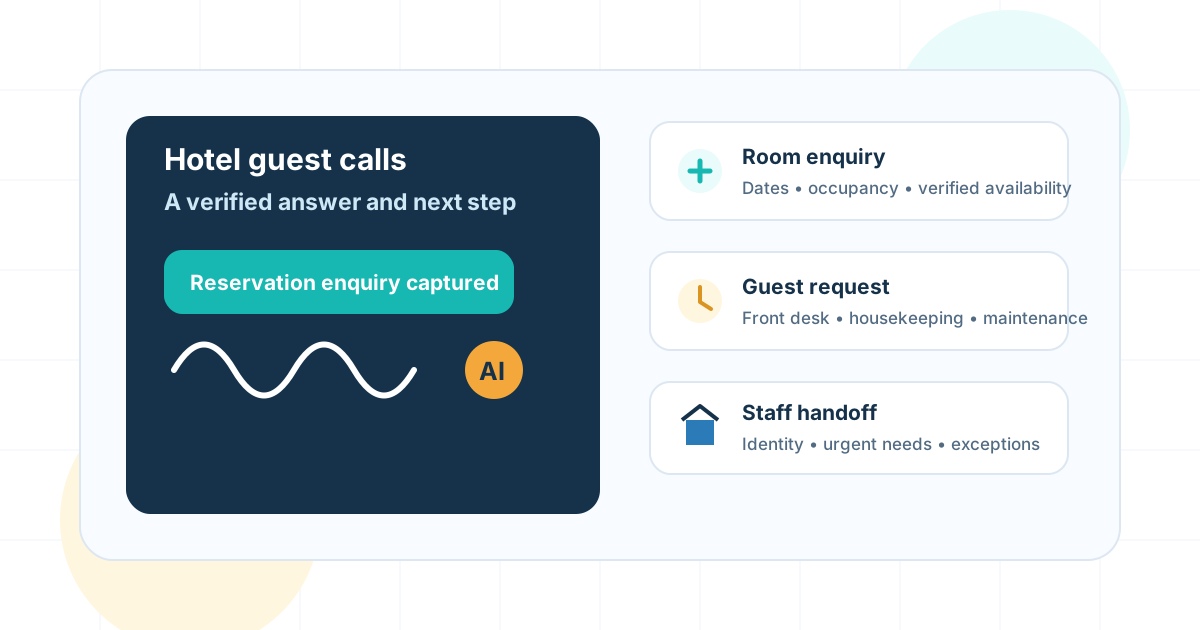
Hotel calls span several distinct workflows. A prospective guest may ask about dates, room types, facilities, directions, or a reservation. A current guest may need housekeeping, maintenance, billing help, or urgent assistance. The right answer depends on the hotel’s live information and operating procedures, so a voice agent needs clear limits and named teams for escalation.
| Call reason | A bounded agent task | Route to hotel staff when |
|---|---|---|
| Room enquiry | Capture dates, guest count, room preference, and contact details; answer only approved property questions | Availability, final rate, eligibility, or an exception is uncertain |
| Reservation request | Check authorized inventory and collect required details | The booking write, payment step, or confirmation cannot be verified |
| Existing booking | Follow the hotel’s identity check and read only permitted details | Records do not match, caller lacks authorization, or the request changes terms |
| In-stay request | Record an approved housekeeping or maintenance request with room and urgency fields | Safety, medical, accessibility, security, or unresolved service issue arises |
| Directions and facilities | Share approved location, check-in, parking, and facility information | Information is missing, time-sensitive, or conflicts with a guest’s needs |
| Group or event enquiry | Capture dates, room count, event requirements, and callback preference | Negotiation, contract terms, availability, or custom pricing is required |
Choose one narrow call reason for the first pilot. Reservation enquiries may be a fit where the property has a reliable availability source. If not, begin with answering stable FAQs and creating a structured callback request.
Reservation calls need a source of truth
Before automating room availability or booking, identify which system owns inventory, rates, occupancy rules, restrictions, and confirmation status. A website rate or cached channel listing may not reflect what the hotel can currently sell. Define whether the agent is allowed to quote an indicative rate, provide a final quote, collect a booking request, or complete a reservation.
For a verified booking, the workflow should check the requested dates and occupancy, use the approved rate and room type, collect only required guest information, and confirm the booking after the system returns a clear success state. If payment is required, follow the hotel’s approved payment flow; do not collect card details into an ordinary transcript or claim payment succeeded without verification.
When an OTA or other intermediary owns the booking record, the hotel may have limited ability to modify it directly. The agent should identify the reservation channel using the hotel’s process and route unsupported changes to the correct team or booking provider. It should not promise that a change or cancellation is complete until the system confirms it.
Protect guest information on existing-booking calls
A caller asking whether someone is staying at a property, what room they occupy, or when they will arrive may be seeking private information. Do not reveal a guest’s presence or booking details before the hotel’s approved verification and authorization checks. A caller’s name, phone number, or claimed relationship may not be enough on its own.
For booking changes, use the hotel’s approved verification fields and permissions. Reveal only the minimum information needed to complete the task. If identity is uncertain, multiple records match, or the caller asks for another guest’s details, stop the lookup and route the request to staff.
Route in-stay requests by urgency and ownership
Guest requests should create an actionable task, not disappear into a call summary. Capture the room or approved guest reference, request category, short description, urgency according to hotel policy, and requested callback method. Send it to the system or team that owns the work and verify that it was accepted.
The hotel must define how the agent handles safety, medical, security, accessibility, fire, or other urgent calls. Use an immediate transfer or the property’s established emergency procedure. Do not make the agent decide whether a potentially serious situation can wait, and do not promise a response time the hotel has not committed to.
Stable property information—such as check-in times, parking directions, or listed facilities—should come from a hotel-approved source with an owner and review date. If details are missing or conflicting, offer a staff callback. Seasonal hours, closures, renovation notices, and service availability should be maintained as operational data, not improvised by the model.
Plan system connections and handoffs
Map the data flow before enabling actions: telephone system, reservation or PMS lookup, booking writes, guest-request ticketing, staff routing, and analytics. For each action, decide which system is authoritative, what response proves success, and who sees a failure. A completed phone conversation is not proof that a booking or maintenance request reached the right queue.
Use the minimum integration permissions needed. Keep booking and guest-service data out of broad access logs where possible, limit recordings and transcripts to approved roles, and set retention according to the hotel’s policy. Prevent duplicate reservations after timeouts by checking the transaction status before retrying.
For implementation patterns, see the CRM integration guide, the human handoff guide, the security checklist, and the multilingual voice guide for India. For food-service calls, see the separate guide to voice agents for restaurants and cloud kitchens.
Test the hotel workflow before launch
Test with hotel staff using a sandbox or test property wherever possible. Include routine calls and failure cases:
- The requested room type or dates are unavailable.
- The rate changes or the caller asks for an unapproved discount.
- A booking attempt times out after it may have been written.
- A caller wants to modify an OTA reservation.
- A person asks whether another named guest is staying at the property.
- Two guest records match the details provided.
- A current guest reports an urgent safety or accessibility issue.
- A housekeeping request is submitted but the receiving system is unavailable.
- The caller changes language, interrupts, or asks for a human.
Review the transcript and system record together. Check that the agent did not invent availability, expose private information, or treat a pending request as confirmed. Test transfers outside business hours and decide who owns requests when reservations, front desk, and housekeeping teams are not available.
Measure eligible calls answered, enquiries captured with complete details, system-verified bookings, successful handoffs, duplicate or incorrect records, repeat calls, guest complaints, and staff correction time. Separate reservation requests from confirmed stays. Expand to additional call types only when the initial workflow meets thresholds the hotel defined in advance.
Frequently asked questions
What can an AI voice agent do for a hotel?
It can answer approved property questions, capture a room enquiry, collect a reservation request, route guest-service calls, and create a staff task. It should confirm a booking or change only when the authorized reservation system verifies the action.
Can an AI voice agent make hotel reservations?
It can assist with a reservation when it has authorized access to current room availability, rates, occupancy rules, and the hotel’s booking process. If it cannot verify the reservation and any required payment or confirmation step, it should submit an enquiry for staff follow-up rather than say the room is booked.
Can a hotel AI agent change or cancel an existing booking?
Only when the hotel’s approved system allows the requested change and the caller passes the required identity checks. Otherwise, capture the request and route it to reservations staff without disclosing or altering guest details.
Can the agent answer guest calls during a stay?
It can handle approved, low-risk requests such as directions or property information and route housekeeping, maintenance, billing, accessibility, or urgent requests to the responsible team. The hotel should define response ownership and escalation hours.
Does hotel voice AI need a property-management-system integration?
Not for every first pilot. It can capture reservation enquiries or route calls without writing to the PMS. Live availability, booking confirmation, modifications, and guest-record lookups require a supported, permissioned integration and verified system responses.
How should a hotel measure a voice-agent pilot?
Track eligible calls answered, correctly captured enquiries, system-verified reservations, successful transfers, repeat calls, booking corrections, guest complaints, and staff effort. Compare against a defined baseline and separate requests captured from bookings actually confirmed.
Related guides
Continue with the AI receptionist guide for India, AI voice agent implementation guide, human handoff guide, and restaurant voice AI guide.
Put these ideas into production
Deploy AI voice agents in minutes and build outbound, inbound, and follow-up workflows on one platform.
Related Articles
AI Receptionist in India: Answer Calls and Book Appointments
AI receptionist for Indian businesses: answer calls, book verified appointments, recover missed calls, handle routine questions, and route exceptions to staff.
AI Voice Agent Implementation Guide for India: Step-by-Step
Complete step-by-step guide to implementing AI voice agents in India. Learn how to plan, deploy, test, and scale voice AI with Hindi support, TRAI compliance, telephony integration, and production best practices.
When Should an AI Voice Agent Transfer to a Human?
Learn when an AI voice agent should transfer to a human, how cold transfer, warm transfer, smart routing, and context handoff work, and what Indian businesses should test before launch.
AI Voice Agents for Indian Restaurants and Cloud Kitchens
Learn how Indian restaurants, cloud kitchens, and food businesses use AI voice agents for phone order taking, table booking, menu inquiries, delivery coordination, and customer support with Hindi support and POS integration.
Is Your AI Voice Agent Secure Enough for Customer Calls?
Use this AI voice agent security checklist to protect call recordings, transcripts, customer data, tool access, prompt injection surfaces, retention policies, and audit logs.
Multilingual Voice Agents for India: Hindi, Tamil, Telugu, Bengali and More
Learn how multilingual voice agents help Indian businesses support Hindi, Tamil, Telugu, Bengali, Marathi, Kannada, Malayalam, Gujarati, and more across sales and support calls.