AI Voice Agents for Electricity Utilities in India: Billing and Outage Calls
AI Voice Agents for Electricity Utilities in India: Billing and Outage Calls
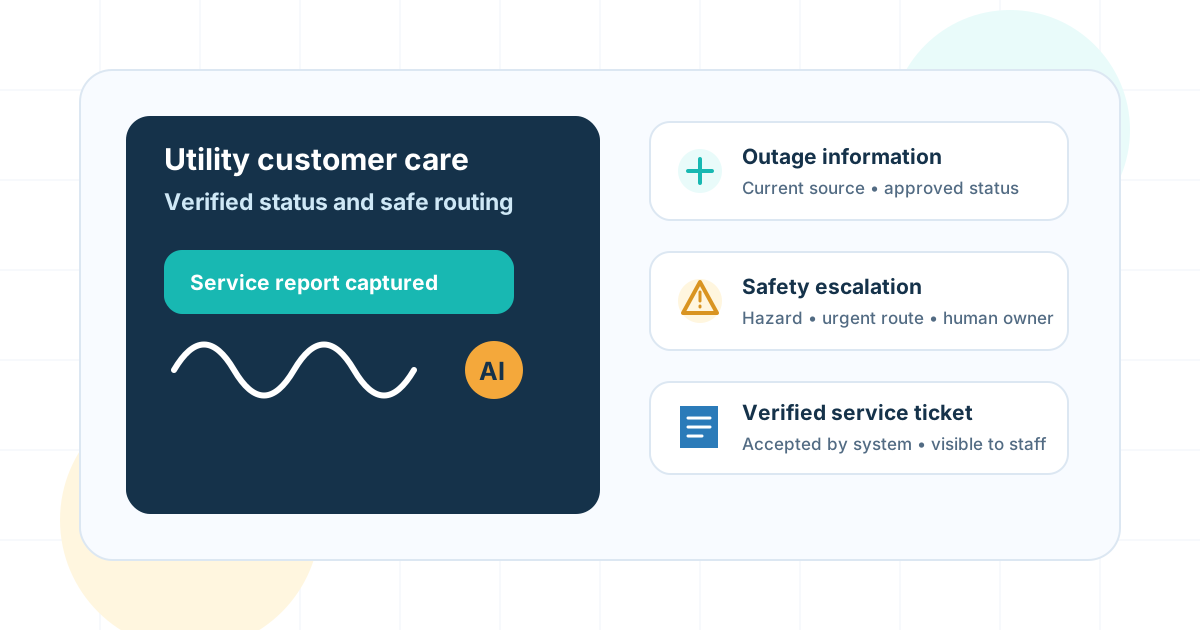
Short answer: An AI voice agent can help an electricity provider answer approved service questions, collect outage reports, share verified status, and create service tickets. Account-specific bill details require the utility’s verification process. Safety hazards need immediate escalation under the provider’s emergency procedure; they must never be handled as routine troubleshooting.
This guide is for electricity distribution companies and utility customer-care teams in India. It covers inbound calls about supply interruptions, bills, service requests, and urgent electrical risks. It does not assume that a utility exposes a live outage-management, billing, metering, or complaint system to an AI agent.
Separate routine calls from operational incidents
Utility contact centres handle routine questions alongside reports that may require fast field response. The agent should classify the call, capture the information the utility needs, and send it to the system or team that owns the next action.
| Call reason | Bounded voice-agent task | Escalation condition |
|---|---|---|
| General service question | Answer from current, utility-approved information | Policy is unclear or caller needs an exception |
| Supply interruption | Capture service location, time noticed, and affected premises; check approved status | No matching incident or system cannot accept a report |
| Outage status | Read current status for the relevant area from an authoritative source | Feed is stale, incomplete, or has no approved estimate |
| Bill enquiry | Explain public bill labels or retrieve permitted details after verification | Dispute, unusual reading, suspected meter issue, or unresolved payment |
| New connection or service request | Capture required fields and submit through an authorized workflow | Eligibility, documents, inspection, or field decision is required |
| Electrical hazard | Follow the utility’s immediate safety escalation procedure | Always urgent; never continue routine troubleshooting |
Start with a narrow use case such as identifying the call reason, collecting a service report, or answering stable public FAQs. Add customer-specific lookups and account actions only when identity checks, system permissions, and staff ownership are clear.
Make outage reporting accurate and actionable
When a caller reports an interruption, collect the location at the level the utility requires, a callback method if needed, when the issue began, and whether nearby premises are also affected. Use the utility’s approved process to look for an existing incident before creating another report. Do not imply that the report is confirmed until the operational system accepts it.
Outage status and restoration estimates must come from a current, authorized source. A cluster of similar calls is not proof of a declared outage, and a model should not infer a cause or estimated repair time. If status is unknown, say so plainly, create the permitted report, and route exceptions to the appropriate team.
During a large incident, define how the agent behaves when call volume increases: which status message is approved, how often it can be refreshed, what callers can do if their issue is different, and when live staff take over. If the source feed or telephony path fails, use a tested fallback rather than repeating stale information.
Treat electrical hazards as urgent
The provider should write and approve the hazard flow with its safety and operations owners. Reports of fallen or exposed wires, sparks, fire, electric shock, or another immediate danger need the designated emergency response. The voice agent should not ask callers to inspect equipment, touch wires, reset hazardous equipment, or wait for a routine callback.
Keep the urgent route easy to reach. Ask only the minimum location and callback details needed by the approved process, and do not delay escalation to complete a long intake form. Test the route with staff at all operating hours and define what happens if the primary queue is unavailable.
Protect customer and meter information
Before sharing account-specific bill or consumption details, use the utility’s required identity verification and authorization rules. Do not reveal account information merely because someone knows a service address or consumer number. Restrict the agent’s lookup permissions to the fields required for the specific task.
For disputes or suspected meter problems, capture the caller’s concern accurately and create a traceable case. Avoid declaring a bill correct, promising an adjustment, or changing a customer record without an authorized decision and confirmed system result. Keep credentials out of transcripts and limit call recordings and summaries to approved roles and retention periods.
Connect utility systems with explicit success checks
Map each task to its system of record: outage management, billing, complaint management, service scheduling, or contact routing. Decide which fields are required, what response means a write succeeded, and who owns pending or failed actions. The call outcome and the system outcome should be logged separately.
Use minimum permissions and test timeout behavior. If a ticket submission times out, check its status before retrying to prevent duplicate reports. If the bill or outage source is unavailable, tell the customer what cannot be verified and offer the approved next step.
For the implementation approach, see the AI voice agent implementation guide, security checklist, human handoff guide, and multilingual voice guide for India. A related operational pattern for support queues is covered in the telecom customer-support guide.
Test utility calls before launch
Test with customer-care, billing, safety, and field-operations owners. Include normal calls and failures:
- A caller reports an outage at a location with no matching declared incident.
- A current outage exists but its status feed has not refreshed.
- The caller asks for an ETA that the utility has not published.
- The ticket system times out after possibly accepting the report.
- A bill lookup fails or the caller disputes the charge.
- Someone reports a fallen wire, sparks, electric shock, or fire.
- The caller cannot pass identity checks but requests account details.
- The caller speaks in a supported Indian language, interrupts, or asks for a person.
For every test, compare the conversation with the system record and the receiving team’s queue. Confirm the agent did not state an unverified outage, restoration time, bill explanation, or completed ticket. Verify that urgent calls reach the approved safety owner and that failures produce a visible follow-up.
Track correct intent classification, accepted outage reports, ticket completion, verified status answers, urgent escalation success, repeat contacts, duplicate reports, complaints, and staff correction time. Define targets and a baseline before the pilot. Do not treat calls answered or tickets created as proof that a field issue was resolved.
Frequently asked questions
What can an AI voice agent do for an electricity provider?
It can answer approved service questions, collect outage or service reports, share verified status information, capture bill enquiries, create a complaint or service ticket, and route unresolved or urgent calls to staff.
Can a voice agent report a power outage?
It can collect the location and issue details and submit a report through an authorized workflow. It should only say a ticket was created after the outage or service system confirms receipt.
Can an AI agent provide an electricity restoration time?
Only when an authoritative utility system provides a current, approved estimate for the relevant area. If no reliable estimate exists, the agent should say it cannot confirm a restoration time.
Can AI explain a customer’s electricity bill?
It may explain public bill terminology or retrieve permitted account-specific details after the utility’s required verification. Disputes, suspected meter faults, unusual charges, and payment issues should be routed according to the utility’s process.
How should an electricity voice agent handle a safety hazard?
The utility must define an immediate safety escalation for hazards such as fallen wires, sparks, fire, or electric shock. The agent should not troubleshoot or place the call in a routine queue; it should follow the approved emergency instructions and connect the caller to the responsible service.
How should a utility measure a voice-agent pilot?
Track correctly classified calls, verified report or ticket creation, status accuracy, successful urgent escalations, repeat contacts, incorrect account actions, complaints, and staff correction effort. Report each call reason separately against a defined baseline.
Related guides
Continue with the AI voice agent security checklist, AI voice agent testing checklist, telecom customer support guide, and AI voice agent implementation guide.
Put these ideas into production
Deploy AI voice agents in minutes and build outbound, inbound, and follow-up workflows on one platform.
Related Articles
Is Your AI Voice Agent Secure Enough for Customer Calls?
Use this AI voice agent security checklist to protect call recordings, transcripts, customer data, tool access, prompt injection surfaces, retention policies, and audit logs.
How Do You Test an AI Voice Agent Before It Goes Live?
A practical AI voice agent testing checklist for teams preparing to launch real customer calls. Learn how to test latency, Hindi and Hinglish conversations, interruptions, tool calls, handoff, and production readiness.
AI Voice Agents for Telecom Customer Support in India: Billing, Plans, and Outages
A practical guide to telecom voice agents in India: handle approved billing and plan enquiries, communicate verified outage updates, protect subscriber data, and escalate account issues safely.
AI Voice Agent Implementation Guide for India: Step-by-Step
Complete step-by-step guide to implementing AI voice agents in India. Learn how to plan, deploy, test, and scale voice AI with Hindi support, TRAI compliance, telephony integration, and production best practices.
When Should an AI Voice Agent Transfer to a Human?
Learn when an AI voice agent should transfer to a human, how cold transfer, warm transfer, smart routing, and context handoff work, and what Indian businesses should test before launch.
Multilingual Voice Agents for India: Hindi, Tamil, Telugu, Bengali and More
Learn how multilingual voice agents help Indian businesses support Hindi, Tamil, Telugu, Bengali, Marathi, Kannada, Malayalam, Gujarati, and more across sales and support calls.