AI Voice Agent vs Human Call Center: Which Should You Choose?
AI Voice Agent vs Human Call Center: Which Should You Choose?
Short answer: Choose an AI voice agent for repetitive, high-volume, structured, 24/7 calls. Choose human call center agents for complex emotion, judgment, negotiation, exceptions, and relationship-sensitive conversations. For most growing businesses, the best answer is hybrid.
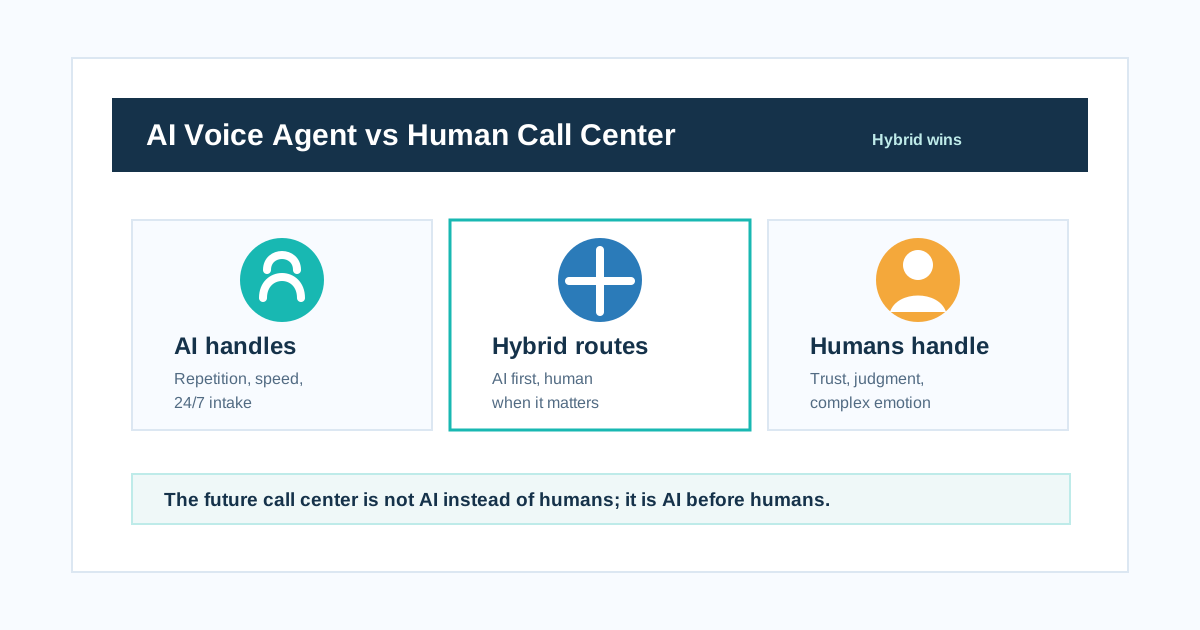
The future call center is not AI instead of humans; it is AI before humans.
That is the practical way to think about it.
AI voice agents are not good because humans are bad. They are good because many calls are repetitive, predictable, time-sensitive, and expensive to handle manually. Human agents are not obsolete because many customer moments still need trust, empathy, discretion, and authority.
The business question is not "AI or humans?"
The business question is: "Which calls should AI handle first, and when should humans take over?"
AI voice agent vs human call center: quick comparison
| Factor | AI voice agent | Human call center |
|---|---|---|
| Availability | 24/7 by default | Depends on staffing and shifts |
| Speed | Answers instantly when capacity is available | Queue time depends on volume |
| Cost pattern | Usage or subscription based | Salary, vendor, training, supervision |
| Consistency | Highly consistent if designed well | Varies by agent and training |
| Empathy | Can detect and respond, but limited | Stronger for emotional nuance |
| Judgment | Good inside defined rules | Better for exceptions and negotiation |
| Scalability | Scales quickly across call spikes | Requires hiring or outsourcing |
| Compliance | Can be consistent, needs guardrails | Human judgment helps, human error still exists |
| Language | Depends on model and setup | Depends on staffing language coverage |
| CRM updates | Can update automatically | Often requires manual after-call work |
The future call center is not AI instead of humans; it is AI before humans.
What AI voice agents are best at
AI voice agents are strongest when the call has a clear goal and repeatable structure.
| Use case | Why AI works well |
|---|---|
| Missed call recovery | Fast response improves conversion |
| Appointment reminders | Repetitive and time-sensitive |
| COD confirmation | Structured confirm/reject/callback flow |
| Order status | Data lookup and simple answer |
| Lead qualification | Standard questions and scoring |
| Payment reminder | Repeatable message plus intent capture |
| Clinic booking | Slot check, confirmation, follow-up |
| Real estate site visit | Budget, location, timing, callback |
| EdTech counselling intake | Course, class, interest, demo slot |
| After-hours support | Captures issue before humans return |
McKinsey notes that AI-driven virtual assistants can already solve simple transactional issues and shift volumes away from live channels. That is where AI belongs first: routine, transactional, high-volume work.
What human call center agents are best at
Humans still win when calls need emotional reading, negotiation, authority, and trust.
| Use case | Why humans matter |
|---|---|
| Angry customer complaint | Empathy and discretion |
| Refund dispute | Policy plus judgment |
| Medical concern | Safety and professional boundaries |
| Loan hardship | Sensitive conversation |
| Enterprise sales | Relationship and negotiation |
| Retention call | Human persuasion and trust |
| Complex support | Diagnosis across many variables |
| Legal or compliance issue | Accountability and review |
| VIP customer | Relationship management |
| Exceptions | Humans can interpret context |
IBM describes customer service AI agents as able to resolve tickets, analyze data, escalate complex issues, and provide personalized service experiences. The word "escalate" matters. Good AI does not pretend every call belongs to automation.
The hybrid model
The strongest setup is usually:
- AI answers first.
- AI identifies intent.
- AI resolves routine workflows.
- AI updates the CRM.
- AI transfers complex calls to humans.
- Human receives summary and next action.
- Managers track outcomes and improve both AI and human performance.
This is not a compromise. It is a better operating model.
| Call type | First owner | Final owner |
|---|---|---|
| FAQ | AI | AI |
| Appointment booking | AI | AI or receptionist |
| Payment reminder | AI | Human for dispute |
| Angry caller | AI detects | Human resolves |
| High-value lead | AI qualifies | Sales closes |
| Support intake | AI collects | Human solves if complex |
| After-hours call | AI captures | Human follows up |
The future call center is not AI instead of humans; it is AI before humans.
Cost comparison: use cost per resolved call
Do not compare only cost per minute. Compare cost per resolved call.
| Cost component | Human call center | AI voice agent |
|---|---|---|
| Staffing | Salary or BPO cost | Platform and usage cost |
| Training | Hiring and ramp time | Prompt, testing, workflow setup |
| Supervision | Team leads and QA | Monitoring and AI ops |
| Queue management | Workforce planning | Capacity and concurrency planning |
| Telephony | Phone minutes and infra | Phone minutes and infra |
| CRM work | Manual after-call work | Automated writeback if integrated |
| Quality control | Sample-based QA | Larger-scale analytics possible |
| Error cost | Agent mistakes | AI mistakes at scale if unchecked |
| Escalation | Human-to-human transfer | AI-to-human handoff |
The important metric is:
| Metric | Formula |
|---|---|
| Cost per resolved call | Total operating cost / successfully resolved calls |
If AI reduces cost per minute but creates repeat calls, human cleanup, or bad CRM data, it may not reduce cost per resolved call.
Speed comparison
AI usually wins on speed.
AI can:
- Answer multiple calls at once
- Call back missed leads quickly
- Work after hours
- Run reminders at scale
- Avoid queue delays for simple workflows
- Capture basic information before human follow-up
Humans win when speed is not enough and the caller needs trust.
For example, a real estate lead asking "What is the price?" can be handled by AI. A buyer negotiating payment plan and family concerns may need a human.
Quality comparison
AI quality is consistent. Human quality is flexible.
That means both have different failure modes.
| Failure mode | AI | Human |
|---|---|---|
| Repeats wrong policy | Can repeat at scale | Usually isolated |
| Gets tired | No | Yes |
| Improvises wisely | Limited | Stronger |
| Skips required step | Less likely if designed well | Possible |
| Handles emotion | Limited but improving | Stronger |
| Updates CRM | Strong if integrated | Often inconsistent |
| Follows script | Consistent | Variable |
| Solves exceptions | Needs escalation | Stronger |
Gartner predicts conversational AI will become a common starting point for customer service journeys, and separately predicts agentic AI will resolve many common customer service issues without human intervention by 2029. But "common" is the key word. Common issues are where AI scales best.
India-specific comparison
For Indian businesses, the question has extra layers:
- Hindi, English, Hinglish, and regional language coverage
- Missed-call culture
- WhatsApp follow-up
- Payment reminders
- COD confirmations
- Outbound consent and DND checks
- Branch-level routing
- Sales teams using mobile numbers
- High variance in call quality and background noise
- Need for fast lead response
AI can help with speed and volume. Humans help with trust and local nuance.
| Indian workflow | Recommended model |
|---|---|
| Ecommerce COD confirmation | AI first, human only for exceptions |
| Clinic appointment booking | AI first, receptionist for sensitive issues |
| EdTech lead qualification | AI first, counsellor for serious prospects |
| BFSI reminder | AI for reminders, human for disputes |
| Real estate lead capture | AI first, sales for site visit and negotiation |
| Restaurant reservations | AI first |
| Complaint escalation | Human with AI summary |
When AI should not replace humans
Do not use AI-only handling when:
- The caller is angry and needs accountability.
- The issue involves medical judgment.
- The conversation involves regulated financial advice.
- The customer is VIP or high value.
- The caller asks for a human.
- The workflow has frequent exceptions.
- The system cannot access accurate data.
- The AI has not been tested in that language.
- The cost of one wrong answer is high.
Automation should reduce burden, not remove responsibility.
When AI should replace manual calling
AI is a strong replacement when:
- The script is repetitive.
- The outcome is structured.
- The call volume is high.
- Speed matters.
- After-hours coverage matters.
- Human agents mostly collect the same fields.
- CRM updates are standard.
- Calls can be safely escalated.
- The business can measure outcomes.
Examples:
- "Confirm your delivery."
- "Do you want to reschedule?"
- "Are you still interested in a demo?"
- "Can we book your appointment?"
- "Would you like a payment link?"
- "Should we arrange a callback?"
These are not poor uses of human talent. They are often poor uses of human time.
The migration plan
Do not move everything to AI on day one.
Use this path:
| Phase | What to automate |
|---|---|
| Phase 1 | Missed calls, after-hours intake, reminders |
| Phase 2 | Appointment booking, lead qualification, support intake |
| Phase 3 | CRM updates, WhatsApp follow-up, payment reminders |
| Phase 4 | Human handoff with summaries and routing |
| Phase 5 | Analytics, coaching, QA, workflow optimization |
Start where risk is low and volume is high.
Buyer checklist
Before replacing or augmenting a call center, ask:
- Which calls are repetitive enough for AI?
- Which calls require human judgment?
- What is the current cost per resolved call?
- What is the current wait time?
- What percentage of calls end without resolution?
- What CRM updates happen after calls?
- What languages are required?
- What compliance rules apply?
- What handoff path will AI use?
- What metrics will prove success?
The best AI deployment starts with call classification, not vendor selection.
FAQ
Is an AI voice agent better than a human call center?
AI is better for repetitive, structured, high-volume, 24/7 calls. Humans are better for complex, emotional, regulated, high-value, or exception-heavy conversations.
Can AI voice agents replace call center agents?
AI can replace some routine call volume, but most businesses should use a hybrid model where AI handles intake and repetitive tasks while humans handle complex cases.
When should a business use AI instead of a call center?
Use AI for missed calls, reminders, appointment booking, order status, COD confirmation, lead qualification, payment reminders, FAQs, callbacks, and after-hours intake.
When should a business keep human agents?
Keep humans for complaints, escalations, negotiations, sensitive workflows, regulated decisions, VIP customers, angry callers, and complex support.
What is the best model: AI call center or human call center?
The best model is usually hybrid: AI answers first, resolves routine calls, updates systems, and transfers complex calls to humans with context.
How do you compare AI voice agent cost with human call center cost?
Compare cost per resolved call. Include labor, training, QA, supervision, telephony, platform cost, transfers, retries, repeat calls, CRM cleanup, and customer outcome.
Final answer
AI voice agents should not be judged as a total replacement for humans. They should be judged as the first layer of a better call operation.
Let AI answer fast, handle repetition, collect context, update systems, and route well. Let humans handle trust, exceptions, negotiation, empathy, and accountability.
The future call center is not AI instead of humans; it is AI before humans.
Related reading: When should an AI voice agent transfer to a human?, What AI voice agent metrics should you track after launch?, How do AI voice agents integrate with CRM systems?, and AI voice agent ROI calculator for Indian call centers.
Put these ideas into production
Deploy AI voice agents in minutes and build outbound, inbound, and follow-up workflows on one platform.
Related Articles
When Should an AI Voice Agent Transfer to a Human?
Learn when an AI voice agent should transfer to a human, how cold transfer, warm transfer, smart routing, and context handoff work, and what Indian businesses should test before launch.
What AI Voice Agent Metrics Should You Track After Launch?
Learn the AI voice agent metrics that matter after launch: task completion, containment, latency, transfer rate, tool-call accuracy, sentiment, cost per resolved call, and failure reasons.
How Do AI Voice Agents Integrate With CRM Systems?
Learn how AI voice agents integrate with CRM systems like HubSpot and Salesforce, what fields to sync, how call summaries work, and what workflow automations to test before launch.
AI Voice Agent ROI Calculator for Indian Call Centers
Calculate the ROI of AI voice agents for your Indian call center. Complete guide with formulas, benchmarks, real examples, and a step-by-step calculator to estimate cost savings and payback period.