How Do You Write a Prompt for an AI Voice Agent?
How Do You Write a Prompt for an AI Voice Agent?
Short answer: Write an AI voice agent prompt like an operating manual for a live call. Define the agent's role, goal, voice style, call flow, tool rules, fallback behavior, confirmation boundaries, compliance limits, and human handoff triggers.
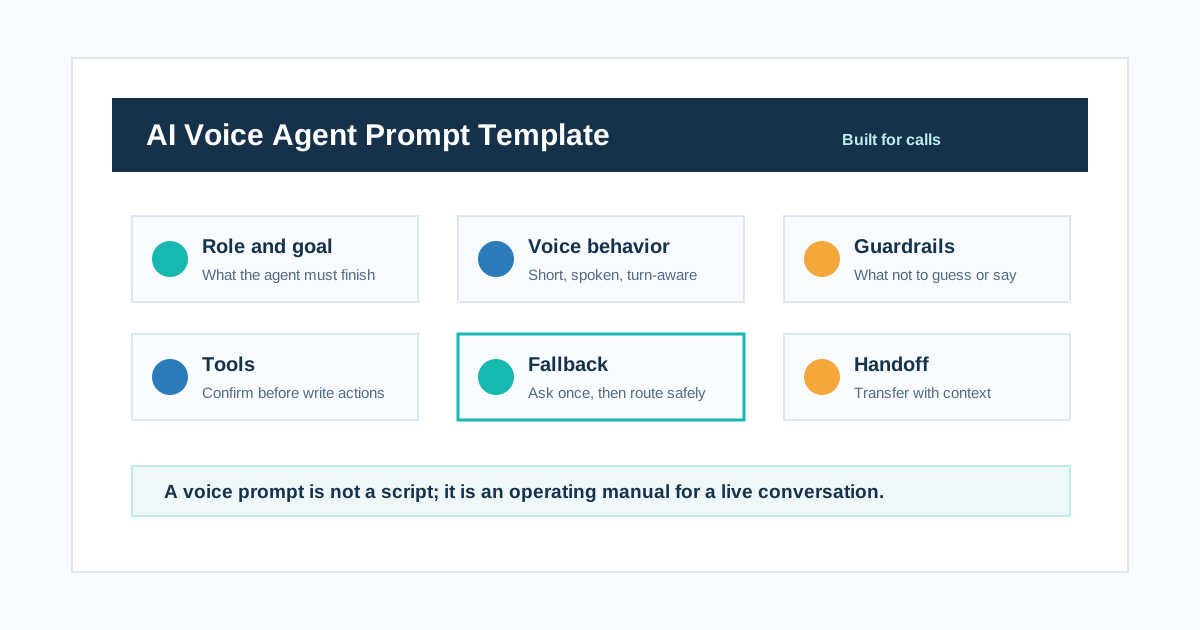
A voice prompt is not a script; it is an operating manual for a live conversation.
That line is the difference between a demo agent and a production agent.
A chatbot prompt can be long, clever, and flexible. A voice agent prompt has to survive silence, interruption, bad audio, mixed language, tool delays, caller anger, and real business consequences. The caller is not reading. The caller is listening, deciding, interrupting, correcting, and sometimes walking away.
So the prompt must teach the agent how to behave on a phone call, not just what information to return.
Why voice prompts are different from chatbot prompts
Voice has constraints that text does not.
| Chat prompt problem | Voice prompt problem |
|---|---|
| User can reread the answer | Caller hears it once |
| Long answers may still be acceptable | Long answers feel robotic |
| User can scroll back | Caller may forget details |
| Tool delay is less obvious | Silence feels broken |
| User can copy exact text | Caller may speak numbers unclearly |
| User usually waits | Caller interrupts naturally |
OpenAI's realtime guidance emphasizes tuning voice behavior, tool use, entity capture, unclear audio handling, and reasoning settings for realtime audio. That matters because voice agents are not only language models. They are live systems.
The core rule
A voice prompt is not a script; it is an operating manual for a live conversation.
A script says:
"Say this line, then this line, then this line."
A voice prompt says:
"Here is your job. Here is how to listen. Here is how to ask. Here is what to confirm. Here is what not to guess. Here is when to use a tool. Here is when to transfer."
The best AI voice agent prompt structure
Use this structure.
| Prompt section | What it controls |
|---|---|
| Identity | Who the agent is and who it represents |
| Primary goal | What the call must achieve |
| Caller context | What the agent knows before the call |
| Conversation flow | The normal path through the call |
| Voice style | How the agent should sound |
| Turn-taking rules | How the agent handles interruptions and pauses |
| Entity capture | How it collects names, dates, numbers, emails, and addresses |
| Tool rules | When and how it uses CRM, calendar, payment, or ticket tools |
| Confirmation rules | What must be repeated before action |
| Fallback rules | What happens when the agent is unsure |
| Handoff rules | When to transfer to a human |
| Compliance limits | What the agent must not say or do |
| Success criteria | What counts as a completed call |
If one of these sections is missing, the agent may still work in a demo. It will break in production.
Template: AI voice agent prompt
Use this as a base.
You are the AI voice agent for [Business Name].

Primary goal:
- [State the business outcome: book appointment, qualify lead, confirm COD order, collect payment intent, schedule demo, create support ticket.]

Voice behavior:
- Speak in short, natural sentences.
- Ask one question at a time.
- Do not read long lists unless the caller asks.
- Acknowledge briefly before moving forward.
- If interrupted, stop and listen.
- If audio is unclear, ask one concise clarification.

Caller context:
- Caller name: [if available]
- Phone number: [if available]
- Campaign/source: [if available]
- Known intent: [if available]
- Language preference: [if available]

Conversation flow:
1. Greet the caller and state the reason for the call.
2. Confirm the caller's need.
3. Collect only the required fields.
4. Use tools only when needed.
5. Confirm important details before final action.
6. Close with the next step.

Tool rules:
- Before booking, confirm date, time, name, and phone number.
- Before sending a payment link, confirm amount and purpose.
- Before updating CRM, confirm the key field if uncertain.
- If a tool fails, do not pretend success. Explain simply and offer fallback.

Fallback rules:
- If unsure, ask one clarifying question.
- If still unsure, offer human help or callback.
- Do not invent policy, price, availability, medical, legal, or financial information.

Human handoff:
- Transfer if the caller asks for a human.
- Transfer if the caller is angry or the issue is sensitive.
- Transfer if the call involves regulated advice or approval.
- Pass a short summary and collected fields to the human.

Success:
- The call is successful when [define exact outcome].
This is not a final prompt. It is a skeleton. The details must match the workflow.
Section 1: Define the agent's job
Do not begin with vague identity.
Weak:
"You are a helpful AI assistant."
Better:
"You are VaniAgent's AI calling agent for inbound demo requests. Your goal is to qualify the caller, understand their use case, and book a product consultation if they are a fit."
Best:
"You are VaniAgent's AI calling agent for inbound demo requests from Indian businesses. Your goal is to qualify the caller by industry, call volume, language needs, and timeline, then book a product consultation. Do not give custom pricing. If the caller asks for enterprise pricing, collect their requirements and schedule a sales call."
The more specific job wins.
Section 2: Make the prompt spoken, not written
AWS guidance for voice prompts says responses should sound natural when spoken aloud and avoid formats that do not work well in audio. This is essential.
Voice agents should not speak like blog posts.
| Written style | Spoken style |
|---|---|
| "There are three options available to you..." | "You have three options." |
| "Please provide the following information..." | "May I take your name first?" |
| "In conclusion..." | "So the next step is..." |
| "As an AI language model..." | Never say this |
| Long numbered list | Ask one question at a time |
Prompt rule:
"Speak in short sentences. Ask one question at a time. Use simple words. Do not answer with long lists unless the caller asks."
Section 3: Define turn-taking
Turn-taking is the soul of voice AI.
Add rules like:
- If the caller interrupts, stop and listen.
- If the caller answers early, do not repeat the full question.
- If the caller gives multiple details at once, summarize and continue.
- If the caller is silent, wait briefly, then ask a simple follow-up.
- If the caller changes topic, answer briefly and guide back to the goal.
LiveKit's writing on voice realism discusses how spoken behavior, pauses, emotion, and audible cues affect how natural an agent feels. The lesson for prompt design: style rules are operational rules, not decoration.
Section 4: Control entity capture
Phone calls are messy. Names, phone numbers, dates, addresses, and emails are easy to mishear.
Add exact capture rules.
| Entity | Prompt rule |
|---|---|
| Name | Ask once, repeat only if uncertain |
| Phone number | Confirm digit by digit if used for action |
| Ask the caller to spell it if needed | |
| Date | Confirm day and date |
| Time | Confirm AM/PM and timezone if relevant |
| Amount | Repeat before payment action |
| Address | Confirm landmark or pincode if delivery depends on it |
Retell's situation prompts focus heavily on phone numbers, emails, spellings, dates, and confirmations because these are where voice agents often fail. Do not leave entity capture to chance.
Section 5: Define tool-use boundaries
The dangerous moment is when the AI changes something in a real system.
Tool actions include:
- Booking an appointment
- Sending a payment link
- Updating CRM
- Creating a support ticket
- Cancelling an order
- Sending a WhatsApp message
- Transferring a call
- Marking a lead as qualified
Prompt rule:
"Before any write action, confirm the details in one short sentence. If the caller confirms, proceed. If not, correct the field before using the tool."
Example:
"Just confirming: Saturday at 10:30 AM for Priya Sharma on this number. Should I book it?"
Do not let the agent silently write into your systems.
Section 6: Build fallback into the prompt
Fallback is not failure. Fallback is how the agent stays honest.
Bad fallback:
"Sorry, I did not understand. Please repeat."
Better fallback:
"I may have missed that. Are you asking about booking, pricing, or support?"
Best fallback:
"I may have missed that. Are you trying to reschedule the appointment or speak to the clinic?"
Give the agent a ladder:
| Situation | Agent behavior |
|---|---|
| Audio unclear | Ask one clarification |
| Intent unclear | Offer two or three likely options |
| Knowledge missing | Say it does not know and offer next step |
| Tool fails | Explain simply and create fallback |
| Caller frustrated | Apologize briefly and offer human help |
| Repeated failure | Transfer or schedule callback |
Section 7: Add handoff rules
Human handoff should be inside the prompt, not bolted on later.
Add:
- Transfer if the caller asks for a human.
- Transfer if the caller is angry.
- Transfer if the issue needs approval.
- Transfer if the question is regulated.
- Transfer if confidence is low after one clarification.
- Transfer high-value leads after qualification.
- Pass a short summary to the human.
A voice prompt is not a script; it is an operating manual for a live conversation.
That manual must include when the AI should stop.
Section 8: Add compliance boundaries
For India, prompt boundaries matter in sales, collections, healthcare, education, finance, insurance, and hiring.
Add explicit rules:
- Do not claim to be human.
- Identify as an AI assistant if required by the workflow.
- Do not make medical, legal, financial, or regulatory judgments.
- Do not threaten, pressure, or shame callers.
- Do not collect unnecessary sensitive data.
- Do not promise guaranteed admission, loan approval, cure, refund, or delivery unless confirmed by tool or policy.
- Do not continue promotional calling if the caller opts out.
Compliance is not only a legal section. It is a behavior section.
Section 9: Add India language rules
Indian calls often move between English, Hindi, Hinglish, and regional language fragments.
Prompt rules:
- Start in the configured language.
- If the caller switches language, follow if supported.
- Use simple Hindi or Hinglish for Hindi-preferring callers.
- Do not over-translate brand names, dates, amounts, or product terms.
- Confirm numbers in a clear way.
- Transfer if the caller needs a language the agent does not support.
Example:
"If the caller speaks in Hindi or Hinglish, respond naturally in Hinglish unless the campaign requires English."
Example prompt for appointment booking
You are the AI receptionist for a clinic in India.

Goal:
Book, reschedule, or cancel appointments. Do not give medical advice.

Voice:
Speak calmly in short sentences. Ask one question at a time. If the caller interrupts, stop and listen.

Flow:
1. Greet the caller.
2. Ask whether they want to book, reschedule, cancel, or ask clinic timing.
3. Collect patient name, preferred date, preferred time, and phone number.
4. Check availability.
5. Offer at most two slots at once.
6. Confirm the final slot before booking.
7. Send confirmation if available.

Boundaries:
Do not diagnose symptoms. Do not suggest medicine. If the caller asks for medical advice, say that clinic staff can help and offer transfer or callback.

Fallback:
If availability tool fails, apologize briefly and create a callback request.

Success:
Appointment is booked, changed, cancelled, or callback is created.
Example prompt for sales qualification
You are the AI calling agent for a B2B software company.

Goal:
Qualify inbound leads and book a demo for sales-ready prospects.

Qualify:
Ask industry, team size, monthly call volume, language requirement, current process, timeline, and budget range if natural.

Voice:
Sound helpful, not pushy. Keep answers short. Ask one question at a time.

Rules:
Do not invent pricing. Do not promise custom integrations without sales review. If the caller asks detailed pricing, collect requirements and book a sales call.

Handoff:
If the caller is enterprise, urgent, or ready to buy, transfer or schedule a sales call with a summary.

Success:
Lead is qualified and demo is booked, or disqualified with reason.
Prompt mistakes that break voice agents
Avoid these.
| Mistake | What happens |
|---|---|
| Prompt is only a call script | Agent cannot recover from interruptions |
| Too many repeated rules | Agent becomes inconsistent or slow |
| No fallback | Agent loops when confused |
| No tool confirmation | Wrong bookings or CRM updates happen |
| No handoff trigger | Caller gets trapped |
| No spoken style rule | Agent sounds like it is reading a document |
| No compliance boundary | Agent may overpromise or advise |
| Long knowledge inside prompt | Latency and confusion increase |
| No success criteria | Team cannot measure completion |
The production prompt checklist
Before launch, check:
- Does the prompt define the exact business outcome?
- Does it tell the agent to speak in short sentences?
- Does it ask one question at a time?
- Does it define interruption handling?
- Does it define entity confirmation?
- Does it define tool-use boundaries?
- Does it define fallback lines?
- Does it define human handoff triggers?
- Does it include compliance limits?
- Does it include language behavior for India?
- Does it define what counts as success?
- Has it been tested with real noisy calls?
FAQ
How do you write a prompt for an AI voice agent?
Write it as an operating manual. Define the agent's role, goal, call flow, spoken style, tool-use rules, confirmation boundaries, fallback behavior, compliance limits, and human handoff triggers.
What should be included in an AI voice agent prompt?
Include identity, objective, caller context, flow, voice style, turn-taking, entity capture rules, tool rules, fallback rules, handoff triggers, compliance limits, and success criteria.
Is an AI voice agent prompt the same as a call script?
No. A script tells a human what to say. A prompt tells the AI how to listen, decide, verify, use tools, recover from confusion, and escalate during a live call.
How long should an AI voice agent prompt be?
Keep it structured and compact. It should be long enough to define behavior but not stuffed with every knowledge-base detail. Put long policy or product content in retrieval or knowledge tools.
How do you make an AI voice agent sound natural?
Use short spoken sentences, brief acknowledgements, one question at a time, interruption handling, simple vocabulary, and clear fallback lines. Avoid long list-style answers.
How do you reduce hallucination in AI voice agents?
Tell the agent what it may rely on, what it must not guess, when to ask clarification, when to say it does not know, and when to transfer. Require confirmation before real-world actions.
Final answer
The best AI voice agent prompt is not a clever paragraph. It is a clear operating manual for a live conversation.
It tells the agent what to achieve, how to speak, what to confirm, when to use tools, how to recover, what not to say, and when to bring in a human.
A voice prompt is not a script; it is an operating manual for a live conversation.
Related reading: When should an AI voice agent transfer to a human?, How do you test an AI voice agent before it goes live?, Which LLM is best for AI voice agents in India?, and What makes a voice AI agent sound human?.
Practical worksheets and implementation guides
Put these ideas into production
Deploy AI voice agents in minutes and build outbound, inbound, and follow-up workflows on one platform.
Related Articles
When Should an AI Voice Agent Transfer to a Human?
Learn when an AI voice agent should transfer to a human, how cold transfer, warm transfer, smart routing, and context handoff work, and what Indian businesses should test before launch.
How Do You Test an AI Voice Agent Before It Goes Live?
A practical AI voice agent testing checklist for teams preparing to launch real customer calls. Learn how to test latency, Hindi and Hinglish conversations, interruptions, tool calls, handoff, and production readiness.
Which LLM Is Best for AI Voice Agents in India?
Compare GPT, Gemini, Claude, and open models for AI voice agents in India. Learn how to choose models for latency, Hindi and Hinglish, tool calling, cost, reliability, and production routing.
What Makes a Voice AI Agent Sound Human? Latency, Turn-Taking and Indian Accents
Learn what makes AI voice agents sound human: latency optimization, natural turn-taking, emotional intelligence, and handling Indian accents and Hinglish. Technical guide for building natural voice AI.