AI Receptionist for Multiple Branches: Route Calls to the Right Location
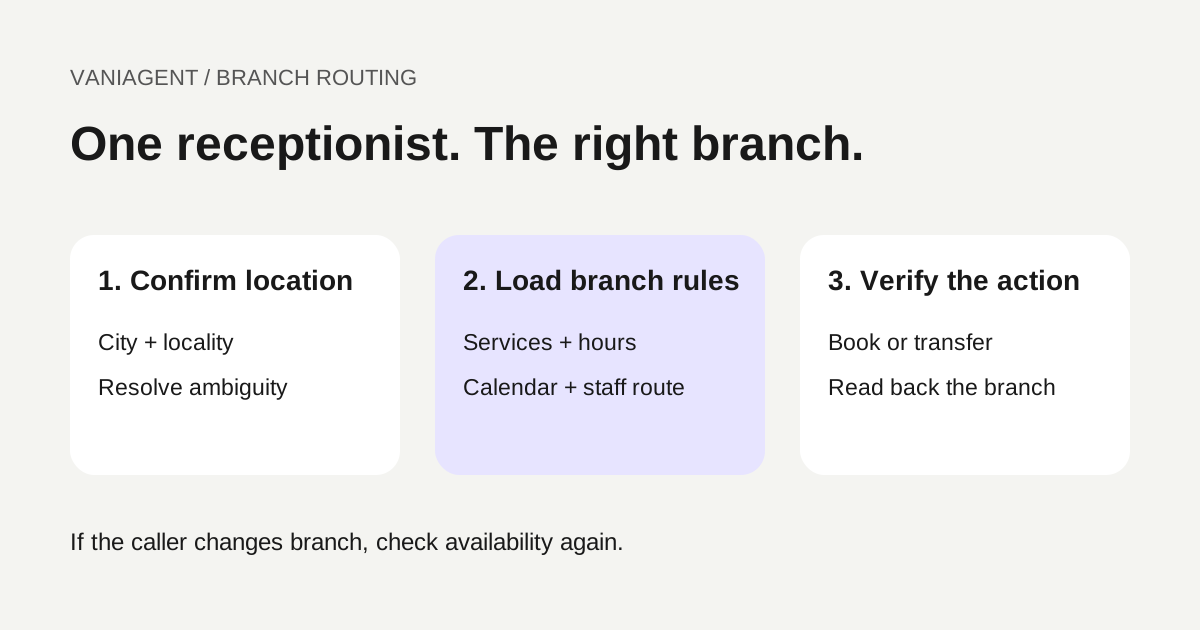
An AI receptionist for multiple branches needs a confirmed location before it offers a branch-specific answer, checks appointments or transfers a call. Give each location an approved record containing its address, services, opening hours, calendar mapping and escalation route. Keep that branch selection consistent throughout the conversation.
A shared business number can make a chain easier to contact, but a wrong-branch booking or transfer creates work for both the caller and staff. This guide provides an example routing matrix, a call flow and a launch checklist for Indian clinics, service businesses and other multi-location teams.
The examples are proposed operating designs, not a claim that every platform provides them out of the box. Confirm integration and capacity requirements in a scoped demonstration. For the wider use case, start with our AI receptionist guide for India.
Should you use one shared number or separate branch numbers?
Either model can work if the phone system supplies reliable called-number information and the workflow handles exceptions. Choose based on how customers already contact the business, not just the simplicity of a new number.
| Number arrangement | Useful routing signal | What still needs confirmation |
|---|---|---|
| One shared number | Caller states the city and branch | Which location they actually want |
| Separate branch numbers | Number dialled maps to a branch | Whether the caller wants another location |
| Shared number plus branch numbers | Called number supplies a starting suggestion | Conflicting caller requests and forwarded-call metadata |
Do not infer the desired branch from the caller's mobile number alone. People travel, move and call for family members. A previous booking can suggest a location, but it should not override the caller's current choice. If using customer history, apply your approved verification rules before revealing private details.
For forwarded calls, test which destination information the carrier passes to the application. A central forwarding number may hide the originally dialled branch number. If the mapping cannot be trusted, ask the location question explicitly.
Build a branch-routing matrix before writing the prompt
Use one maintained source of approved branch information. The fictional matrix below shows the fields a business owner should supply; the hours and services are examples rather than real business details.
| Branch ID | Spoken name and aliases | Services | Illustrative hours | Scheduling mapping | Staff route |
|---|---|---|---|---|---|
| BLR-IND | Bengaluru, Indiranagar | Consultation, follow-up | Mon–Sat, 9am–6pm | Indiranagar consultation calendar | Indiranagar desk |
| BLR-JAY | Bengaluru, Jayanagar | Consultation only | Mon–Fri, 10am–7pm | Jayanagar consultation calendar | Jayanagar desk |
| PUN-BAN | Pune, Baner | Consultation, follow-up | Mon–Sat, 9am–5pm | Baner consultation calendar | Baner desk |
Add the verified street address, map link, timezone, approved service prices, slot duration, language coverage, closure overrides and backup contact to each record. Calendar names in this table are labels; the integration needs the actual authorized resource identifiers.
Assign a named owner and a last-reviewed date. A central administrator can own the directory while branch managers approve local changes. Avoid maintaining conflicting copies in a prompt, spreadsheet and website without a defined synchronization process.
Ask a short question when the branch is ambiguous
A shared-number greeting might say: “Which city and branch would you like to contact?” If the caller says only “Bengaluru,” ask: “Indiranagar or Jayanagar?” If they say “the usual one,” request a location instead of guessing.
Confirm the full branch name before a consequential action: “You'd like a consultation at our Jayanagar branch in Bengaluru. Is that correct?” Use a familiar landmark only if the approved directory contains it. Do not invent directions or claim that a branch is nearest without suitable location data and a defined selection method.
For difficult audio, offer an approved keypad or staff fallback if the configured telephony supports it. Twilio's Gather documentation describes speech and keypad input and timeout handling. That is an implementation example, not evidence that a particular VaniAgent route already supports the same fallback. Test branch-name recognition on the actual telephone connection and supported languages.
Keep branch selection attached to every action
The confirmed branch should be a structured value, not just a phrase somewhere in the transcript. Every availability lookup, booking request, transfer and follow-up should receive the same validated branch identifier.
Use this sequence:
- Identify the caller's purpose: enquiry, appointment, existing booking or staff request.
- Resolve the city and branch, then confirm them with the caller.
- Check whether that branch offers the requested service.
- Load its current hours, closures, calendar and escalation rules.
- Perform the permitted action using the selected branch mapping.
- Read back the location and action result; record the outcome for staff.
Keep routing destinations on an approved allowlist. The language model should select a valid branch record rather than generate a new phone number or calendar identifier. If a required field is missing, use a defined fallback instead of borrowing another branch's configuration.
Separate branch calendars and confirm the saved booking
“There is a free slot” and “your appointment is booked” describe different states. Availability must come from the correct branch and service. Booking creation must then use that same resource, with the correct duration and timezone.
Google Calendar's free/busy API returns availability information for specified calendars and can return calendar-specific errors. Its event insertion API creates an event in a specified calendar. These are separate operations; an availability result alone is not a reservation or a guarantee against competing writes.
Your scheduling layer must enforce the business's resource and collision rules, handle retries without duplicate appointments and verify the write result. A generic calendar event is not automatically a complete clinic scheduling system. Use the double-booking prevention guide for the booking safeguards.
Only confirm success after a verified booking result. Read back the branch, address, service, date and local time. If the save fails or its result is uncertain, explain that staff must confirm the appointment; do not announce success merely because the caller agreed to a time.
Handle holidays, closed branches and unavailable staff
Recurring opening hours need date-specific overrides. A branch can be closed for a local holiday while another remains open. Staff transfer hours may also differ from appointment hours, so record both where needed.
If a branch is closed, offer its next verified availability or an approved callback. Offer another branch only after explaining the location change and receiving the caller's agreement. If the closure data is unavailable, say you cannot confirm today's hours and route the enquiry through the approved fallback.
A staff route needs a timeout, a no-answer outcome and a busy outcome. Prevent transfer loops between the central number and a branch number that forwards back to the same receptionist. Give the receiving team a concise summary with the selected branch and reason for transfer, subject to your information-sharing policy.
Recover when the caller changes location halfway through
Suppose the caller initially selects Indiranagar, hears an available time and then says, “Actually, I meant Jayanagar.” Stop the previous action and reconfirm the new branch. Discard Indiranagar's availability results and check Jayanagar's service and calendar afresh.
If nothing was saved, there is no appointment to move. If a booking already exists, verify the caller and use the authorized rescheduling or cancellation workflow. Do not quietly leave the first booking active and create another one. If the integration cannot complete the change reliably, hand the case to staff with both booking states clearly recorded.
This recovery path deserves its own test. A fluent conversation can conceal a wrong calendar write unless the tester checks the scheduling records.
Test these scenarios before routing live callers
| Test | Expected evidence |
|---|---|
| Caller gives only a city with two branches | Agent asks for the locality; no booking action yet |
| Caller dials one branch but requests another | Explicit request wins after confirmation |
| Requested service is absent at that branch | Agent explains and offers approved alternatives |
| Branch is closed on a date-specific holiday | No open-now promise or unavailable staff transfer |
| Calendar access fails | No false availability or booking confirmation |
| Caller changes branch after hearing a slot | New lookup uses the newly confirmed branch |
| Save succeeds but response is lost | Recovery checks existing state before retrying |
| Branch desk does not answer | Approved callback or alternate staff path; no loop |
| Two branches receive calls simultaneously | Capacity and overflow behave as quoted |
Use consented test calls and inspect the resulting branch identifiers, calendar writes and transfer outcomes. Include local pronunciations, Hindi-English switching where supported, background noise and a caller correcting the agent. A transcript review alone cannot prove that the right calendar or phone route was used.
Measure routing quality branch by branch
Track confirmed branch selection, wrong-branch transfers, bookings saved to the wrong location, successful booking writes, staff handoff outcomes and caller abandonment. Define each metric before measuring it. For example, wrong-branch booking rate can be confirmed wrong-location bookings divided by all successfully created bookings in the reviewed sample.
Report sample size and unresolved cases. Compare similar periods and call types, since a new branch or campaign can change the mix. Review the actual errors before changing prompts: the underlying directory or forwarding configuration may be responsible.
Capacity is a separate purchase decision. A workflow serving three branches does not establish three simultaneous sessions. Use peak demand and overflow requirements with the simultaneous calls guide, then confirm the proposed configuration and current pricing.
Launch one branch first, then expand
Start with one approved directory record and a limited set of enquiries. Verify answers, booking writes and transfers before adding another branch. Keep a rollback route to staff and nominate the person who can approve directory updates.
For the next branch, reuse the tested workflow while changing only its approved data and integration mappings. Repeat the routing tests rather than assuming a copied configuration is correct. A multi-branch receptionist is ready when callers reach the intended location and the underlying records prove the actions the agent announces.
Frequently asked questions
Can one AI receptionist answer calls for multiple branches?
A suitably configured system can select a branch and use its approved information, calendar and transfer destination. Verify that your proposed platform and telephony setup support those actions. One shared number does not automatically provide separate calendars or enough simultaneous call capacity.
How should an AI receptionist identify the correct branch?
Use the called number as an initial hint when it maps to one branch, then confirm the location before booking or transferring. For a shared number, ask for the city and locality. If several branches match, offer a short choice rather than guessing from the caller’s number.
Can each branch use its own appointment calendar?
Yes, if the integration explicitly maps each branch and service to the correct authorized scheduling resource. Availability lookup and booking creation must use that same mapping. A successful availability lookup alone does not confirm a booking.
What happens when a caller chooses the wrong branch?
Confirm the intended location again, clear the previous branch-specific availability and load the correct branch information. If a booking was already saved, use the approved cancellation or rescheduling process instead of silently creating a second appointment.
How should the receptionist handle branch holidays?
Maintain approved hours and date-specific closure overrides for every location. Check them before offering service or attempting a transfer. If the information is stale or unavailable, explain the limitation and offer an approved callback or staff handoff.
Does one AI receptionist mean only one simultaneous call?
The conversational workflow and the purchased concurrency limit are separate. Ask how many simultaneous calls the configuration supports, how shared capacity is allocated and what happens when all sessions are busy.
Review your branch workflow
Bring your branch directory, calendar setup and transfer requirements to a scoped VaniAgent demonstration. Verify the proposed integrations and concurrency before switching live calls.
Put these ideas into production
Deploy AI voice agents in minutes and build outbound, inbound, and follow-up workflows on one platform.
Related Articles
AI Receptionist in India: Answer Calls and Book Appointments
AI receptionist for Indian businesses: answer calls, book verified appointments, recover missed calls, handle routine questions, and route exceptions to staff.
How Does AI Book Appointments Without Double-Booking?
Design reliable AI appointment booking with current availability, exclusive reservations, idempotent retries and a runnable calendar-conflict demonstration.
Can an AI Receptionist Handle Several Calls at Once?
Understand simultaneous AI receptionist calls, initiation rate, shared capacity and overflow, with a peak-demand worksheet and overlapping-call test plan.