Can an AI Receptionist Fill Cancelled Clinic Appointments From a Waitlist?
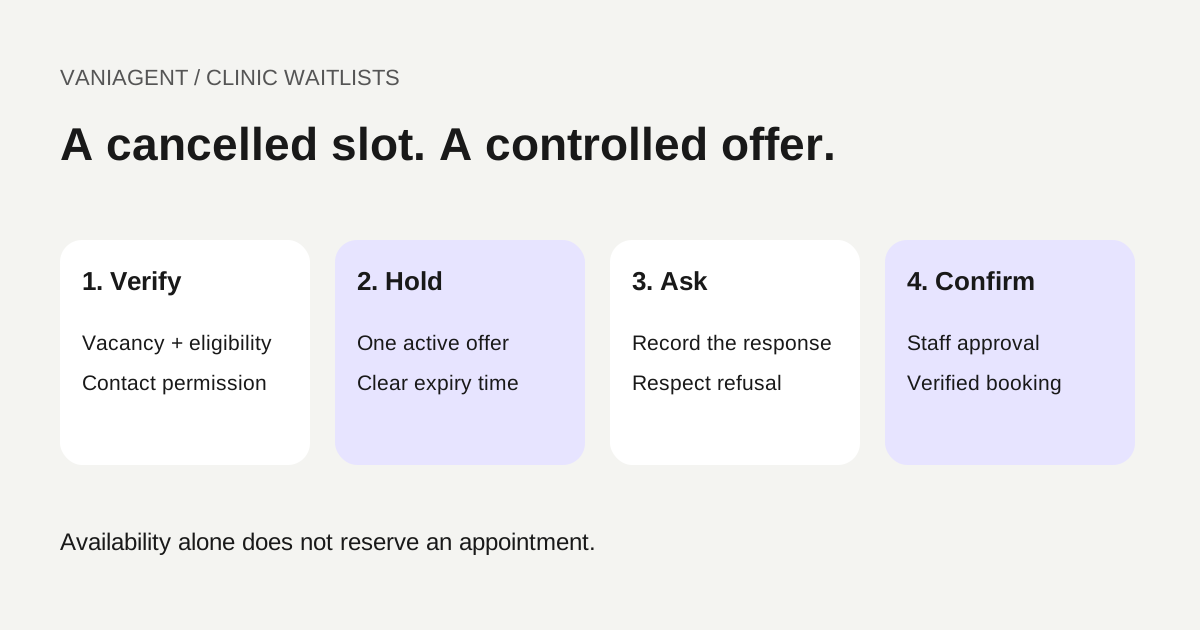
An AI receptionist can help fill a cancelled clinic appointment by contacting eligible patients who have agreed to receive earlier-slot offers. The reliable workflow is: verify the vacancy, select the next eligible patient, make a time-limited offer, record the response and confirm only after the scheduling system has secured the appointment under the clinic's approval rules.
The difficult part is controlling the slot while people respond. Two patients saying yes must not produce two confirmed bookings. This guide describes a proposed operating design for clinic teams in India, with an example timeline, a waitlist worksheet and acceptance tests. It is not a claim that every voice platform already implements these controls.
For general scheduling safeguards, read our AI appointment booking and double-booking prevention guide. For the broader reception workflow, see AI receptionist for clinics and service businesses in India.
What should trigger a waitlist offer?
Start with a verified cancellation in the clinic's authoritative scheduling system. A caller saying “I cannot come” is a cancellation request until the authorized workflow saves the change. A free-looking calendar gap may also be a break, a blocked resource or a slot that cannot accept that service.
Before contacting anyone, check the practitioner, branch, service duration, room or equipment requirements, and the remaining notice period. Staff should approve which cancellation types can enter the waitlist process. Exclude cases needing clinical review until the appropriate person approves them.
Give the vacancy a stable identifier and a current version or equivalent change check. Repeated notifications about the same cancellation should not start duplicate calling sequences. If the practitioner later blocks the time, stop the sequence and withdraw outstanding offers through the approved process.
Build a permission-based waitlist record
Record only the information needed to make and fulfil the offer. An example worksheet is below; the clinic should adapt it to its scheduling and privacy policies.
| Field | Purpose |
|---|---|
| Waitlist entry ID | Track one request without duplicating outreach |
| Patient reference and verified contact | Reach the intended person under the clinic's verification process |
| Contact permission and channel | Record what outreach the person agreed to and any withdrawal |
| Requested branch, service and practitioner | Avoid offering an unsuitable appointment |
| Acceptable dates and time windows | Skip slots the person cannot attend |
| Minimum notice needed | Allow realistic travel and preparation time |
| Existing booking reference, if any | Support a controlled move to an earlier appointment |
| Queue timestamp and staff-approved priority | Apply the clinic's ordering rule consistently |
| Last offer, attempts and response | Respect contact limits and prevent repeated calls |
Do not treat a patient phone number as permission for unrelated marketing. Confirm applicable calling requirements with the clinic and its telephony provider. TRAI's preference-registration guidance explains consumer preferences for commercial communications; it does not by itself determine the classification or requirements of a particular clinic call. Keep appointment outreach within the approved purpose.
Remove or suppress withdrawn and expired requests before calling. If a parent, caregiver or other representative answers, follow the clinic's authorization procedure rather than revealing appointment details automatically. Clinical notes do not belong in a general calling list merely because they are available elsewhere.
Define the queue before letting the agent contact patients
Use explicit eligibility filters first, then an approved ordering rule. For example, a routine follow-up vacancy at one branch should only be offered to entries that match the service, practitioner rules, location and time window.
Within that eligible group, a clinic might use first-joined order unless authorized staff have assigned a different priority. The voice agent should not infer clinical urgency from a conversation or silently move someone ahead. Clinical prioritization belongs with qualified staff.
Record why each entry was selected or skipped. A patient who cannot attend one opening may remain on the list for another; a patient who asks to stop receiving offers should be suppressed according to that request. Keep those outcomes separate.
Use temporary holds and a clear offer deadline
A temporary hold needs an owner, an expiry time and a defined release process. It belongs in the scheduling or allocation layer that controls the slot, rather than only in the agent's spoken promise. The clinic must decide how long it can keep a vacancy unavailable while awaiting a response.
Google Calendar's free/busy endpoint returns availability information. Its event insertion endpoint creates an event in a selected calendar. These separate operations do not establish an atomic clinic reservation process or prevent competing bookings by themselves. Your scheduling application must enforce the hold and booking rules.
For an initial pilot, one active offer per vacancy is easier to audit. Parallel outreach is possible only with explicit allocation controls and wording that does not promise the same slot to everyone. A broadcast “first to respond wins” process has different patient expectations and should not be introduced accidentally.
Example: one vacancy, two sequential offers
The following is a fictional operating example, not a recommended universal deadline. Suppose a routine appointment at the Baner branch opens for 4pm the following day. Staff have approved the slot for the waitlist process and selected a ten-minute offer window.
| Time | Action | Slot state |
|---|---|---|
| 10:00am | Verify cancellation, resource and eligible queue | Available for allocation |
| 10:01am | Secure a hold for patient A; offer expires at 10:11am | Held for A |
| 10:04am | Patient A declines | Hold released |
| 10:05am | Secure a new hold for patient B; expiry 10:15am | Held for B |
| 10:08am | B accepts; record response and request staff approval | Held, pending approval |
| 10:10am | Staff approves; system saves and verifies booking | Booked for B |
| 10:12am | Send the approved confirmation and close the vacancy | Completed |
Staff approval needs its own deadline and escalation rule within the hold period. If approval cannot occur before expiry, do not assume the slot remains protected. Revalidate the allocation or tell the patient that staff must confirm availability.
If A calls back after B has booked, check the current record. Explain that the previous offer is no longer available and offer another verified option. Do not delete B's appointment to honour A's expired offer.
What should the AI receptionist say?
Use a brief script that identifies the clinic, verifies the recipient appropriately and gives the relevant appointment details without unnecessary sensitive information. An illustrative offer after verification is:
“You asked to hear about earlier appointments. A slot is available at our Baner branch tomorrow at 4pm. Would you like us to request that time? This offer is held until 10:15am, and our team will confirm the booking.”
Adapt the wording to the actual hold and approval state. Do not say “your appointment is confirmed” while the request is still waiting for a booking write or staff approval. Read back the date, branch and local time; “tomorrow” alone becomes ambiguous in delayed messages.
If the patient asks about symptoms, treatment suitability or changing preparation instructions, use the clinic's clinical escalation path. The waitlist workflow should not improvise medical advice. For voicemail or an unverified recipient, use the clinic's approved minimal message or callback request.
Move an existing appointment without creating a second one
Many waitlist patients already have a later booking. Accepting an earlier offer may mean rescheduling that appointment, not adding another consultation. Confirm the patient's intention and link the existing booking reference to the proposed new one.
Use the scheduling system's supported rescheduling operation where possible. If the process requires separate writes, define failure recovery before launch. Cancelling the old appointment before securing the new one can leave no booking; saving the new one without resolving the old one can leave duplicates.
When a response is lost after a write, check the saved state before retrying. Keep an action identifier or equivalent duplicate-prevention mechanism. Staff should resolve ambiguous outcomes rather than allowing repeated calls to create new bookings.
Handle no answer, refusal and late responses separately
| Patient outcome | Approved next step |
|---|---|
| No answer | Follow the contact-attempt limit; expire or release the hold as defined |
| Declines this slot | Release the hold; retain the waitlist request if still wanted |
| Requests no further offers | Suppress future outreach and record the withdrawal |
| Accepts within the window | Revalidate the hold and proceed through approval and booking |
| Accepts after expiry | Check current availability; never revive an expired promise |
| Needs a different branch | Recheck eligibility and availability for that location |
| Asks a clinical question | Escalate to authorized clinical staff |
For multi-location clinics, keep the branch attached to the offer, hold and booking. See our multi-branch AI receptionist routing guide for location confirmation and wrong-branch recovery.
Test the workflow before using it with patients
Run fictional records through the complete sequence, then inspect scheduling and outreach records. The test is whether the underlying state is correct, not simply whether the call sounds natural.
- Duplicate cancellation notification starts only one sequence.
- Withdrawn permission prevents further offers.
- An incompatible service or branch is excluded before outreach.
- A busy slot cannot be offered from a stale availability result.
- Two simultaneous acceptances cannot confirm one vacancy twice.
- A late acceptance does not displace an existing booking.
- An expired hold cannot proceed without revalidation.
- Lost booking responses recover without duplicate writes.
- Staff approval delays produce a clear pending outcome.
- Moving an existing appointment leaves the intended final booking state.
Have the clinic owner approve the queue, scripts, escalation paths and contact limits. Keep a staff-only fallback for failed integrations and uncertain scheduling state. Confirm the selected platform can support the design before treating it as a live capability.
Measure recovered appointments honestly
Track eligible cancellations, vacancies offered, patients reached, acceptances, verified bookings, eventual attendance and staff time spent. Define a recovered appointment as a cancelled slot that was rebooked through this workflow; track attendance separately rather than calling every acceptance recovered revenue.
For example, 18 verified rebookings from 30 eligible cancellations is a 60% rebooking rate in that fictional sample. If only 15 of those appointments are attended, report that result separately. Include the time period, sample size and exclusions. It is not a predicted performance level.
Compare like-for-like periods and practitioner schedules before attributing improvement to AI. Count failed outreach, duplicate-booking incidents and patient complaints alongside the filled slots. A small controlled pilot should demonstrate reliable allocation and appropriate patient communication before increasing volume.
Frequently asked questions
Can an AI receptionist fill cancelled clinic appointments from a waitlist?
A configured workflow can contact eligible patients, explain an available appointment and record their response. The scheduling system must control slot allocation, and the clinic must define eligibility, permission to contact and confirmation rules. Verify these integrations before using the workflow with patients.
Should the AI call every patient on the waitlist at once?
For a single vacancy, sequential offers with a defined expiry are easier to control. If the clinic uses parallel offers, it needs an explicit allocation policy and must prevent multiple callers from receiving confirmed bookings for one slot.
Does checking calendar availability reserve an appointment?
No. An availability check alone does not reserve the slot. Your scheduling system must enforce a temporary hold or equivalent allocation control, then verify the booking write before the appointment is confirmed.
What happens if a patient accepts after the offer expires?
Check the current slot state again. Do not revive an expired offer or displace a patient who already has the appointment. Offer another verified time or route the request to staff.
Can AI decide which patient needs the cancelled appointment most urgently?
The workflow should follow clinic-approved eligibility and ordering rules. Clinical priority or symptoms requiring assessment should go to authorized clinical staff; conversational AI should not independently assign urgency or clinical suitability.
Should the original appointment be cancelled when a patient accepts an earlier slot?
Only through the clinic’s approved rescheduling process. Link the old and new booking, verify the intended change and handle failures explicitly so the patient is not left with duplicate appointments or no confirmed appointment.
Review your clinic waitlist workflow
Bring your cancellation rules, scheduling system and staff approval process to a scoped VaniAgent demonstration. Verify the integrations with fictional records before routing patient outreach.
Put these ideas into production
Deploy AI voice agents in minutes and build outbound, inbound, and follow-up workflows on one platform.
Related Articles
How Does AI Book Appointments Without Double-Booking?
Design reliable AI appointment booking with current availability, exclusive reservations, idempotent retries and a runnable calendar-conflict demonstration.
AI Receptionist in India: Answer Calls and Book Appointments
AI receptionist for Indian businesses: answer calls, book verified appointments, recover missed calls, handle routine questions, and route exceptions to staff.
AI Receptionist for Multiple Branches: Route Calls to the Right Location
Plan an AI receptionist for multiple branches with a routing matrix, separate calendars, holiday hours, wrong-branch recovery and a launch checklist.